Most higher education institutions aren’t struggling to generate interest. They’re struggling to turn that interest into enrollment, revealing a growing challenge within higher education lead generation today.
For many institutions, inquiry numbers look strong on paper, but downstream conversions are telling a different story. As a result, marketing teams are under pressure to deliver more leads. Enrollment teams are tasked with converting them faster. And institutional leaders are left asking the same question: Why isn’t this working the way it used to?
The answer is simple — and uncomfortable. Visibility alone doesn’t drive enrollment growth. Viability does.
To compete in today’s enrollment environment, institutions must move beyond lead volume and focus on attracting, engaging, and converting the right inquiries. This is an essential shift in student lead optimization.
The disconnect between inquiry growth and enrollment results
For years, success in higher ed marketing was measured by reach and response. More impressions. More clicks. More inquiries. But rising acquisition costs and shifting student expectations have exposed the limits of that approach.
Institutions now face a familiar set of challenges:
- Inquiry growth that doesn’t translate to applications or enrollment
- Increased spend on channels with diminishing returns
- Limited visibility into which prospects are truly enrollment-ready
- Enrollment teams overwhelmed by volume but underpowered by insight
The result? Teams work harder, pipelines look fuller, and outcomes stay flat. This isn’t a performance problem. It’s a strategy problem, one that requires more intentional enrollment pipeline growth strategies across marketing and enrollment teams.
Redefining what inquiry success really means
Inquiry success can no longer be defined by volume alone, especially in modern higher education lead generation efforts. Viable inquiries are students who demonstrate clear program interest, academic fit, and intent to move forward.
That shift changes everything.
Instead of asking, “How do we get more leads?”, institutions must ask:
- Who is most likely to enroll and why?
- Which channels attract students with long-term potential?
- Where are we losing qualified prospects in the funnel?
Answering those questions requires more than tactics. It requires alignment across research, marketing, and enrollment.
How market research strengthens inquiry quality
Institutions can’t improve inquiry quality without understanding the market they’re recruiting from. Higher ed market research provides that clarity.
Done well, it reveals:
- True demand for programs and modalities
- How prospective students perceive value, outcomes, and cost
- Where competitors are winning — or overreaching
- What motivates students to inquire, apply, and enroll
This insight informs smarter decisions before dollars are spent. Messaging becomes more precise and channel strategy becomes more intentional. This ensures program positioning aligns with real student needs, not assumptions.
Market research turns recruitment from reactive to strategic. And it ensures institutions invest in visibility that attracts viable demand.
Ready for a Smarter Way Forward?
Higher ed is hard — but you don’t have to figure it out alone. We can help you transform challenges into opportunities.
Marketing strategies that prioritize fit and intent
Marketing still plays a critical role in enrollment growth, but its role has evolved.
Effective higher ed marketing doesn’t just attract attention. It plays a critical role in student lead optimization by qualifying interest before a student ever submits an inquiry.
That shift demands a more disciplined approach that requires:
- Data-informed audience segmentation
- Messaging that balances inspiration with transparency
- Channel strategies that integrate paid and organic performance
- Measurement tied to downstream enrollment outcomes, not surface-level metrics
When marketing is aligned to enrollment viability, institutions see fewer unqualified inquiries and stronger funnel progression. Brand visibility becomes a lever for enrollment efficiency — not just awareness.
The role of enrollment execution in inquiry conversion
Even the most qualified inquiry can be lost without the right follow-up experience.
Once a student raises their hand, expectations are high. Delays, generic outreach, or disconnected communication quickly erode momentum. And when enrollment teams lack insight into inquiry intent, prioritization becomes guesswork.
High-performing higher ed enrollment operations focus on:
- Personalized, multichannel engagement aligned to student preferences
- Clear prioritization of high-intent inquiries
- Seamless coordination between marketing and admissions
- Visibility into funnel behavior and progression
Inquiry quality doesn’t end at the form fill. It’s reinforced — or undermined — by every interaction that follows.
The power of alignment across the enrollment lifecycle
The most successful institutions don’t treat inquiry quality as a single-team responsibility. They treat it as a system.
Market research informs marketing strategy. Marketing insights guide enrollment engagement. Enrollment outcomes feed continuous optimization across the funnel.
When teams operate in silos, inquiry viability suffers. When they align around shared data, goals, and outcomes, institutions gain clarity and control over enrollment performance.
This integrated approach enables institutions to:
- Reduce wasted spend
- Improve conversion efficiency
- Strengthen collaboration across teams
- Build a sustainable enrollment pipeline
Alignment isn’t just operationally efficient. It’s strategically essential.
Building an inquiry strategy that scales — and converts
Enrollment growth doesn’t come from chasing volume. It comes from intentional visibility, informed by insight, and reinforced through experience. While many institutions are already working toward this alignment, sustaining it can be challenging without the right infrastructure, integrated data, and capacity to support ongoing optimization.
At Collegis Education, we partner with institutions to help connect strategy, data, and execution across the entire enrollment lifecycle. Through our Connected Core® platform, we bring marketing, enrollment, and institutional data together into a shared, actionable view — enabling clearer insight, smarter prioritization, and more consistent conversion. The result is greater efficiency and momentum, without adding unnecessary complexity for internal teams.
If this approach aligns with your enrollment goals, our team is ready to connect and explore what’s possible.
Innovation Starts Here
Higher ed is evolving — don’t get left behind. Explore how Collegis can help your institution thrive.
Higher education leaders are navigating a more complex landscape than ever before. Enrollment pressure is rising. Student expectations are shifting. And teams are being asked to do more with fewer resources, while continuing to deliver meaningful outcomes.
At the center of these challenges is the student journey. Too often, it’s treated as a series of disconnected moments: marketing hands off to enrollment, enrollment hands off to student support, and retention becomes a downstream concern. But when you approach the journey as a connected, data-informed lifecycle, you create momentum that improves both enrollment and persistence.
Reimagining the student journey isn’t about adding more tactics. Aligning strategy, technology, and teams moves you from fragmented efforts to intentional execution and leads to student journey optimization across the entire lifecycle.
How student expectations are reshaping the enrollment journey
Today’s learners don’t follow a straight path from inquiry to enrollment. They research across channels, pause and restart their journey, and expect you to recognize them at every step. When systems and teams aren’t aligned, friction becomes unavoidable, and even strong enrollment conversion strategies lose effectiveness.
These misalignments often show up as:
- Marketing and enrollment teams working from different data sets
- Manual handoffs that slow follow-up and limit personalization
- Limited visibility into where students disengage or stop out
These breakdowns don’t just impact enrollment metrics. They affect student confidence, momentum, and long-term success. Addressing them starts with a full-funnel view of the student lifecycle.
4 Tactics to improve enrollment and persistence outcomes
Reimagining the student journey requires more than isolated improvements. These four tactics focus on aligning data, strategy, and execution across the student lifecycle to reduce friction, strengthen engagement, and drive measurable enrollment and persistence outcomes. Together, they form a practical framework for student journey optimization.
1. Use data to see and support the entire funnel
If your data lives in silos, it’s difficult to understand what’s really happening across the student journey. When CRM, SIS, LMS, and marketing platforms operate independently, your ability to act proactively is limited.
A data-enabled approach gives you clarity.
To support the full lifecycle, you need to:
- Unify data from across the student journey into a single, trusted environment
- Use predictive analytics to identify enrollment and persistence risk earlier
- Equip teams with real-time dashboards that support informed decisions
When your data is integrated and accessible, you move beyond reactive reporting. You gain insight into what’s driving conversion, where students struggle, and how to intervene before challenges escalate. That visibility allows you to invest resources more strategically across both enrollment and retention, strengthening your enrollment conversion strategies while reducing stop-out risk.
2. Design marketing for the entire student lifecycle
Higher education marketing doesn’t stop at inquiry, and neither should your strategy. The messages you deliver before enrollment shape expectations that carry into the student experience.
To support enrollment and persistence outcomes, your marketing efforts should:
- Align messaging across prospect, applicant, and enrolled student stages
- Personalize outreach based on behavior, intent, and academic goals
- Balance brand-building with conversion and yield-focused campaigns
When your marketing reflects the full student journey, you attract better-fit students and reinforce trust at every interaction. That consistency supports stronger conversion rates and helps students arrive more informed and engaged.
All of this sets a stronger foundation for persistence. These lifecycle-based enrollment conversion strategies also play a critical role in persistence by setting clearer expectations from the start.
3. Modernize enrollment operations to reduce friction
Every unnecessary step in your enrollment process increases risk. Complex applications, delayed follow-up, and inconsistent communication all contribute to melt, and it strains your teams in the process.
Modern enrollment operations prioritize clarity, speed, and relevance.
That often means:
- Streamlining inquiry-to-application workflows
- Delivering personalized, multichannel communication at scale
- Using enrollment data to prioritize outreach and staffing decisions
When enrollment operations are designed to reduce friction, you improve conversion while freeing your staff to focus on high-impact engagement. Counselors spend less time managing manual tasks and more time guiding students forward with confidence.
4. Shift retention from reactive to proactive
Retention efforts often begin when a student is already struggling. By then, engagement has dropped and options are limited. Improving persistence outcomes requires earlier, more intentional support.
A proactive retention strategy allows you to:
- Identify risk through academic, engagement, and behavioral data
- Deliver scalable coaching and advising before issues compound
- Create coordinated onboarding and first-term experiences that build belonging
When retention is embedded into the student journey (not treated as a separate initiative), you create continuity. Students feel supported earlier, challenges are addressed sooner, and persistence becomes a shared responsibility across teams. These proactive approaches form the foundation of effective student persistence solutions.
The power of connecting strategy, services, and teams
Improving enrollment and persistence outcomes doesn’t come from optimizing one area in isolation. Your greatest gains happen when marketing, enrollment, retention, and analytics operate as a connected system.
This alignment allows you to:
- Share goals and metrics across teams
- Act on insights instead of assumptions
- Scale personalized support without overextending staff
It also reflects a broader shift in higher education, moving away from fragmented solutions and toward a lifecycle-based strategy. True student journey optimization depends on this level of coordination. You don’t need more tools. You need stronger alignment across data, technology, and talent.
Designing the student journey for long-term impact
Institutions that strengthen enrollment and persistence outcomes don’t chase trends. They make intentional decisions about how the student journey is designed, supported, and measured.
That work starts by breaking down silos and committing to data-informed decision-making across the lifecycle. It also requires a foundation that brings systems, insights, and teams together. Collegis built our Connected Core® platform to support this kind of alignment, unifying institutional data into a single, actionable environment that helps you see the full student journey and act with confidence.
Reimagining the student journey isn’t a one-time initiative. It’s an ongoing commitment to meet students where they are, guide them forward with clarity and care, and ensure every touchpoint reflects a cohesive experience.
When you take that approach, enrollment improves, persistence strengthens, and the student experience becomes a true differentiator.
Innovation Starts Here
Higher ed is evolving — don’t get left behind. Explore how Collegis can help your institution thrive.
Enrollment growth doesn’t happen by chance. It’s the result of intentional strategy, aligned execution, and the ability to turn insight into action.
This spring, Collegis Education partners delivered standout enrollment performance across institutions. Our partners are exceeding goals, accelerating year-over-year growth, and strengthening their position in an increasingly competitive landscape. These outcomes reflect what’s possible when data, technology, and talent work together across the student lifecycle.
Translating strategy into results
Below, we highlight a snapshot of recent Spring 2026 enrollment wins and the measurable impact our partners are achieving.
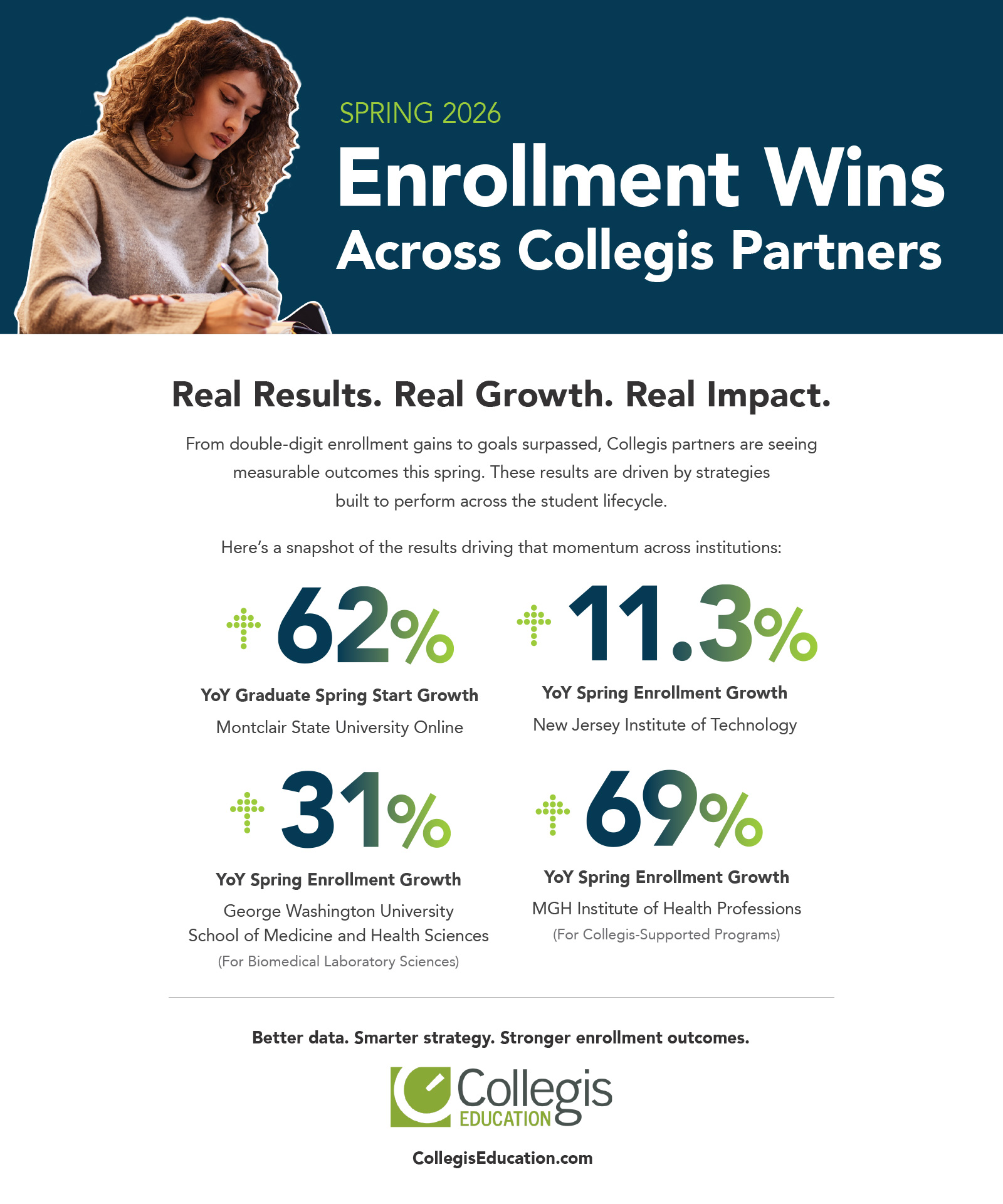
A smarter approach to sustainable enrollment growth
These results reflect more than short-term gains. They demonstrate what institutions can achieve with the right strategy, the right support, and a partner invested in outcomes.
At Collegis, we work alongside colleges and universities to build sustainable enrollment strategies that drive performance today and position institutions for long-term success. From inquiry to enrollment and beyond, our approach is designed to deliver measurable impact at every stage of the student journey.
Ready to accelerate enrollment at your institution? Let’s start the conversation.
Innovation Starts Here
Higher ed is evolving — don’t get left behind. Explore how Collegis can help your institution thrive.
Forecasting Digital Advertising Impact with Greater Precision
How Collegis helped Augusta University Online use historical CRM data to better understand how marketing investment influences future start terms.
Augusta University Online partnered with Collegis to improve the accuracy of its paid media forecasting and budget planning process. As the institution expanded its online programs, leadership saw uneven results across programs — some overdelivered and strained faculty capacity, while others struggled to generate sufficient enrollment. To better allocate marketing resources, Augusta needed clearer insight into how paid media investments actually influence future start terms. Collegis analyzed historical CRM data and developed a more accurate forecasting model that reflected real student behavior rather than simplified assumptions.
Understanding Enrollment Impact Across Multiple Start Terms
Augusta University Online relied on a forecasting model that assumed inquiries generated within a given month would enroll in the next available start term.
Key considerations included:
- Programs experiencing uneven enrollment performance across terms
- Marketing budgets allocated based on simplified assumptions about inquiry timing
- Lack of visibility into how leads actually convert across multiple future start terms
- Difficulty aligning marketing investment with term-level program goals
In reality, prospective students often enroll months (or even years) after their initial inquiry, making short-term attribution models unreliable for forecasting enrollment outcomes.
Building a Data-Driven Forecasting Model for Smarter Media Planning
Collegis developed a forecasting framework based on Augusta’s historical CRM data to better understand how inquiries contribute to future start terms.
Key components included:
- Analyzing historical lead behavior to determine how inquiries distributed across future start terms
- Mapping month-to-start-term conversion patterns to identify realistic enrollment timelines
- Reforecasting media investment impact using historical lead distribution percentages
- Identifying budget allocation opportunities to prioritize programs and timelines with the greatest potential impact
This model provided a more accurate view of how marketing investments influence enrollment outcomes over time.
The Collegis Impact
The revised forecasting model gave Augusta University Online clearer insight into how marketing investment should be distributed throughout the year to support enrollment goals.
Key outcomes included:
- Revealed that inquiries generated in a given month often influence multiple future start terms, not just the next one
- Demonstrated that Fall start terms typically require at least a year-long lead generation cycle
- Identified opportunities to rebalance media spend across programs and months
- Provided leadership with a more accurate framework for forecasting enrollment impact from paid media investment
These insights helped Augusta align marketing budgets with realistic enrollment timelines and make more informed program-level investment decisions.
The Takeaway: Accurate Forecasting Drives Smarter Investment
Marketing performance isn’t just about generating leads. It’s about understanding when those leads will convert and how they support future enrollment goals. By leveraging historical CRM data, Collegis helped Augusta University Online build a forecasting model that better reflects real student behavior and supports more strategic marketing investment.
Align Marketing Strategy with Future Enrollment Demand
Augusta University Online’s experience highlights the importance of aligning marketing forecasts with actual enrollment patterns. Collegis partners with institutions to transform marketing and CRM data into actionable insights, helping leaders allocate budgets more effectively, support program growth, and drive sustainable enrollment outcomes.
Let’s Start Writing Your Success Story
See what’s possible when strategy, creativity, and execution come together. Partner with Collegis to turn your challenges into outcomes worth sharing.
Transform Challenges Into Opportunities
Facing challenges in enrollment, retention, or tech integration? Seeking growth in new markets? Our strategic insights pave a clear path for overcoming obstacles and driving success in higher education.
Unlock the transformative potential within your institution – partner with us to turn today’s roadblocks into tomorrow’s achievements. Let’s chat.
Higher ed institutions are producing more creative than ever, across more channels, in more formats, and at a faster pace. But more output doesn’t necessarily translate into better performance.
Campaigns launch, assets go live, budgets are spent, and still, results fall short of expectations. The issue is not effort. It is fragmentation.
Too often, higher ed creative is built in silos, executed inconsistently, and optimized in isolation. Without a unifying structure, even high-volume marketing struggles to make an impact.
When creative is fragmented, it becomes difficult to recognize, harder to trust, and easier to forget.
Higher ed marketing is moving faster, but not smarter
The pace of higher ed marketing has changed. Today’s institutions are expected to launch campaigns quickly, respond to market shifts in real time, and compete in crowded digital environments
Speed has become the baseline.
But most institutions are still operating within structures designed for a slower pace. This involves long approval cycles, siloed teams with competing priorities, and one-off asset creation tied to individual campaigns.
This creates a clear disconnect between how teams are expected to operate and what their current systems actually support. Teams are asked to move faster, but the systems supporting them have not evolved to match that pace. Speed alone does not drive performance. Without the right structure, it just creates more noise.
The hidden cost of fragmented creative
Fragmentation is not always obvious. Individual campaigns may look strong, but together they reveal gaps. Without a clear structure, inconsistencies build across channels and teams, weakening both brand perception and performance over time.
Here’s how fragmentation shows up and why it matters.
What fragmentation actually looks like
Fragmented creative shows up in ways that are easy to overlook but difficult to ignore over time. This might include:
- A different tone of voice from one campaign to the next
- Visual identity that shifts across channels or programs
- Messaging that does not clearly reflect the institution’s value propositions
- A disconnect between brand storytelling and enrollment messaging
Each inconsistency may seem small on its own. But together, they create a disjointed experience.
Why it matters
Prospective students do not evaluate campaigns one at a time. They experience your institution as a whole.
When your creative lacks cohesion:
- Trust begins to erode
- Decision-making becomes more difficult
- Brand recall weakens
- Conversion rates decline across the funnel
In a competitive landscape, forgettable creative is ineffective creative. Every inconsistency forces prospective students to work harder to understand your value — and most won’t bother.
Why speed alone makes the problem worse
When creative performance falls short, the natural response is to increase output: Launch more campaigns, produce more assets, move faster.
But without structure:
- Teams bypass brand standards to meet deadlines
- Creative becomes reactive instead of strategic
- Inconsistency increases across campaigns and channels
Speed without alignment does not solve the problem. It amplifies it.
The shift from campaigns to creative systems
High-performing institutions take a different approach. They move from isolated campaigns to structured creative systems that support scale.
A creative system provides the foundation for consistency, clarity, and speed. It includes:
- Defined messaging frameworks that align brand, audience, and enrollment priorities
- Modular design components that can be adapted across channels
- Clear guidelines that support decision-making without slowing execution
- Shared visibility across marketing, enrollment, and leadership
This is not about adding complexity. It is about building the infrastructure that allows teams to work more effectively.
Structure creates focus. Focus creates impact.
Aligning creative with enrollment insights
Effective creative is not based on assumptions. It’s informed by how students engage, evaluate, and decide.
That means grounding creative in:
- Student behavior and engagement patterns
- Funnel performance and conversion data
- Channel-level insights
It also requires alignment across teams.
When marketing, enrollment, and data functions work together, creative becomes more relevant and more precise. Messaging reflects what resonates, and creative evolves based on performance.
This is where institutions begin to scale impact. An integrated approach that connects data, technology, and talent enables more informed creative decisions across the student lifecycle.
What focused, scalable creative looks like in practice
Structure does not limit creativity — it enables it.
In practice, focused creative systems make it possible to:
- Test and refine creative variations tied to enrollment KPIs
- Use pre-defined messaging pillars to accelerate production
- Maintain consistency across channels without duplicating effort
- Continuously optimize creative using real-time performance data
Instead of starting from scratch, teams can build from a foundation designed to scale. This is what allows institutions to move with clarity instead of reacting with urgency.
The takeaway: Scale comes from structure
Institutions do not need more creative. They need more focused creative. And that focus comes from structure.
The real advantage is the ability to deliver both:
- Speed with consistency
- Creativity with strategy
The institutions that stand out are not producing the most. They are producing work that is aligned, intentional, and built to scale.
That level of performance requires alignment across strategy, creative, and enrollment, supported by the right systems and insights.
The question is whether your current approach supports that level of performance:
- Are your campaigns consistent across channels?
- Can your team move quickly without sacrificing quality?
- Is your creative informed by enrollment insights?
If the answer is no, the challenge is not creative output. It is the system behind it. And that is where the opportunity begins. A more connected approach to creative and marketing turns fragmented efforts into focused, scalable growth.
At Collegis, we help institutions build that connection by aligning strategy, creative, and enrollment expertise to deliver work that performs and scales. Let’s connect to turn your creative into a more consistent, scalable driver of enrollment growth.
Innovation Starts Here
Higher ed is evolving — don’t get left behind. Explore how Collegis can help your institution thrive.
For years, higher ed marketing teams built their digital strategies around one primary goal: rank in search. Optimize program pages, capture high-intent keywords, improve technical SEO, and generate inquiries.
Search still matters, but it’s no longer the full story.
Today, content is surfaced before a query is typed (and increasingly before users ever click) as algorithms predict what users care about and AI-powered results synthesize answers directly in search.
Visibility is no longer just about intent. It’s about interest, authority, and being trusted as a source.
For colleges and universities, this shift demands a more mature approach to higher education content strategy, one that moves beyond isolated blog posts and embraces a discovery-driven model of influence.
The shift from search intent to content discovery
Traditional SEO is reactive. A prospective student searches “MBA in healthcare management” and optimized content competes to appear.
Today’s discovery environments operate differently. Platforms now surface content based on:
- Topical depth and consistency
- Geographic and regional relevance
- Demonstrated expertise
- Clear, value-driven headlines
At the same time, AI-powered search is changing how content is surfaced within search itself. Instead of simply ranking results, platforms now generate answers, pulling from sources they determine to be credible and authoritative. As queries become more conversational and specific, content must be clear, direct, and grounded in real expertise.
This evolution is reshaping higher education content marketing. Institutions aren’t just competing for keyword rankings. They’re competing to be recognized as credible authorities in the areas that matter most to their audiences. This changes how content should be planned, produced, and measured.
Why this matters for higher education
Early-stage visibility influences perception long before inquiry.
Prospective students, parents, and employers form impressions based on the expertise they encounter in their feeds. Institutions that consistently surface insight build credibility early. Those that don’t risk being left out of the conversation altogether.
This is where higher ed needs to evolve its content strategy. Instead of publishing primarily to support program pages or campus news, institutions need a coordinated authority strategy that reinforces their strengths across academic, regional, and industry dimensions.
Think of it this way: Search captures students who are already looking. Discovery introduces your institution to those who aren’t yet.
Both are essential, and increasingly, they’re converging. AI-generated results blur the line, combining elements of search and discovery by prioritizing authority, clarity, and relevance.
3 Forces reshaping higher education content strategy
Several clear trends are changing how institutional content earns attention and builds credibility. Understanding these shifts is key to staying competitive.
1. Regional relevance is now a competitive advantage
Algorithms increasingly prioritize content tied to geographic context. For colleges and universities, that’s an opportunity, not a constraint.
Institutions can strengthen visibility by highlighting:
- Workforce-aligned programs supported by regional labor data
- Employer partnerships and internship pipelines
- Community-based research initiatives
- Alumni success stories within local industries
For regional and state institutions, this creates a clear advantage. National publishers may dominate broad topics, but they can’t replicate authentic local impact.
2. Thematic authority beats content volume
Publishing frequently isn’t enough. Authority is built through depth and consistency.
Instead of sporadically posting unrelated blog articles, institutions should define three to five core content pillars aligned to their strengths.
Examples might include:
- Healthcare workforce innovation
- AI and applied technology
- Sustainability and environmental leadership
- Online learning excellence
- Student outcomes and career mobility
From there, build clusters of related content that reinforce those themes over time. This approach strengthens credibility by signaling sustained expertise rather than episodic activity. It also supports enrollment strategy by clarifying what the institution stands for in a crowded market.
Authority compounds through consistent, focused content. Random publishing dilutes it.
3. Substance outperforms promotion
Discovery-driven platforms (e.g., Google Discover, AI-powered search results, and social or content feeds like Reddit and YouTube) increasingly reward clarity and expertise over exaggerated headlines or overly promotional messaging.
That’s good news for higher ed. Colleges and universities are built on research, faculty insight, and measurable outcomes. The opportunity isn’t creating substance; it’s strategically elevating it.
Faculty represent one of the most underutilized assets in higher ed content strategy. Elevating faculty voices as subject matter experts demonstrates credibility.
Strong content should:
- Lead with insight, not enrollment language
- Use descriptive, transparent headlines
- Be easy to understand and quickly scan
- Provide timely commentary on industry trends
- Translate faculty expertise into real-world relevance
When faculty perspectives are integrated into content strategy, institutions build both visibility and trust, positioning themselves as credible voices in the conversations that matter most.
Ready for a Smarter Way Forward?
Higher ed is hard — but you don’t have to figure it out alone. We can help you transform challenges into opportunities.
Building a discovery-focused higher education content strategy
A modern content strategy requires alignment across marketing, enrollment, and academic teams. To move forward, institutions should focus on four key areas.
1. Define institutional authority pillars
Start by identifying the themes that differentiate your institution. Anchor content around these pillars so every piece reinforces a clear area of expertise.
To keep messaging consistent, we often work with our partners to develop message maps that align institutional strengths with meaningful student outcomes. This ensures content stays focused, aligned, and grounded in real value.
Remember, clarity and consistency drive credibility. Without them, content loses impact.
2. Integrate regional and workforce signals
To resonate, content must connect offerings to outcomes. Make an effort to connect your content to:
- State and regional economic data
- Employer demand trends
- Community partnerships
- Local alumni impact
This strengthens relevance while reinforcing your institution’s role in its ecosystem.
3. Align marketing and academic voices
Marketing teams shape content direction and distribution. Faculty and academic leaders provide depth and credibility. When academic insight and strategic storytelling operate together, authority becomes visible.
This alignment turns expertise into impact. Instead of disconnected efforts, institutions create content that reflects real knowledge, answers real questions, and builds trust with prospective students.
4. Use data to understand what’s working and why
Discovery performance should be evaluated differently from traditional search performance. Both matter, but they reflect different audience behaviors.
- Search reflects existing demand — what users actively look for.
- Discovery reflects emerging interest — what earns attention based on relevance and expertise.
Together, they show both what audiences ask for and what captures their attention. And AI-powered results add another layer, prioritizing content that is clear, credible, and easy to interpret.
The opportunity for institutions ready to lead
For colleges and universities, this shift in how people consume information and evaluate credibility is an opportunity.
Institutions already possess subject matter expertise, research credibility, community impact, and authentic mission-driven narratives. The ones that will lead in this environment are those that operationalize these strengths through a disciplined, insight-driven higher education content strategy.
The institutions that thrive will:
- Own clearly defined areas of expertise
- Connect content to regional and workforce outcomes
- Replace promotional tone with informed perspective
- Align marketing, enrollment, and academics
- Use data to guide continuous refinement
What to do when your team can’t do it all
Not every institution has the internal skills or capacity to sustain this type of content strategy. It requires planning, cross-functional alignment, and consistent execution over time.
For many, the challenge isn’t recognizing the need — it’s operationalizing it.
That’s where an experienced higher ed marketing partner can help, bringing structure and execution together to ensure content efforts remain consistent and aligned to institutional goals.
Building authority in a discovery-driven future
Search still matters. But discovery and AI-driven experiences are shaping influence earlier than ever. Institutions that adapt will build lasting authority, grounded in expertise and visible where decisions begin.
At Collegis, we help institutions turn strategy into execution, building content that drives credibility and supports enrollment outcomes.
Because authority isn’t built by reacting. It’s built by design.
Innovation Starts Here
Higher ed is evolving — don’t get left behind. Explore how Collegis can help your institution thrive.
Fueling Graduate Enrollment with High-Intent Content
How The University of Scranton leveraged SEO-optimized content to attract prospective students, earn AI overview visibility, and convert engagement into measurable actions.
As The University of Scranton launched a new graduate microsite following its transition away from an online program management (OPM) partnership, establishing organic traction was critical. Collegis partnered with Scranton to build its graduate admissions blog, creating a high-intent, SEO-driven content strategy designed to accelerate visibility, attract qualified prospective students, and support graduate inquiries.
Rebuilding Organic Visibility After an OPM Transition
As Scranton exited its OPM partnership and launched a new graduate microsite, it faced a critical moment. The institution needed to quickly establish organic authority and visibility for its graduate programs, without the infrastructure previously supporting digital recruitment.
That meant:
- No existing blog or organic content engine tied to the new microsite
- Limited organic traction for graduate-focused search terms
- No structured strategy to capture high-intent prospective student searches
- A need to rebuild search visibility and inquiry pathways from the ground up
With a new digital presence in place, Scranton needed more than pages — it needed momentum. Establishing organic credibility quickly was essential to supporting graduate inquiry growth and long-term enrollment stability.
A Strategic, SEO-Driven Content Engine to Accelerate Visibility
To support the launch of Scranton’s new graduate microsite, Collegis partnered closely with Scranton to develop and execute a focused content strategy designed to rapidly build organic authority, capture high-intent search demand, and drive inquiry momentum.
The approach included:
- Building the graduate blog to anchor the new microsite
- Targeting high-intent, SEO-driven keywords
- Developing program-aligned, enrollment-focused content
- Structuring content to drive discovery and inquiry
This wasn’t content for content’s sake. It was a strategic effort to establish organic traction, rebuild search visibility, and position Scranton’s new graduate microsite as an authoritative destination for prospective students.
The Collegis Impact
Within the first six months of launch, the blog delivered:
- 7,300+ new users driven by organic content
- 568 conversions driven by the blog
- 800+ keywords ranked on page one
- 86 appearances in Google AI overviews
From zero presence to hundreds of page-one rankings, the blog quickly became a powerful visibility and inquiry driver for graduate admissions.
The Takeaway: Organic Content Isn’t a Tactic — It’s a Growth Strategy
When institutions invest in strategic, SEO-aligned content built around prospective student intent, organic traffic becomes predictable. And predictable traffic drives measurable inquiry growth. A well-built blog isn’t a marketing add-on. It’s enrollment infrastructure.
Ready to Build Your Content Engine?
If your graduate programs aren’t visible in search, you’re missing qualified prospects every day. Collegis partners with institutions to design data-enabled marketing strategies that turn organic search into sustainable enrollment growth. Let’s build a content engine that drives results.
Let’s Start Writing Your Success Story
See what’s possible when strategy, creativity, and execution come together. Partner with Collegis to turn your challenges into outcomes worth sharing.
Transform Challenges Into Opportunities
Facing challenges in enrollment, retention, or tech integration? Seeking growth in new markets? Our strategic insights pave a clear path for overcoming obstacles and driving success in higher education.
Unlock the transformative potential within your institution – partner with us to turn today’s roadblocks into tomorrow’s achievements. Let’s chat.
Driving More Engagement with Smarter Navigation
How Collegis helped the College of Western Idaho boost CTA clicks through conversion-focused website optimization and A/B testing.
The College of Western Idaho (CWI) partnered with Collegis to enhance website navigation and increase engagement with key calls to action. Key navigation and calls to action were only accessible at the top of the page, requiring users to scroll back up to take action.
To reduce friction and improve the user experience, Collegis recommended testing a persistent “sticky” navigation system that keeps essential navigation and conversion elements visible as users scroll. The goal was to create a more intuitive browsing experience while increasing interaction with high-value calls to action.
Improving Navigation Without Disrupting User Experience
CWI’s existing website required users to scroll back to the top of the page to access navigation and key calls to action (CTAs), creating unnecessary friction for prospective students exploring programs.
Key considerations included:
- Improving access to navigation and CTAs without disrupting the browsing experience
- Demonstrating the value of sticky navigation to stakeholders before development
- Ensuring the new functionality worked seamlessly across desktop and mobile experiences
- Managing technical constraints while running an A/B test within the existing site environment
Balancing usability improvements with technical feasibility required careful design, development, and testing.
Testing Persistent Navigation to Improve Engagement
Collegis implemented an A/B test to evaluate the impact of persistent navigation and conversion elements across CWI’s website.
Key components included:
- Sticky header navigation designed to keep key menu items accessible as users scroll
- Sticky mobile footer providing persistent access to high-value CTAs on smaller screens
- A/B testing through VWO to compare the existing site experience against the sticky navigation variant
- Collaborative design and development to prototype, test, and implement the solution within the client’s technical environment
This approach allowed the team to validate the impact of sticky navigation before full deployment.
The Collegis Impact
The A/B test ran for 29 days and achieved a 99.98% confidence level, confirming the effectiveness of the sticky navigation experience.
Key results included:
- 31% increase in clicks on primary CTAs, significantly exceeding the 10% target
- 2,250% increase in mobile ‘taps’ on the “Call CWI” CTA after replacing “Give to CWI”
- 18% increase in application starts from program page
- Sticky navigation improved wayfinding while increasing engagement with key conversion actions
Based on these results, CWI moved forward with full implementation of the sticky global header and mobile footer across the production site.
The Takeaway: Strategic Web Optimization Drives Measurable Engagement
Small improvements to website navigation can have a significant impact on how prospective students engage with institutional websites. By testing persistent navigation and optimizing access to key calls to action, Collegis helped the College of Western Idaho create a more intuitive user experience that drives measurable engagement and conversion improvements.
Optimize Your Website Experience to Drive More Student Action
The College of Western Idaho case demonstrates how data-driven testing uncovers opportunities to improve website performance and deliver more personalized digital experiences. From UX optimization and conversion strategy to development and experimentation, Collegis partners with institutions to turn website insights into measurable enrollment outcomes.
Let’s Start Writing Your Success Story
See what’s possible when strategy, creativity, and execution come together. Partner with Collegis to turn your challenges into outcomes worth sharing.
Transform Challenges Into Opportunities
Facing challenges in enrollment, retention, or tech integration? Seeking growth in new markets? Our strategic insights pave a clear path for overcoming obstacles and driving success in higher education.
Unlock the transformative potential within your institution – partner with us to turn today’s roadblocks into tomorrow’s achievements. Let’s chat.
Institutions are collecting more student data than ever, but more data doesn’t mean more enrollments. Action does. The institutions pulling ahead are using AI, behavioral signals, and predictive insight to cut through the noise, recognize student intent, and engage prospects with the relevance the market demands.
Building a Predictive Enrollment Engine:
Using Student Signals, Data & AI to Improve Matriculation
Thursday, March 26
1:00 pm ET / 12:00 pm CT
What you’ll learn
In this webinar, you’ll explore how institutions can use predictive data and AI to identify student intent and personalize engagement, sharpen recruitment strategy, and move prospective learners from inquiry to enrollment with more confidence and control.
Key topics include:
- The “Student Digital Twin” Model: How institutions can create a dynamic, evolving profile of each prospective student to understand behavior, preferences, and intent
- Shifting From Data Collection to Data Activation: Strategies for transforming institutional data into real-time enrollment actions
- Behavior-Based Engagement: How specific student activities can trigger personalized outreach across marketing, enrollment, and student experience teams
- AI-Powered Enrollment Intelligence: Using predictive insights to prioritize high-intent prospects and optimize engagement strategies
Expert speakers
Join Collegis leaders Ashley Nicklay and Chris Greene as they share insights from their work helping institutions activate enrollment and student experience data to drive smarter engagement, stronger conversion, and better outcomes across the student lifecycle.

Ashley Nicklay
Associate VP – Marketing & Enrollment
Collegis Education

Chris Greene
Associate VP – Student Experience
Collegis Education
Who should attend
This webinar is designed for higher education leaders responsible for enrollment growth and student engagement, including:
- Provosts and senior-level enrollment leaders
- Admissions and retention team leaders
- Marketing and digital strategy leaders
- Institutional leaders focused on data-driven decision making
Complete the form on the top right to reserve your spot. We look forward to seeing you on Thursday, March 26.
Colleges and universities are pouring more budget and bandwidth into recruitment and not seeing the return. Funnels are stalling. Costs are climbing. Yield is unpredictable. And students are checking out without warning. It’s not a lack of effort. It’s a system that isn’t built for how students decide now. Put simply, the model is broken.
Institutions are operating in a fundamentally different environment than the one this recruitment playbook was built for. Attention is fragmented. Expectations are higher. And personalization that stops at a first name is no longer enough. Continuing to rely on outdated recruitment models doesn’t just slow progress, it puts institutions at a competitive disadvantage.
The legacy model doesn’t match how students decide today
Many recruitment strategies still rely on a familiar set of assumptions:
- Students move predictably through a linear funnel
- Stage-based triggers signal readiness to advance
- Communication plans can be prebuilt and scaled
- Historical reports provide enough insight to guide what comes next
This model was designed for a time when student journeys were more linear and decision-making was easier to anticipate. But that’s not the reality institutions are recruiting into today.
Today’s learners don’t follow a neat path from awareness to enrollment. They research across devices. They pause and re-engage on their own timelines. They evaluate cost, outcomes, flexibility, reputation, and support — often all at once. And they expect institutions to recognize their needs without forcing them to repeat themselves at every step.
When recruitment strategies rely on stage-based signals alone, they miss what actually matters: behavior.
Two students may both be labeled “inquiry stage,” but one may be ready to apply while the other is still building trust. Treating them the same doesn’t create efficiency. It creates friction.
This is where the traditional recruitment playbook breaks down. Funnels show movement, but they don’t explain motivation. They don’t reveal intent. And they don’t equip institutions to respond in the moments that matter most.
Higher education leaders are increasingly naming this gap as an inflection point. As Arizona State University President Michael Crow has argued, institutions face an “evolve or die” moment, one that underscores the risk of continuing to rely on models built for a different era. His framing isn’t about alarmism. It’s about recognizing when long-standing approaches no longer align with how learners actually discover, evaluate, and choose where to enroll.
Recruitment sits squarely inside that challenge. When institutions continue to optimize outdated models rather than rethink them, they reinforce systems that no longer reflect how students decide today.
Shifting from funnel management to student experience
Forward-looking institutions are changing the question. Instead of asking, “Where is this student in the funnel?” they’re asking, “What does this student need right now?”
That shift requires more than new messaging or additional channels. It requires a different recruitment model — one built around experience, not sequence.
It calls for a model that brings marketing, enrollment, and engagement together into a single, coordinated system that uses data not just to report outcomes, but to guide decisions in real time and respond to students as individuals rather than averages.
Turning student data into actionable intelligence
What leading institutions are moving toward isn’t a new tool or platform. It’s a more sophisticated way of understanding students, and it starts with data.
Think of it as creating a “digital twin” of each student — a living, continuously evolving model that reflects how an individual actually engages across channels, systems, and moments in time. Rather than relying on static personas or stage-based assumptions, this approach combines behavioral signals, engagement data, and institutional context to surface real insights into student intent.
What does that enable?
- Website behavior that signals readiness or hesitation
- Device usage that informs how (and where) to engage
- Content engagement that reveals what matters most to the student
- Patterns over time that help predict next best actions
With this level of intelligence, institutions don’t have to wait for students to raise their hands or move to the next stage. They can anticipate needs and respond with relevance. Outreach becomes more timely, conversations feel more personal, and trust builds earlier in the journey.
This isn’t about automation or scale for its own sake. It’s about using data intentionally—to create recruitment experiences that reflect how students actually make decisions.
Why most providers can’t deliver this
Many service providers talk about personalization, but few can operationalize it.
Traditional models are constrained by their structure: email-heavy communication, predefined workflows, and limited visibility into what’s actually happening across the recruitment journey. Even when data is collected, it’s often siloed, static, or disconnected from human engagement.
A model built on real-time student intelligence requires something fundamentally different:
- Unified data environments grounded in actual behavior
- Transparent access to insights within institutional systems
- Multichannel engagement guided by data, not dictated by it
- Human expertise embedded alongside technology
It also requires the ability to scale personalization without sacrificing experience, supporting thousands of students while still treating each one as an individual.
What a modern recruitment partner looks like
As recruitment models evolve, expectations of partnership must evolve with them.
Institutions need partners who do more than generate demand. They need partners who help convert it. Partners who embed alongside internal teams bring a strategic perspective and adapt as student behavior shifts. Partners who can support across learner types and enrollment moments, not just the most profitable ones.
Most importantly, institutions need partners with a proven approach — one grounded in data, enabled by technology, and delivered by people who understand the complexity of enrollment today.
It’s time for a new recruitment playbook
The institutions that succeed next won’t recruit harder. They’ll recruit smarter.
They’ll move beyond linear funnels and static campaigns. They’ll replace assumptions with insight. And they’ll design recruitment experiences that reflect how students actually make decisions — not how we wish they did.
The rules of recruitment have already changed. The only question is whether institutions will continue running the old plays or adjust to a game plan built for what comes next.
Innovation Starts Here
Higher ed is evolving — don’t get left behind. Explore how Collegis can help your institution thrive.