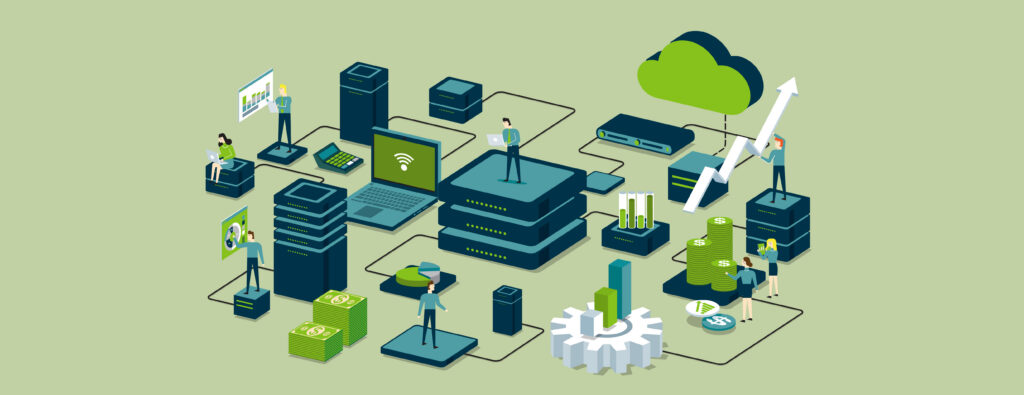
From Cost Center to Growth Engine: Rethinking the Role of IT in Higher Education
Higher education leaders are under pressure to make every dollar work harder. For many institutions, that puts IT spending under a particularly bright spotlight.
The scrutiny is understandable. Technology is one of the highest line items on every institution’s budget. Adding to the existing load, aging infrastructure, cybersecurity requirements, growing expectations, and talent constraints add further complexity.
Yet, focusing solely on reducing IT costs can mask a more important question: What does the institution need from technology to accomplish its mission?
Technology touches nearly every institutional priority, every office on campus, and every stage of the student life cycle. When leaders view IT through that lens, it becomes a strategic lever for improving institutional performance and advancing the mission.
The hidden costs of treating IT as overhead
Viewing IT primarily as overhead encourages institutions to focus on expenses that appear on the IT budget as an opportunity to save money. However, the savings found from deferring IT investments can create costs which show up elsewhere.
Departments may purchase their own tools, creating duplicated licensing and functionality, disconnected applications, and integration and project work that were not part of the original budget. Lifecycle investments may be deferred until an aging system creates an urgent reliability, security, or compliance problem. Duplication of toolsets, unplanned projects, and supporting aged-out technology causes IT teams to redirect capacity from strategic initiatives to focus on overcoming system outages and responding to emergency support requests.
When looked at through a strategic lens, the financial conversation begins to change. Cutting line items for a cost center makes it cheaper. Governing an investment makes it worth more.
For institutional leaders, the objective should be to understand the full value, cost, and risk associated with technology and make investment decisions accordingly.
Students experience one institution, not separate systems
Consider the journey from prospective student to alum. Students interact with admissions, financial aid, bursar, registrar, academics, advising, student support, and career services.
Behind those interactions are systems including CRM, SIS, LMS, ERP, and analytics platforms. Students expect all areas of the institution to know who they are and provide the support they need. When disconnected systems and processes put the burden on students to navigate those boundaries, the result is friction that can shape their experience and perception of the institution.
In today’s integrated world, strategy-centric IT organizations are uniquely positioned to see across departmental boundaries. To be effective, IT must understand where information originates throughout the student journey, how it moves between systems, where manual handoffs create friction, and which teams need that information, and at which times, to positively impact students.
From this vantage point, technology decisions consider their impact across the full student lifecycle. Rather than addressing one department’s needs at a time, a strategy-centric IT organization looks across systems, processes, and departments to anticipate downstream impacts and reduce friction for students and staff.
Define IT value through institutional outcomes
When technology is connected to strategy, its value becomes visible in outcomes leaders already care about.
IT investments can strengthen enrollment by improving the systems and workflows used to attract and support students. They can improve persistence and student experience by making information available when faculty and staff need it. Trusted data can give leaders greater confidence in institutional decisions, while automation can reduce manual work and hidden operating costs.
A mature technology environment also gives institutions greater agility to launch programs, pursue partnerships, adopt AI, and respond to changing needs. At the same time, lifecycle planning and cybersecurity practices strengthen institutional resilience.
That’s the shift from viewing IT as infrastructure to managing it as a growth engine. Its value isn’t measured by uptime or cost savings alone, but by how effectively technology strengthens institutional performance, expands capacity, and advances the mission.
Turn IT governance into institutional governance
Making this shift requires leaders outside IT to participate in technology governance.
Instead of asking what IT needs, leadership teams should be asking what the institution needs technology to accomplish for them. Technology initiatives can then be evaluated against institutional strategy, available capacity, timing, readiness, regulatory requirements, and risk.
A useful starting point is to ask these three questions about every proposed investment:
- Value: What outcome will this deliver, who owns that benefit, and how will we measure it?
- Risk: What risk does the investment reduce or introduce, and does it align with the institution’s risk tolerance?
- Resources: What will it require over its lifecycle, including funding, staff time, integrations, and project capacity?
If a proposal is unable to answer these questions, it needs more work before it is ready for a funding decision.
Understand what you are running, growing, and transforming
Leaders also need a clearer view of where technology resources are going.
One useful framework is to organize IT investments into Run, Grow, and Transform:
- Run investments keep today’s institution operating through infrastructure, cybersecurity, support, maintenance, and lifecycle refreshes.
- Grow investments improve existing capabilities through areas such as automation, integrations, analytics, and better user experiences.
- Transform investments create new capabilities, including major system modernization, AI readiness, new modalities, and data-driven approaches to student success.
Instead of asking whether or not each category receives equal investment, leaders should ask whether the current mix reflects the institution’s priorities.
Build the operating model your strategy requires
For many colleges and universities, reaching this level of capability does not require building a larger internal IT organization.
A sustainable model starts by determining what the institution should own, what capabilities they should build, andwhat opportunities they should partner around. Institutional leaders retain responsibility for strategy, governance, data ownership, budget decisions, and risk. Internal teams build capabilities such as technology roadmaps, process maturity, project governance, and data discipline. Partnerships can provide specialized capacity where scale, speed, or expertise make an external model more effective.
That can include managed IT operations, cybersecurity expertise, enterprise-system support, data engineering, project capacity, and fractional leadership. Collegis Education’s managed IT model is designed to provide this flexible capacity while institutions retain control of their data, technology roadmap, and strategic decisions.
This same approach can provide the insight needed to uncover savings through application rationalization, contract negotiations, lifecycle planning, automation, and technology right-sizing. These savings can then create the opportunity to reinvest resources in institutional priorities rather than simply shrinking the IT budget.
Is your IT operating model built for what comes next?
Start with a candid look at whether IT has the capacity to support where your institution is headed. Ask yourself the following:
- Do leaders understand how systems and data connect across the student lifecycle?
- Are technology funding decisions governed by clear institutional priorities?
- Is there a multi-year lifecycle roadmap, flattening out your capex needs and giving you continual visibility?
- Does your institution know its most significant technology risks?
- Does your IT team have enough capacity left after daily operations to advance strategic projects?
If every IT resource is consumed keeping today’s environment running, tomorrow’s environment will never get built.
Collegis Education helps colleges and universities assess their technology environments, strengthen IT operations, and build practical roadmaps that connect technology investment to institutional priorities. Connect with us to explore what a stronger IT operating model could look like for your institution.
Innovation Starts Here
Higher ed is evolving — don’t get left behind. Explore how Collegis can help your institution thrive.