
8 Alternative Tuition Models for Forward-Thinking Colleges [Infographic]
Today’s students prioritize cost and value, pushing colleges to balance affordability with revenue. With cost-per-credit becoming outdated, new tuition models aim to attract price-conscious and new student bases.
Explore eight emerging higher ed pricing trends to help institutions explore the best-fit strategies.
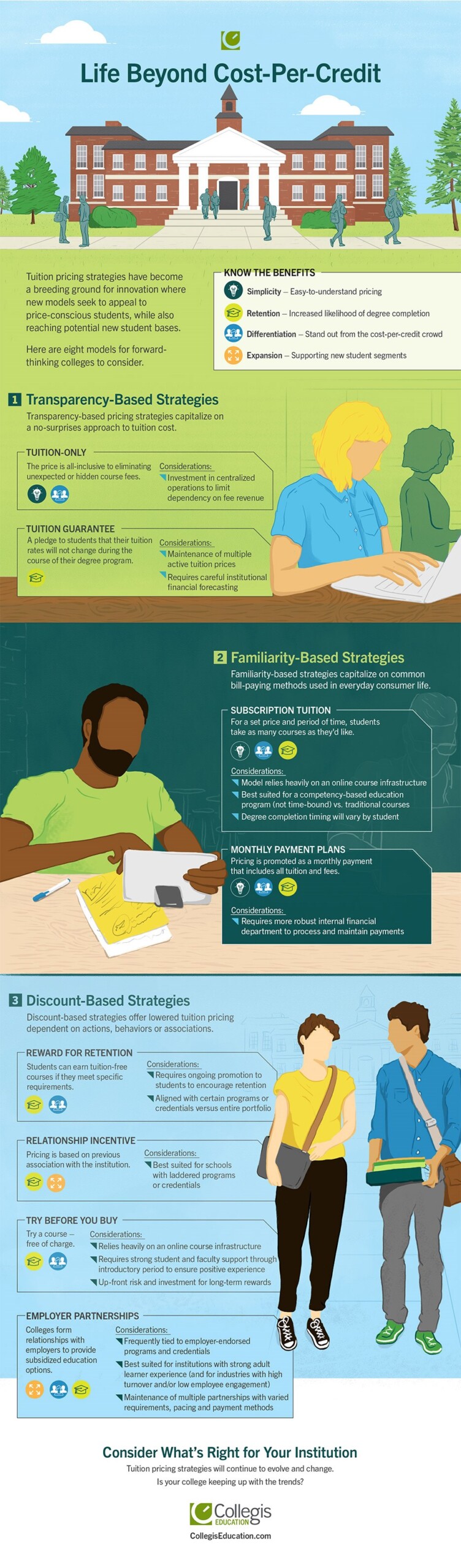
Reinventing college tuition
While college degrees have never been more important, they have also never been more expensive. According to the U.S. Department of Education, over the past three decades, tuition at public four-year colleges has more than doubled, even after adjusting for inflation.
New tuition pricing models offer colleges and universities many advantages to set themselves apart from the intense competition for student enrollment. As we reviewed various emerging pricing strategies, we identified potential benefits in the following areas:
- Simplicity – Transparent and simplified pricing is not just a benefit to prospective students seeking to understand the cost of their college degree. It also allows college staff to clearly articulate degree costs. Streamlined costs can breed efficiencies within the institution in admissions, financial aid and student support.
- Retention – Strategies that encourage or incentivize persistence and completion have the ability to increase your retention rates. With increased retention, your institution could see revenue gains over time.
- Differentiation – There are more than 4,000 degree-granting colleges and universities in the United States—and nearly all utilize cost-per-credit pricing. Offering a different way of calculating or understanding your degree cost can be a key point of differentiation that elevates your institution and attracts new students.
- Expansion – As the traditional college-seeking student population continues to decline, expanding your reach to new student segments is a critical opportunity. Pricing models that cater specifically to a new revenue stream will become increasingly important.
As you consider adopting a new tuition pricing strategy, keep these benefits in mind.
Investigating alternative tuition pricing strategies
Models of tuition pricing are constantly evolving, but we have broken down the emerging trends in higher education to help college leaders evaluate different options to find what’s right for their institution. Learn more about eight models that fall under three overarching strategies: transparency, familiarity and discounting.
Transparency-based strategies
Today’s college students are cost-savvy and want to know the total financial investment they will make up front. Transparency-based pricing strategies capitalize on a no-surprises approach to tuition cost. These types of models provide students with a measure of financial predictability.
1. Tuition-only
Tuition-only pricing models eliminate course and comprehensive fees, presenting students with an all-inclusive price that ensures clarity in program cost.
Benefits:
- Simplicity
- Differentiation
Considerations:
- Investment in centralized operations to limit dependency on fee revenue
2. Tuition guarantee
Institutions utilizing the tuition guarantee model pledge to students that their tuition rates will not change during the course of their degree program. Oftentimes, students must stay continuously enrolled to capitalize on this benefit.
Benefits:
- Retention
Considerations:
- Maintenance of multiple tuition prices yearly
Familiarity-based strategies
A college degree is one of the top five largest purchases a person will make in their lifetime. Familiarity-based strategies capitalize on common bill-paying methods used in everyday consumer life. These types of models create peace of mind for students by relating to things they already do.
3. Subscription tuition
Subscription tuition models eliminate cost-per-credit and instead allow students to take as many courses as they’d like over a set period of time (term), for a set price. In most cases, the faster they complete their coursework, the more affordable their degree program becomes.
Benefits:
- Simplicity
- Retention
- Differentiation
Considerations:
- Model relies heavily on an online course infrastructure
- Best suited for a competency-based education program (not time-bound) vs. traditional courses
- Degree completion timing will vary by student
4. Monthly payment plans
Payment plan models promote cost-per-degree as a manageable, monthly payment that is all-inclusive of tuition and fees. These models spread costs out over time, allowing students to budget monthly versus taking on student loan debt.
Benefits:
- Simplicity
- Retention
- Differentiation
Considerations:
- Requires more robust internal financial department to process and maintain payments
Discount-based strategies
Many pricing models offer students discounted tuition pricing dependent on actions, behaviors or associations. Most often, these models have increased overall student retention, allowing institutions to grow revenue over time. These types of models directly target the “deal” or “savings” seekers.
5. Reward for retention
Reward for retention models allow students to earn tuition-free courses based on meeting certain requirements. These types of programs are generally tied to specific programs or credentials versus an entire portfolio, and are usually offered during the final year of degree work to encourage persistence. An alternative is to offer a free course for a certain number completed versus holding all until the end.
Benefits:
- Retention
- Differentiation
Considerations:
- Requires ongoing promotion to students to encourage retention
- Aligned with certain programs or credentials versus entire portfolio
6. Relationship incentive
Relationship incentivized models provide discounted tuition on additional courses/programs of study to a school’s alumni—and sometimes their family. Pricing is based on previous association with the institution in order to receive a discount.
Benefits:
- Retention
- Expansion
Considerations:
- Best suited for schools with laddered programs or credentials
7. Try before you buy
Try-before-you-buy models actually give away courses free of charge to give students a taste of the education they could receive. Some models offer a risk-free period versus a whole course, i.e., 3 weeks of an 11-week course. Oftentimes, this model is only offered in high-demand programs or credentials with large revenue potential.
Benefits:
- Retention
- Differentiation
Considerations:
- Relies heavily on an online course infrastructure
- Requires strong student and faculty support through introductory period to ensure positive experience
- Up-front risk and investment for long-term rewards
8. Employer partnerships
Employer education partnerships form relationships between a college and corporate employer to provide affordable, outcomes-focused education options to the employees of the corporate partner. These relationships frequently improve employee engagement, community awareness and student retention. These models also typically rely on subsidized costs from the employer or discounted tuition—or a combination of both.
Benefits:
- Expansion
- Retention
- Differentiation
Considerations:
- Frequently tied to employer-endorsed programs and credentials
- Best suited for institutions with strong adult learner experience (industries with high turnover and/or low employee engagement
- Maintenance of multiple partnerships with varied requirements, pricing and payment methods
Consider what’s right for your institution
Tuition pricing strategies are continuing to evolve and change. Some of the mentioned models will expand to institutions across the country—while others will beget new options. As your institution seeks out ways to grow revenue and differentiate itself, consider how a new pricing model could fulfill your strategic objectives.
Innovation Starts Here
Higher ed is evolving — don’t get left behind. Explore how Collegis can help your institution thrive.