Higher education is seeing a surge of interest in non-degree credentials. Learners are seeking faster, more affordable pathways to workforce advancement. Employers are increasingly open to (and in some cases requesting) alternatives to traditional degrees. And with new federal policy expanding Pell Grant eligibility to non-degree programs, institutions are feeling the urgency to act.
But not all certificate programs are created equal. And while the trend line is clear, the strategy behind how institutions respond is anything but. This moment presents an opportunity, but only for those willing to plan with purpose and set realistic expectations.
What’s driving demand for short-term credentials?
Recent data underscores a clear increase in interest:
- Undergraduate certificate enrollment grew 33% and graduate certificate enrollment grew 21% from Fall 2020 to Fall 2024, according to National Student Clearinghouse data.
- Google search volume for certificates has increased 19% from 2020 to 2025, according to Google Trends data.
Today’s learners are drawn to programs that offer accelerated timelines, reduced costs, and clear pathways to meaningful career outcomes. Many working adults are looking to upskill or pivot careers, and a certificate can be a more practical option than a full degree — especially in disciplines where market demand is accelerating and new opportunities are emerging.
On the employer side, organizations want proof of skills and are increasingly willing to collaborate with institutions on curriculum design. In fact, according to a 2022 employer survey from Collegis and UPCEA, 68% of respondents said they would be interested in teaming up with an institution to develop non-degree credentials to benefit their workforce.
Certificates are a piece of the puzzle — not the whole strategy
Despite the interest, many institutions struggle to meet enrollment goals for certificate programs. Strong market trends do not automatically translate into high enrollment volume. The reality is that most certificates serve niche audiences and deliver modest numbers. When treated as stand-alone growth drivers, they often fall short.
The institutions that see the most strategic value from certificates do so by positioning them within a larger enrollment and academic ecosystem. For example, we’ve helped our partner institutions find success in using certificate interest as a marketing funnel to drive engagement in related master’s programs. Once a prospective student engages, enrollment teams can advise them on the best fit for their career goals, which, for some students, is enrolling in the full degree program.
Ready for a Smarter Way Forward?
Higher ed is hard — but you don’t have to figure it out alone. We can help you transform challenges into opportunities.
What a strategic certificate model looks like
A certificate program with purpose isn’t just a set of courses — it’s a product with clear value to both learners and the institution. Key elements of a strategic approach include:
- Workforce alignment: Programs must be rooted in real-time labor market data. What skills are employers seeking? Which certifications are valued? Aligning with reputable industry certifications is a proven way to ensure relevance and employer recognition.
- Accessibility: Pricing should reflect the certificate’s value relative to degree programs, and eligibility for financial aid must be prioritized. Lack of aid is a significant barrier to enrollment for many prospective learners.
- Laddering and stackability: Certificates should not be terminal unless intentionally designed that way. They should stack into larger degree pathways or offer alumni incentives for continuing their education.
- Delivery speed and flexibility: Busy adult learners expect quick starts, clear outcomes, and minimal red tape. Institutions need streamlined onboarding and agile curriculum design.
- Internal collaboration: Designing certificates in isolation often leads to friction. Academic, enrollment, and marketing teams must be aligned on purpose, target audience, and outcomes.
- Employer engagement: Employers want to be part of the development process and seek assurance that certificate programs teach the skills they need. Their involvement enhances the recognition and credibility of the credential.
The role of institutions: Balance mission with market
Certificate programs are not a shortcut to growth. But they can be a smart strategic lever when grounded in data and designed to complement an institution’s broader mission. They offer colleges and universities an opportunity to:
- Expand access to underserved learners
- Respond more nimbly to labor market shifts
- Strengthen ties with regional employers
- Drive awareness and enrollment for degree programs
The key is alignment. When certificate offerings reflect both market demand and institutional mission, they can play a powerful role in expanding reach and impact.
Plan with purpose, execute with intent
Certificates are more than just a trending credential. They’re a tool to serve learners in new ways. But institutions must resist the urge to chase quick wins. Success requires thoughtful design, realistic expectations, and cross-functional collaboration.
With the right foundation, certificate programs can do more than fill a gap. They can open doors for learners, employers, and institutions alike. Collegis supports this effort with integrated services in market research, instructional design, and portfolio development — empowering institutions to make informed, mission-aligned decisions that deliver impact.
Innovation Starts Here
Higher ed is evolving — don’t get left behind. Explore how Collegis can help your institution thrive.
As demand for skills-based learning grows, microcredentials are emerging as a key opportunity for higher education institutions to strengthen employer partnerships. But what do businesses actually look for in these programs, and how can colleges and universities position themselves as the preferred partner?
To find out, Collegis Education and UPCEA surveyed 500 organizations to gauge employer perceptions of non-degree credentials. Here’s a snapshot of what we found:
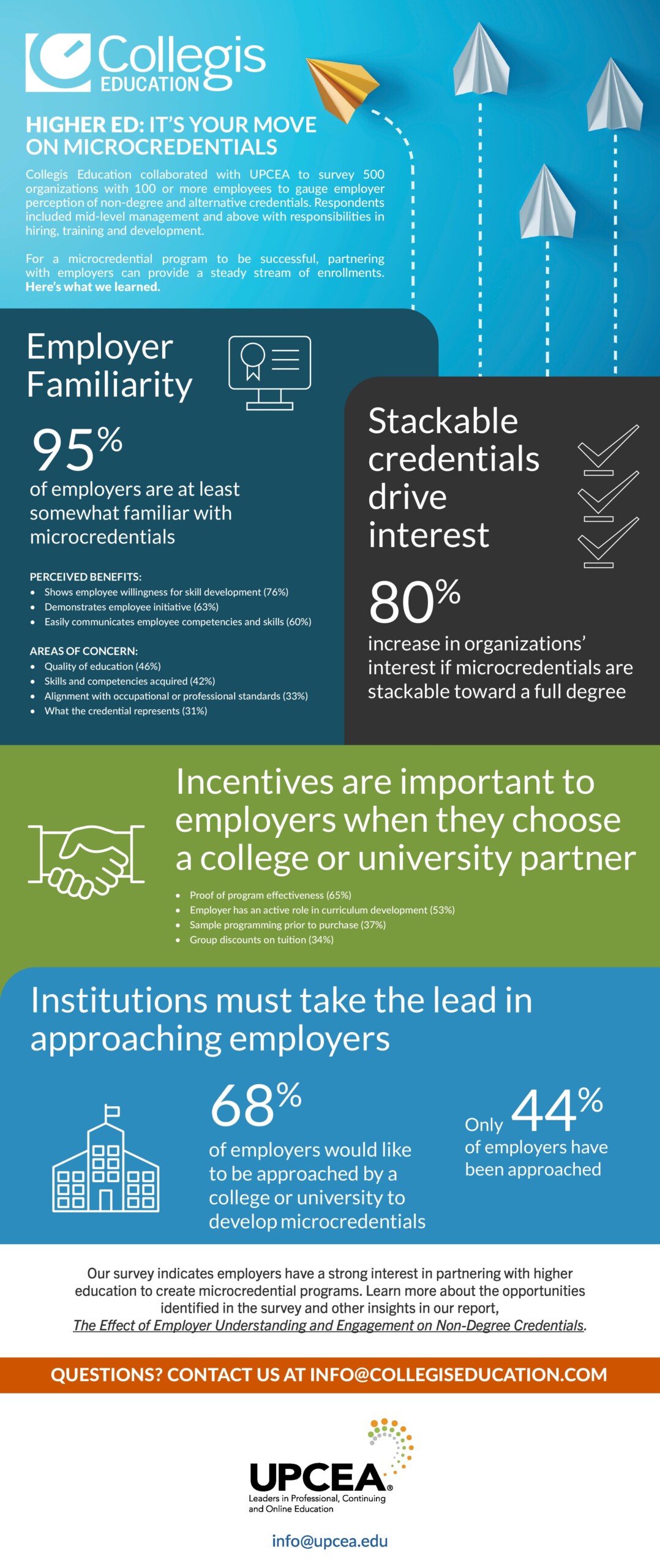
To capitalize on the growing demand for microcredentials, institutions must proactively engage employers with well-designed, industry-aligned programs. By addressing employer concerns and offering flexible, high-value learning pathways, colleges and universities can establish long-term workforce partnerships and create sustainable enrollment pipelines.
The insights found in the infographic only scratch the surface of what the research uncovered. Download the full report to learn what incentivizes employers to work with four-year higher ed schools.
Unlock Employer Insights
Learn what businesses seek in higher ed partnerships. Download the report today.
As the demand for workforce upskilling grows, higher education institutions have a unique opportunity to partner with employers on microcredentials and professional development programs. But with increasing competition from private providers like LinkedIn Learning, Coursera, and Khan Academy, how can colleges and universities stand out?
To answer this question, Collegis Education and UPCEA surveyed more than 500 employers to understand their perceptions of working with higher ed institutions on professional development and alternative credentials.
Here’s a snapshot of what we found:
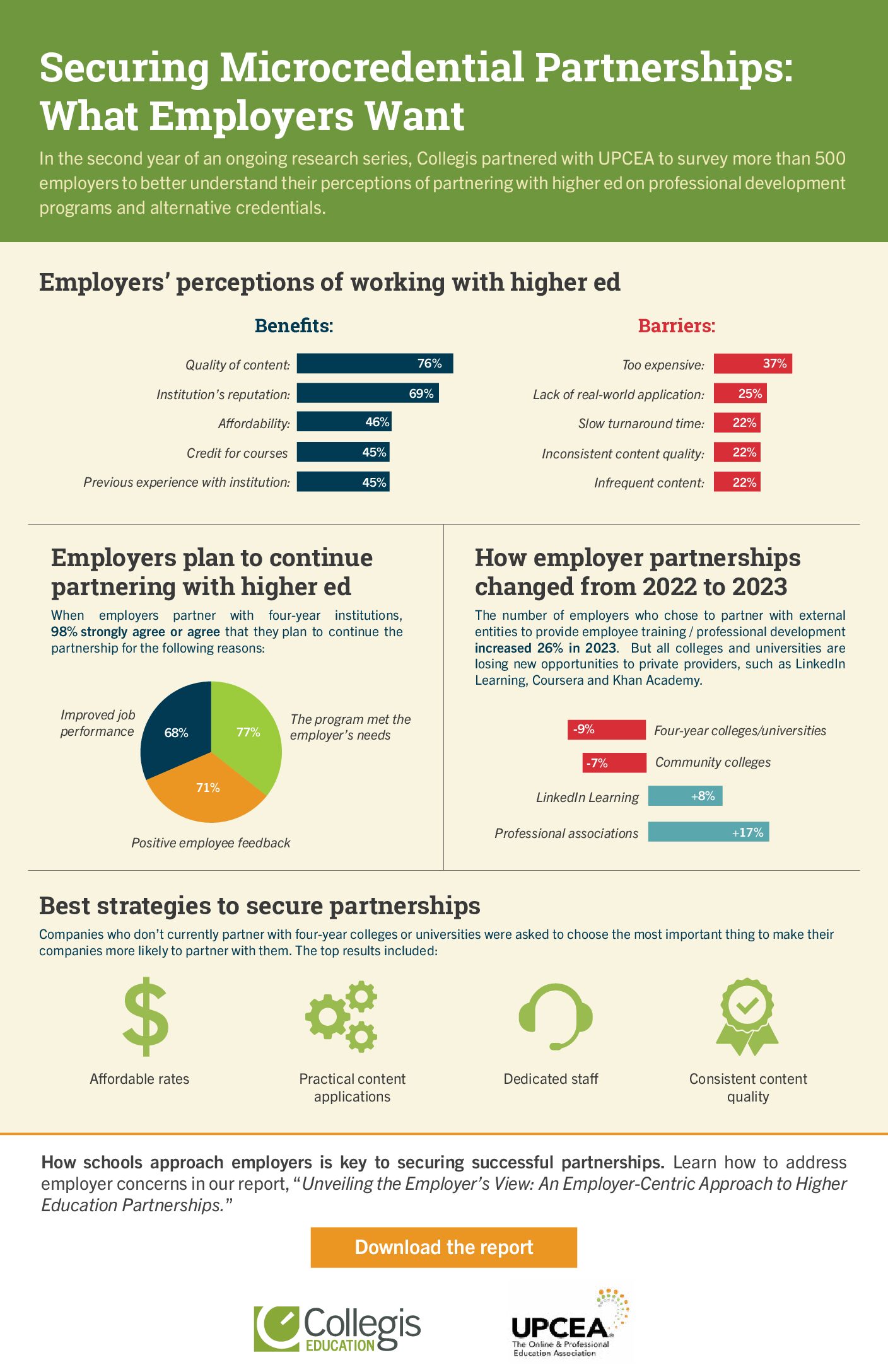
To stand out, institutions must focus on affordable, practical, and well-structured programs that align with employer needs. Successful partnerships require responsive engagement, clear outcomes, and content that directly applies to the workplace.
The insights found in the infographic only scratch the surface of what the research uncovered. Download the full report to learn what incentivizes employers to work with four-year higher ed schools.
Unlock Employer Insights
Learn what businesses seek in higher ed partnerships. Download the report today.
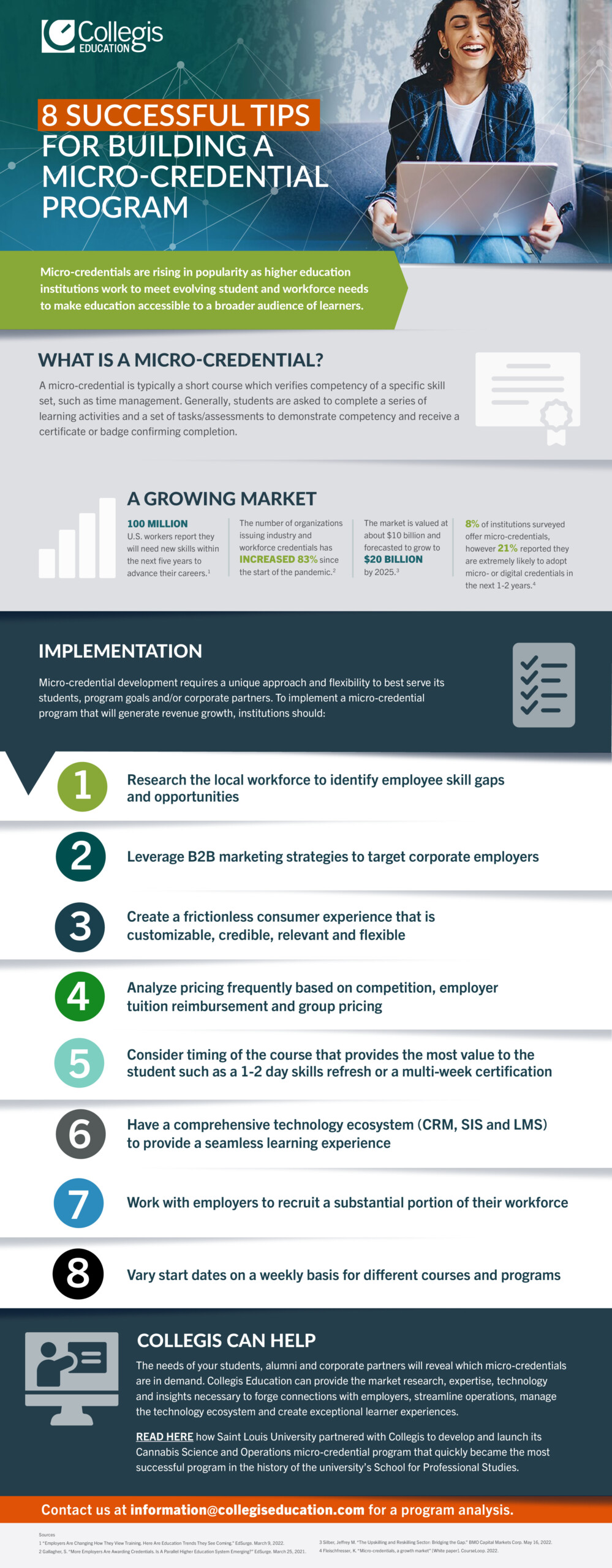
As workforce demands evolve, microcredentials are becoming a key strategy for higher education institutions looking to expand their offerings and serve lifelong learners. These short, skills-focused programs provide flexible, career-aligned learning opportunities that appeal to students, alumni, and corporate partners alike.
Our infographic outlines essential steps for institutions looking to develop, market, and scale high-impact microcredentials.
Innovation Starts Here
Higher ed is evolving — don’t get left behind. Explore how Collegis can help your institution thrive.
Online learning offers students flexibility to access classes where – and often when – they choose. This style of education has become the world’s most prevalent model for postsecondary learning, according to an Inside Higher Ed article. To stay relevant and best serve students, institutions must develop quality and effective online (or “distance learning”) courses.
There are five key elements that make up a quality distance education program. Let’s break them down…
1. Courses are designed to be conducted online.
One of the most important characteristics of a quality online education program is the fact that the courses were designed specifically for online delivery. Their learning modules are built to be effective and engaging online experiences.
When designing an online program, Dave Lungren, vice president of content solution at Collegis, says consistency is key. He believes it’s critical to have a single, fundamental design implemented across all courses in the program.
“Nothing is more difficult for students than needing to figure out what to do or where to go in a particular course,” Lungren explains. He adds that effective online courses are often structured in a weekly cadence, with regular activities and due dates that allow students to establish a weekly rhythm of effort, assignment completion and interaction.
2. Opportunities for student engagement are embedded within the courses.
An obvious drawback of distance learning is the lack of direct interaction between students and their instructors (as well as their peers). While it’s difficult to replicate the face-to-face collaboration that exists in a residential learning environment, a quality online program will have practical alternatives intentionally designed into the courses.
Lungren describes the three levels of interaction that are important in distance learning programs:
- Student-to-faculty interaction: Creating opportunities for students to have contact with the course instructor. This can be done through discussion boards, email, virtual office hours, phone calls and thoughtful assignment feedback.
- Student-to-student interaction: Providing ways for students to connect and collaborate with their peers. This can take place via group assignments, synchronous learning sessions, discussions boards and email, and can help build a sense of comradery within the program.
- Student-to-content interaction: Leveraging dynamic learning materials that require active involvement from the student. This could come in the form of animated or clickable images or through more complex interactive simulations.
3. Instructors are trained to teach in an online environment.
Not all instructors have experience teaching courses online. In fact, according to data from Bay View Analytics, when COVID prompted schools to shift courses online, 97 percent of the institutions surveyed tasked instructors who had no prior online teaching experience with transitioning to distance education courses. And 56 percent of faculty reported using teaching methods they had never used before.
Yet, instructors play a critical role in the success of any distance education program. That’s why the best programs revolve around instructors who receive the specific training, coaching and ongoing support it takes to be effective educators in an online modality.
4. Assessments are structured to be delivered virtually.
One of the most challenging parts of remote learning has been figuring out how to deliver effective, valid – and secure – assessments. This critical component is typically an area of intense focus when designing a quality distance education program.
Lungren describes three important elements that should be incorporated into every online course:
- Formative assessment: Building in opportunities for monitoring student learning throughout the term, providing ongoing feedback so students can measure their own personal learning progress.
- Summative assessment: Evaluating student achievement of course-level learning objectives. Authentic, project-based assessment methods tend to be most effective for online delivery.
- Exam security for objective tests: Ensuring exams are protected in an online environment using lockdown browsers, online proctoring and randomized test question pools in the learning management system (LMS).
5. Support is easily accessible.
Just because students aren’t on campus doesn’t mean they should be on their own. A successful distance education program is backed by 24×7 support for students and faculty alike. This helps ensure technology or accessibility issues won’t disrupt the learning process.
In the asynchronous world of online education, problems can pop up day or night on any given day. Having around-the-clock technology support provides peace of mind for students, allowing them to focus on their learning.
The best distance education programs also offer other types of support catered to online students. This can include access to academic advising, online tutoring options, networking opportunities, career services and more.
Elevate your online education offerings
As you evaluate the future of distance education programs at your institution, keep these factors in mind. If you need assistance in navigating the road ahead, we’re happy to help!
Let us help you develop the enriching online learning experience your students are seeking.
Innovation Starts Here
Higher ed is evolving — don’t get left behind. Explore how Collegis can help your institution thrive.
The workforce has changed. And with its transformation, workers have evolved their qualifications to meet new demands.
These changes are driven by technology — and the workforce must respond. Higher education institutions must also adapt to provide relevant, capable graduates who are properly equipped for today’s corporate landscape.
We’re in the information age, in which the economy is shaped by technology — a significant departure from manufacturing-focused industrialism. With new innovation comes exciting promise, but also a unique set of challenges for today’s graduates.
There’s a new skillset today’s students need in order to succeed, and these have been dubbed “21st century skills.” Keep reading to learn more about why 21st century skills are so critical and what it means for higher education.
What are 21st century skills?
What specialized skills does one need to succeed in today’s information age? That’s the ideology behind the concept of 21st century skills. 21st century learning can be broken out into three main groups, each comprising different sets of competencies:
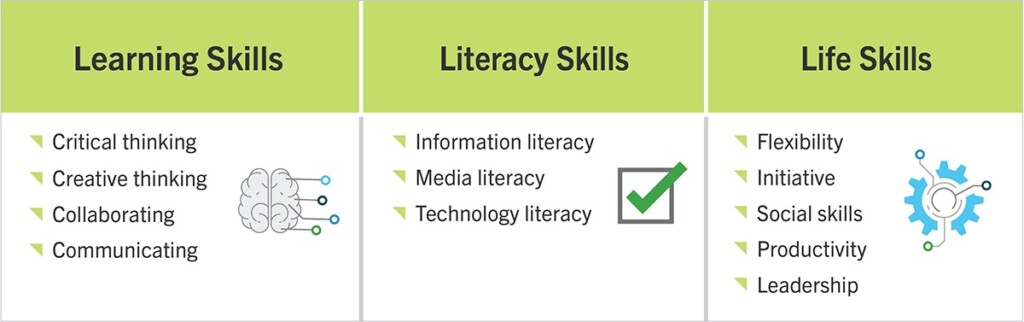
The 21st century skills movement caught on around the beginning of the millennium, when the National Education Association established the Partnership for 21st Century Skills (P21) and developed a “Framework for 21st Century Learning.”
This framework outlined different skills deemed especially valuable and necessary to prepare today’s students for tomorrow’s workforce. Numerous states have since joined P21 through the years and have built these 21st century skills into their school districts’ curriculums.
21st century skills were specifically selected and deemed critical to modern workplaces. Advancements in technology have changed not only the type of work that’s done, but how it’s done. Because of this, the human element is growing more important than ever before.
This is especially true with emerging technologies, such as machine learning and artificial intelligence. With technology taking on more and more of the repetitive, task-based work, it means that humans are left to tackle more dynamic issues that require creativity, critical thinking and collaboration.
What do employers think of 21st century skills?
The term “soft skills” is slowly being replaced by “21st century skills.” Competencies like communication and collaboration have long been characterized as soft skills, and remain important through the evolution into 21st century skills. These are skills that employers are seeking in job candidates.
In fact, a majority of employers find these skills to be just as important as technical skills. In LinkedIn’s 2019 Global Talent Trends Report, over 90 percent of surveyed employers reported that soft skills are just as or even more important to hire for than hard skills.
And in a recent survey of 400 employers, 85 percent reported wanting to hire individuals with a broad range of knowledge and skills, as compared to field-specific skills. These employers listed leadership, written communication, verbal communication, flexibility and teamwork as some of the most-desirable attributes in candidates.
Unfortunately, only 11 percent of business leaders agree that today’s college graduates have the skills needed for today’s dynamic workforce. On the other hand, 96 percent of college academic officers believe in their school’s ability to prepare students for the workforce.
As you can see, there’s a disconnect between academia and corporate America. So what can be done to connect the needs of employers with the qualifications of college graduates?
What role does higher education play in developing 21st century skills?
Some universities or particular programs naturally incorporate these kinds of transferable skills into their curriculum. Liberal arts programs, for example, are notorious for emphasizing soft skills like leadership, communication and teamwork. But 21st century skills aren’t only valuable for communications or philosophy majors.
Even the most technical fields – like computer science or accounting – are in need of professionals who can collaborate, adapt, think critically and take initiative. So how can schools equip students with these types of 21st century skills without overhauling their entire curriculum?
Several higher education institutions have acknowledged the need to better prepare students for the modern workforce using a more innovative approach. This includes new offerings, such as digital badges and micro-credentials, which help arm their graduates with the 21st century skills employers are seeking.
Digital badges can cover anything from blogging to time management or even initiative – competencies that until now have not been formally recognized on resumes or LinkedIn profiles.
Students earn digital badges in a similar manner to competency-based courses. A digital badge typically contains sub-competencies that are outlined within a rubric, and students must prove their proficiency in the specified skill in order to earn the badge. From there, they can add it to their LinkedIn account, website, portfolio or resume.
As many as one in five schools now offer some form of digital badges. And many of these offerings address the interpersonal, transferable-skill emphasis that aligns with the 21st century skillset.
Consider the following examples:
- Colorado State University offers soft skill badges in teamwork, conflict resolution and stress management.
- Johnston Community College in North Carolina offers an intercultural fluency badge.
- George Mason University offers a resilience badge.
- California Community Colleges (CCC) now offer “21st Century Skills Badges” in subjects such as collaboration, digital fluency, entrepreneurial mindset and social/diversity awareness.
Prepare your graduates for the professional world
The workforce has evolved, and higher education must follow suit. Today’s graduates are entering a different type of workforce, so make sure you’re setting yours up for success.
Learn more about how some colleges are adapting to meet this need in our article, “What Are Micro-Credentials? How Colleges Are Adapting to the Modern Workforce.”
Innovation Starts Here
Higher ed is evolving — don’t get left behind. Explore how Collegis can help your institution thrive.