Heraclitus once said, “The only certainty in life is change.” I don’t often quote ancient philosophers, but that line feels especially true in the context of higher education.”
We hear a lot about change and change management in higher ed, but we don’t hear enough about how to successfully navigate it and use it as a springboard to propel institutions forward. But change in our industry is no longer episodic; it’s constant. From evolving student expectations to emerging technologies and shifting funding models, institutions are facing wave after wave of disruption. The sheer volume of change within higher education makes effective change management not just important, but essential to success.
Too often, change management in higher education is treated like a checklist: a one-and-done plan that lives and dies with the project at hand. A new technology platform. A revised advising model. A restructured academic department. Each initiative gets a task force, a timeline, maybe a town hall or two. Then it ends.
This reactive, fragmented approach may get things over the finish line, but it can also lead to burnout, resistance, and a lack of long-term adoption. Change fatigue is real, and without a strategic change management plan, it can lead to staff turnover and a revolving door of changes that fail to realize their full potential. Institutions get stuck in a perpetual loop of short-term fixes and long-term frustration.
We can’t continue to treat change management in higher education as a one-time initiative but need to start thinking of it as a core leadership discipline.
Higher ed change management deserves a seat at the table
Higher ed leaders are navigating an environment where agility is essential. Budgets are tighter. Competition is fiercer. Student needs are more complex. And digital transformation is an ongoing reality that will drive constant change.
But too often, higher education views change management as a reactive function, kicking in when something is already in motion, such as implementing a new CRM, redesigning an advising model, or centralizing key functions and departments. The focus is often on damage control: How do we minimize pushback, smooth over disruptions, and reach the finish line without too much friction?
Start by elevating change management to the strategic level, not only giving it a seat at the leadership table, but also providing it with the same structure, dedicated resources, and strategic oversight as any other core function. Schools that do this are better equipped to:
- Improve cross-campus alignment
- Reduce resistance and increase buy-in
- Accelerate the adoption of new systems or models
- Minimize disruption to students and staff
- Deliver better outcomes, faster
The bottom line? In this climate, the ability to manage change effectively is a competitive advantage. If you want your institution to be resilient, you need to be deliberate about how you manage change.
Build the muscle: 3 strategies for better change management in higher ed
To help get you started, here are three practical ways you can help your institution build confidence, strengthen its change management muscle, and create a culture that’s ready to adapt.
1. Create a change management playbook and use it
Successful change management cannot be ad hoc or reactive. A change management playbook brings clarity and consistency. It outlines the steps, tools, and best practices for managing change from start to finish. When creating your playbook, consider:
- Stakeholder mapping: Who are the executive sponsors? Who is affected? Who are the influencers? Who needs to be consulted early and often?
- Communication protocols: What do different audiences need to know and when? How will you keep them informed and engaged? How will the messages be delivered? How will we gather feedback?
- Training and support: What tools, resources, or guidance will people need to succeed in the new environment?
Having a playbook doesn’t mean every change looks the same. It means every change follows a thoughtful, proactive approach, building institutional memory and contributing to a proven, repeatable model. It also sends a clear signal to your campus community: We take change seriously, and we’re investing in doing it well.
Don’t silo your playbook. Make it a shared resource across IT, academic affairs, student services, and marketing. The more aligned your teams are, the more cohesive your change efforts will be.
2. Appoint change champions across the institution
Change doesn’t stick because a VP says so. It sticks because people at every level understand it, own it, and advocate for it.
That’s why identifying change champions is essential. Change champions are individuals with influence in their peer groups who understand the value of the change and are willing to help others navigate the transition. They can be faculty, staff, or student leaders. When building your network, identify advocates across departments and at all levels.
Empower these individuals with context, talking points, and direct lines of communication to leadership. Let them surface concerns early and share success stories along the way. Peer advocacy goes a long way in building trust, momentum, and reinforcing key messages.
The result? Change doesn’t feel imposed. It feels supported, even co-owned.
3. Make Communication your top priority
Communication is the lifeblood of effective change management in higher education. But too often, it’s treated as an afterthought. You can’t lead change in silence, and exceptional leaders should communicate early and often
Your institution should approach communication with intention and discipline:
- Start with the “why” behind the change. People are more likely to support change when they understand its purpose.
- Tailor messages to each audience. Faculty care about different things than students or staff. Don’t send one-size-fits-all emails and expect engagement.
- Use multiple channels. Email, intranet, in-person forums, social media, video — different people absorb information in different ways.
- Be transparent, even when things aren’t going according to plan. Share what you know, when you know it. When things change, explain why.
Clear, frequent communication is one of the most powerful tools you for building trust and reducing resistance. And remember: Communication is a two-way street. Build feedback channels into your plan. Listen actively. Adapt as needed.
Change management as a strategic function
So, what does it look like when an institution treats change management as a true leadership discipline? It looks like this:
- A standing change management office or role, reporting into strategy or operations.
- A centralized playbook that guides every major initiative.
- Regular training and coaching for leaders on how to lead through change.
- KPIs and feedback loops that track engagement, adoption, and outcomes.
- An inclusive culture where stakeholders are part of the process, not just recipients of it.
In this model, change is no longer a disruption. It’s a capability. Something your institution can do reliably, thoughtfully, and at scale.
Lead like change is the constant
If you take one thing away from this, let it be that change management isn’t a project, it’s a leadership discipline. It deserves the same strategic attention as budgeting, enrollment planning, or accreditation. Because, when done right, it unlocks the potential of your people, your technology, and your mission.
Change will keep coming, and by making change management a core part of how your institution operates every day, you can take control of it and effectively drive your desired outcomes.
Innovation Starts Here
Higher ed is evolving — don’t get left behind. Explore how Collegis can help your institution thrive.
In today’s competitive higher education landscape, institutions can no longer afford to rely on instinct alone when it comes to academic program planning. The stakes are too high and the margin for error too slim.
Leaders are facing increasing pressure to align their portfolios with market demand, institutional mission, and student expectations — all while navigating constrained resources and shifting demographics.
The good news? You don’t have to guess. Market intelligence offers a smarter, more strategic foundation for building and refining your academic program mix.
Why program optimization matters now more than ever
Most institutions have at least one program that’s no longer pulling its weight — whether due to declining enrollment, outdated relevance, or oversaturated competition. At the same time, there are often untapped opportunities for growth in emerging or underserved fields.
But how do you decide which programs to scale, sustain, or sunset?
Optimizing your portfolio requires more than internal performance metrics. It calls for an external lens — one that brings into view national and regional trends, labor market signals, and consumer behavior. When done effectively, academic portfolio strategy becomes less about trial and error, and more about clarity and confidence.
The first step: Start with the market
The strongest portfolio strategies begin with robust external data. At Collegis Education, we draw from sources like the National Center for Education Statistics (IPEDS), Lightcast labor market analytics, and Google search trends to assess program performance, student demand, and employment outlooks.
National trends give us the big picture and a foundation to start from. But for our partners, we prioritize regional analysis — because institutions ultimately compete and serve in specific geographic contexts, even with fully online programs. Understanding what’s growing in your state or region is often more actionable than knowing what’s growing nationwide.
Our proprietary methodology filters for:
- Five-year conferral growth with positive year-over-year trends
- Programs offered by a sufficient number of institutions (to avoid anomalies)
- Competitive dynamics and saturation thresholds
- Job postings and projected employment growth
This data-driven process helps institutions avoid chasing short-term trends and instead focus on sustainable growth areas.
Ready for a Smarter Way Forward?
Higher ed is hard — but you don’t have to figure it out alone. We can help you transform challenges into opportunities.
Data in action: Insights from today’s growth programs
Collegis’ latest program growth analyses — drawing from 2023 conferral data — surface a diverse mix of high-opportunity programs. While we won’t detail every entry here, a few trends stand out:
- Technology and healthcare programs remain strong at the undergraduate level, with degrees like Computer Science and Health Sciences showing continued growth.
- Graduate credentials in education and nursing reflect both workforce need and strong student interest.
- Laddering potential is especially evident in fields like psychology and health sciences, where institutions can design seamless transitions from associate to bachelor’s. In fields such as education, options to ladder from certificate to master’s programs are growing in demand.
What’s most important isn’t the specific programs, it’s what they reveal: external data can confirm intuition, challenge assumptions, and unlock new strategic direction. And when paired with regional insights, these findings become even more powerful.
How to turn insight into strategy
Having market data is just the beginning. The true value lies in how institutions use it. At Collegis, we help our partners translate insight into action through a structured portfolio development process that includes the following:
- Market analysis: Analyzing external data to identify growth areas, saturation risks, and demand signals — regionally and nationally.
- Gap analysis: Identifying misalignments between current offerings and market opportunity.
- Institutional alignment: Layering in internal metrics — enrollment, outcomes, mission fit, modality, and margin.
- Strategic decisions: Prioritizing programs to expand, launch, refine, or sunset.
- Implementation support: Developing go-to-market plans, supporting change management, and measuring results.
By grounding these decisions in both internal and external intelligence, institutions can future-proof their portfolios — driving enrollment, meeting workforce needs, and staying mission-aligned.
Put data to work for your portfolio
Program portfolio strategy doesn’t have to be a guessing game. With the right data and a trusted partner, institutions can make bold, confident moves that fuel growth and student success.
Whether you’re validating your instincts or exploring new academic directions, Collegis can help. Our market research and portfolio development services are built to support institutions at every step of the process — with national insights and regional specificity to guide your next move.
Innovation Starts Here
Higher ed is evolving — don’t get left behind. Explore how Collegis can help your institution thrive.
Your students are already running to AI for answers. The only question is — what’s it saying about your institution? More importantly, are you in the conversation or being left out? If you’re not actively shaping how your school shows up in AI-driven search and decision-making platforms, you’re not just invisible — you’re irrelevant.
Digital Darwinism in Higher Ed:
Adapt Your Marketing for AI — or Get Left Behind
Date: May 29, 2025
Time: 2:00 p.m. ET / 1:00 p.m. CT

Ashley Nicklay
Sr. Director of Marketing
Collegis Education
Jessica Summers
Director of Web Strategy
Collegis Education
In this webinar, Collegis Education’s Ashley Nicklay, Sr. Director of Marketing, and Jessica Summers, Director of Web Strategy, will unpack what “AI-ready” really means for higher ed marketing and enrollment leaders. We’ll explore how generative AI influences the student journey from search to selection, why most websites and content strategies are falling short, and what forward-thinking institutions are doing to lead the algorithm, rather than get buried by it.
This isn’t just about better SEO or smarter ads. It’s about understanding how AI evaluates your institution — and making sure you’re feeding it the right data, signals, and story to stay in the game.
What You’ll Learn
- How AI impacts the early stages of the enrollment journey: Understand how tools like ChatGPT and Google’s AI Overviews influence what students see when exploring colleges.
- Why AI prompt bias is real — and how to beat it: Learn how content, structured data and reputation shape AI responses.
- What AI actually sees when it looks at your website (and what it may miss): Explore how site structure, clarity and technical markup shape what AI-based tools can find and summarize – and what they may overlook.
- What it really means to have an AI-optimized website: We’ll show you our checklist of what your .edu needs to show up in AI-generated answers.
- How to future-proof your marketing model in an AI-driven search landscape: Assess your current channels and content strategy for resilience as search becomes more conversational and less click-based.
Future-Ready Starts Here
The institutions that will thrive tomorrow are learning how to market to machines today. Find out what it takes to survive the AI era of higher ed marketing.
Complete the form on the right to view the webinar recording.
The buzz around AI in higher ed is undeniable. The topic dominated conference discussions at ASU + GSV, with nearly every booth, breakout, and keynote referencing AI somehow. When AI gets tossed around so often, it can be hard to differentiate between what’s real and what isn’t.
While the transformative promise of AI is exciting, successful AI implementation requires more than fast adoption. The more important question is: How can institutions move from ideas to impact?
The reality is that achieving meaningful results with AI requires more than just purchasing the latest tool. That’s often the easiest part, but it can also be a trap. Tool and tech procurement, absent a well-informed implementation strategy, can add to your technical debt. It’s critical to look beyond the buzzword and first define where you want your institution to be in the future. With your north star in place, you can determine how AI can play a role in a holistic solution.
Operationalizing AI for Real Impact
Many discussions around AI for higher ed focus on its evolving capabilities to generate content, automate tasks, engage and support students, and handle other critical functions. But what is the impact you’re looking to make, and how are you going to measure the return on investment? Those questions tend to be missing from higher ed’s ongoing AI conversation. Don’t implement tactics (or tools) until you know their role in your broader tech strategy. Too often, there is a heightened sense of urgency to implement and not enough focus on the complexities of weaving these tools into the intricate fabric of an institution. There is no easy button in AI.
Trying to catch the AI hype without having a strategic AI implementation plan is like buying state-of-the-art lab equipment before you’ve decided what type of science courses you are going to offer. Effective integration involves significant change management, process design, and ongoing investment.
For example, many schools already use AI-powered agents to assist with student recruitment by answering prospects’ questions and suggesting next steps. These bots can scale engagement significantly — but to be effective, they require meticulous training, constant monitoring, and attentive human oversight to ensure the interaction is aligned with a school’s culture and values. As technology evolves, the operational model must adapt. Without constant care and feeding, AI tools can become outdated, provide incorrect information, or fail to align with the institution’s unique voice and mission. Remember, technology and tool outputs are only as good as the inputs.
And the investment isn’t just the initial software cost. The investment also includes ongoing commitment to deployment, integration, training, and ensuring the technology drives the desired outcomes. Many underestimate this operational heavy lifting in the rush to adopt AI, yet it’s the linchpin for success.
Start with Strategy, Not Just Software
A more effective, pragmatic approach to AI implementation in higher education begins by identifying the institution’s core challenges and strategic objectives.
Are you focused on reversing enrollment declines? Improving student retention rates? Enhancing support services? Increasing operational efficiency? By defining your goals and measurable key performance indicators (KPIs) from the outset, you’re in the best position to strategically evaluate how AI — alongside other data, technology, and talent resources — can contribute to a solution that supports the entire student lifecycle.
Without this clarity, institutions risk spending significant resources without achieving tangible returns. It’s about focusing efforts, perhaps starting with a contained, controllable area where impact can be carefully monitored and measured, rather than attempting to boil the ocean.
Leveraging AI Strategically
Currently, many institutions are grappling with important discussions around AI ethics, academic integrity, and preventing misuse by students to cheat. It’s important not to get stuck there. Students who want to circumvent rules will find a way. AI is simply the newest tool. Focusing excessively on policing AI use means missing the boat on its strategic potential.
The real opportunity lies in leveraging AI across the entire student lifecycle — from recruitment and enrollment to engagement, support, and retention. AI can personalize outreach, provide 24/7 advising support, identify at-risk students earlier, and automate administrative tasks, freeing up staff for higher-value interactions. It will almost certainly be part of effective solutions, but it shouldn’t be the only part.
The Indispensable Human Element
In the race to apply AI, we must not forget the crucial role of human intelligence (HI). AI tools, even sophisticated ones, require human oversight. They must train on the correct data and the institution’s values, mission, and unique persona.
Humans are essential for guiding AI, correcting its inevitable errors and ensuring its outputs align with institutional standards. Furthermore, education remains a fundamentally human endeavor. While AI can enhance efficiency and scale, it cannot replace true empathy, mentorship, and social-emotional connection, which are vital to student success and belonging. The most effective approach combines the power of AI with the irreplaceable value of human talent — a synergy Collegis champions through its focus on data, tech, and talent.
Moving Fast, But Moving Smart
The desire to rapidly adopt AI in higher ed is understandable. However, a rushed implementation without a clear strategy is likely to falter. Stepping back to define objectives, plan the integration, and establish metrics is the best way to accelerate the path to meaningful impact.
This more deliberate, strategic approach enables institutions to harness AI’s power effectively, ensuring it serves their unique mission and drives measurable results. It’s about moving beyond the hype and focusing on the pragmatic steps needed to make AI work for higher ed, creating sustainable value for the institution and the students it serves. The journey requires careful navigation, a focus on operational reality, and often, a partner who understands how to bridge the gap between potential and practice.
Innovation Starts Here
Higher ed is evolving — don’t get left behind. Explore how Collegis can help your institution thrive.
Let’s cut to it: Higher ed is sprinting toward the AI revolution with its shoelaces untied.
Presidents are in boardrooms making bold declarations. Provosts are throwing out buzzwords like “machine learning” and “predictive modeling.” Enrollment and marketing teams are eager to automate personalization, deploy chatbots, and rewrite campaigns using tools like ChatGPT.
The energy is real. The urgency is understandable. But there’s an uncomfortable truth institutions need to face: You’re not ready.
Not because you’re not visionary. Not because your teams aren’t capable. But because your data is a disaster.
AI is not an easy button
Somewhere along the way, higher ed started treating AI like a miracle shortcut — a shiny object that could revolutionize enrollment, retention, and student services overnight.
But AI isn’t a magic wand. It’s more like a magnifying glass, exposing what’s underneath.
If your systems are fragmented, your records are outdated, and your departments are still hoarding spreadsheets like it’s 1999, AI will only scale the chaos. It won’t save you – it’ll just amplify your problems.
When AI goes sideways
Take the California State University system. They announced their ambition to become the nation’s first AI-powered public university system. But after the headlines faded, faculty across the system were left with more questions than answers. Where was the strategy? Who was in charge? What’s the plan?
The disconnect between vision and infrastructure was glaring.
Elsewhere, institutions have already bolted AI tools onto outdated systems, without first doing the foundational work. The result? Predictive models that misidentify which students are at risk. Dashboards that contradict themselves. Chatbots that confuse students more than they support them.
This isn’t an AI failure. It’s a data hygiene failure.
You don’t need hype — You need hygiene
Before your institution invests another dollar in AI, ask these real questions:
- Do we trust the accuracy of our enrollment, academic, and financial data?
- Are we still manually wrangling CSVs each month just to build reports?
- Do our systems speak the same language, or are they siloed and outdated?
- Is our data governance robust enough to ensure privacy, security, and usefulness?
- Have we invested in the unglamorous but essential work (e.g., integration pipelines, metadata management, and cross-functional alignment)?
If the answer is “not yet,” then congratulations — you’ve found your starting point. That’s your AI strategy.
Because institutions that are succeeding with AI, like Ivy Tech Community College, didn’t chase the trend. They built the infrastructure. They did the work. They cleaned up first.
What true AI readiness looks like (a not-so-subtle sales pitch)
Let’s be honest: there’s no shortage of vendors selling the AI dream right now. Slick demos, lofty promises, flashy outcomes. But most of them are missing the part that actually matters — a real, proven plan to get from vision to execution.
This is where Collegis is different. We don’t just sell transformation. We deliver it. Our approach is grounded in decades of experience, built for higher ed, and designed to scale.
Here’s how we help institutions clean up the mess and build a foundation that makes AI actually work:
Connected Core®: Your data’s new best friend
Our proprietary Connected Core solution connects systems, eliminates silos, and creates a single source of truth. It’s the backbone of innovation — powering everything from recruitment to reporting with real-time, reliable data.
Strategy + AI alignment: Tech that knows where it’s going
We don’t just implement tools. We align technology to your mission, operational goals, and student success strategy. And we help you implement AI ethically, with governance frameworks that prioritize transparency and accountability.
Analytics that drive action
We transform raw data into real insights. From integration and warehousing to dashboards and predictive models, we help institutions interpret what’s really happening — and act on it with confidence.
Smarter resource utilization
We help you reimagine how your institution operates. By identifying inefficiencies and eliminating redundancies, we create more agile, collaborative workflows that maximize impact across departments.
Boosted conversion and retention
Our solutions enable personalized student engagement, supporting the full lifecycle from inquiry to graduation. That means better conversion rates, stronger persistence, and improved outcomes.
AI wins when the infrastructure works
Clean data isn’t a project — it’s a prerequisite. It’s the thing that makes AI more than a buzzword. More than a dashboard. It’s what turns hype into help.
And when you get it right, the impact is transformational.
“The level of data mastery and internal talent at Collegis is some of the best-in-class we’ve seen in the EdTech market. When you pair that with Google Cloud’s cutting-edge AI innovation and application development, you get a partnership that can enable transformation not only at the institutional level but within the higher education category at large.”
— Brad Hoffman, Director, State & Local Government and Higher Education, Google
There are no shortcuts to smart AI
AI can only be as effective as the foundation it’s built on. Until your systems are aligned and your data is trustworthy, you’re not ready to scale innovation.
If you want AI to work for your institution — really work — it starts with getting your data house in order. Let’s build something that lasts. Something that works. Something that’s ready.
Curious what that looks like? Let’s talk. We’ll help you map out a real, achievable foundation for AI in higher ed.
You stuck with me to the end? I like you already! Let’s keep the momentum going. If your wheels are turning and you’re wondering where to start, our Napkin Sketch session might be the perfect next step. It’s a fast, collaborative way to map out your biggest data and tech challenges—no pressure, no sales pitch, just a conversation. Check it out!
Innovation Starts Here
Higher ed is evolving — don’t get left behind. Explore how Collegis can help your institution thrive.
In higher education, it’s easy to feel stuck.
You know something isn’t working — maybe enrollment processes are clunky, or student support services feel disconnected. You’ve tried new tools, updated systems, created initiatives to create change, and added staff, but the problem persists. It’s like there’s a giant boulder in your way, and no matter how hard you push, it doesn’t budge.
It turns out, you don’t need a bulldozer – just a napkin sketch to start building momentum to move the boulder standing in the way.
It’s a surprisingly simple concept, using visual design thinking exercises to help colleges and universities get unstuck. Not with more tech, or a fancy AI solution, but with more clarity to understand how things work today to create a framework for change tomorrow.
Because real innovation in higher education doesn’t come from software or a technology — it starts with understanding the systems and the processes you already have so you can visualize what they could be.
What is a napkin sketch?
The napkin sketch is exactly what it sounds like: a back-of-the-napkin-style drawing that quickly maps out how a particular process actually works in your institution so it can be reimagined.
It’s low-tech, but high-impact.
Think of it as building a gameboard for players to play. Like a Monopoly board, everyone knows the players, the rules, and the steps. It makes the choices that need to be made for each player’s turn clear. When these choices are laid out visually, it becomes much easier to pinpoint where the real opportunities (and challenges) are.
What does the napkin sketch exercise entail?
I usually start these sessions by asking one simple questions with a key follow-up
- What’s the opportunity for ‘impact’? (What are you trying to accomplish?)
- What’s preventing progress?
Then we get to work. Together, we sketch out the entire process: from first interaction to the final outcome. We account for every step, system, and stakeholder that’s involved. We highlight the costs, the tools and technology handoffs, potential delays, and where things might be falling through the cracks.
We typically conduct the sketch in a virtual drawing space, where we can collaborate in real time to map out the full process. It’s not about polished visuals — it’s about building a shared understanding of how things operate today.
And in about 60-90 minutes, we always have at least one person in the group say out loud “I didn’t realize that’s how it actually works.” And another will inevitably ask “You’re going to send us this napkin sketch, right? I want to print it out.”
Ready for a Smarter Way Forward?
Higher ed is hard — but you don’t have to figure it out alone. We can help you transform challenges into opportunities.
What can the napkin sketch reveal?
In our experience working with hundreds of institutions of all shapes and sizes, we’ve found that many face surprisingly similar challenges. This exercise consistently shines a light on hidden opportunities, creating a blueprint for change.
Common things we uncover include:
- Manual, repetitive tasks that could be automated or streamlined
- Workarounds that have become permanent fixtures without anyone questioning them
- Disconnects between departments, systems, or technologies
- Operational silos that prevent teams from seeing the full picture or collaborating effectively
- Missed opportunities to better track, analyze, or act on data
- Unclear ownership of key steps in the process
In short, the napkin sketch helps institutions see what’s really going on — and what needs to change to move forward.
Why does it work?
Higher ed innovation often stalls because teams are too close to the problem or too deep in their own silo to see the bigger picture. The napkin sketch breaks through that by creating a space for everyone involved to step back and collaborate.
Here’s why it’s effective:
- It’s fast — most sessions take an hour or two.
- It’s visual — helping teams align quickly and clearly.
- It’s collaborative — bringing together voices from across departments.
- It’s actionable — revealing next steps that are grounded in reality.
Most importantly, it shifts the focus away from jumping to solutions and toward understanding the system. Once you understand the system, smart solutions become much more obvious — and effective.
Real examples of the napkin sketch in action
Whether it’s enrollment workflows, transcript processing, student communications, or data handoffs between systems or teams, the napkin sketch exercise can help untangle a wide variety of operational challenges. No two institutions are exactly alike, but many face similar complexities — manual processes, siloed teams, and unclear ownership that stall progress.
Here are a few discoveries we uncovered in recent napkin sketch sessions I’ve led:
- One institution realized how many steps were involved in processing transcripts — with staff toggling between platforms, uploading the same file in multiple places, and doing manual comparisons. Once the process was mapped, we explored how AI could handle the course match evaluations — saving hours of staff time each week.
- Another team sketched out their enrollment outreach process and discovered they were sending multiple conflicting messages to students at the same time. The sketch helped them realign their communications and reduce student confusion.
- A third school wanted to integrate a new tool into their tech stack, but the sketch revealed that the underlying workflow was broken — and that no tool would help until the foundational process was improved.
In each case, the aha moment didn’t come from buying something new — it came from clearly seeing what was already happening so it could be improved upon.
What could your napkin sketch uncover?
If you’re wrestling with outdated processes, disconnected systems, or unclear handoffs — you’re not alone. Many institutions are trying to drive higher ed innovation with limited resources and overwhelming complexity.
But you don’t need to have all the answers right now. You just need a clearer view of the problem so you can develop a thoughtful solution.
That’s what the napkin sketch offers: a simple, collaborative way to map your reality, uncover opportunity, and take a smarter next step forward.
Let’s sketch it out — and see what we find!
Ready to uncover what’s holding you back?
Reach out to schedule your own session and take the first step toward smarter solutions.
College administrators wear many hats to ensure their institutions thrive. Stakeholders expect them to be visionaries, budget stewards, tech experts, and student champions. However, wearing too many hats can hinder the ability to meet more strategic and forward-thinking institutional demands, effectively diluting leadership capacity and outcomes.
How can administrators remove some of those hats without losing control or spending more?
How can they guide their institutions to achieve better outcomes with fewer resources?
At the 2024 Collegis Education Summit, keynote speaker Dr. John Smith-Coppes, president of Joyce University, shared his advice for achieving higher ed excellence amid market paradigms, shifting learner expectations, and capacity constraints.
“Embrace your institutional superpower and then partner for expertise. You have to know what you are really good at, but also where you might need help. Having the bravery to objectively look at the brutal facts can take you from good to great. Keep this in mind: Your institution is perfectly designed to get the outcomes it’s getting.”
-Dr. John Smith-Coppes, President of Joyce University
Dr. Smith-Coppes is right. If you’re not getting the results you want, you have to shine a light on the operation and consider what adjustments or changes will better position your institution for desired outcomes.
To echo Dr. Smith-Coppes and answer the earlier questions, working with a strategic partner who has deep expertise in higher education shared services and can manage certain responsibilities more efficiently can get your institution closer to turning aspiration into reality. A true partnership is not about simply outsourcing tasks. Rather, it’s a strategic way to gain access to specialized knowledge, proven methodologies, and scalable resources, all while enabling administrators to focus on their core areas of expertise.
Mounting challenges facing higher ed leaders
When I talk to administrators, the conversation inevitably turns to the challenge of doing more with less. They consistently grapple with four key issues:
- Budget Cuts: Funding is uncertain or shrinking, forcing them to rethink the allocation of resources.
- Advancing Technology: Technology is rapidly evolving, leaving administrators to scramble after the next advancement or emerging capability.
- Socioeconomic Pressures: With some questioning the value of postsecondary education, relevant programs with affordable tuition have never been more critical.
- Employee Turnover: Retaining top talent is difficult, leaving critical gaps.
But none of these issues surprise us. On the contrary, Collegis Education has partnered with numerous public and private institutions of varying sizes and levels of brand recognition to address these challenges, uncovering advantageous pathways toward more sustainable and fruitful operations.
The results speak for themselves. Administrators gain more time to leverage their core strengths to elevate their institution’s mission and educational outcomes while actualizing a variety of clear benefits. Here is what Collegis Education continues to deliver for our shared-service partners.
Seven ways shared services in higher education deliver results
Institutions that leverage shared services experience benefits in a variety of key areas. Explore some of the most significant advantages:
1. Improved financial stability
Predictability and optimization are the key words here. With our solutions for technology management, enrollment management, and student services, institutions know exactly what to budget every year. At the same time, we find cost savings by getting a better return on technology investments, strategically decommissioning redundancies, and renegotiating contracts.
2. Enhanced operational efficiency
Is there a better way to reach an institution’s goals more efficiently? More often than not, the answer is yes. We help bring these opportunities to the surface by fully assessing the school’s infrastructure, technology, processes, and other operating procedures. This assessment denotes areas of excellence and points of failure as well as identifies where lag or waste exists. With these insights, we can identify and prioritize emerging opportunities to drive improvement. All this informs a multiyear roadmap that guides higher ed leaders on how to thoughtfully implement changes that engage key stakeholders to accelerate the change management cycle.
3. Objective perspective & best practices
We bring a unique perspective to our recommendations based on our work with other schools while protecting each school’s anonymity and uniqueness. This helps give you a baseline of how your school performs when compared to similar ones. Are you leading or lagging? As an unbiased third party, we offer fresh ideas backed by the knowledge of the results they have produced. It’s a great way to eliminate the “but this is how we’ve always done it” objection and gain buy-in from internal staff.
4. Risk mitigation & accountability
There’s rarely a higher ed situation we haven’t already dealt with at another institution. Our partners benefit from this experience, allowing them to proactively avoid operational and technical risks. They also benefit tremendously from having a partner who holds themselves accountable to quantifiable outcomes measured by agreed-upon service level agreements (SLAs). Together, these provide a lot of peace of mind when it comes to issues like cybersecurity, compliance, disaster recovery, and business continuity.
5. Specialized expertise without the overhead
Hiring and retaining experienced staff is challenging enough. Finding people with skill sets to leverage evolving technology capabilities like artificial intelligence (AI) is a whole other story. That’s why our partners rely on Collegis to provide the expertise that’s hard to find. We’re software-agnostic and implement solutions that are in the school’s best interest from a financial, operational, and strategic perspective without the need for full-time employees to manage them.
6. Data-enabled decision making with full transparency
Data at most institutions is stored in siloes, with limited stewardship and governance over its quality and consistency. However, many of the “data” solutions in the market today are complicated and difficult to implement and support.
This is why we built Connected Core, a scalable higher education industry cloud solution that integrates siloed data sets, systems, and applications to enable institutional intelligence. This proven approach and methodology for collecting, connecting, and activating institutional data eliminates data doubt and gives leaders the confidence to make quickly make strategic decisions with confidence.
7. Focus on core mission & educational outcomes
By outsourcing some functions, administrators can redirect resources and energy to what truly matters: student success. By reducing the number of hats they wear, leaders can instead focus on using the tools they have on hand to manage strategic initiatives that drive institutional growth.
Strategic delegation to yield better outcomes
Some leaders fear losing control through outsourcing, and rightfully so. Too many vendors tout “partnership” when, in fact, they are trying to build an unhealthy dependency that is not mutually beneficial.
That’s just not us. It fundamentally goes against our values and who we are as a company.
Our partnerships are built on collaboration and shared governance. Institutions set priorities, and all actions follow clear assessments, implementation plans, and progress reviews. Our partners gain greater control over technology, enrollment, and budgets. Control isn’t lost, but visibility and accountability are gained.
Shared-services models allow administrators to confidently offload specific responsibilities. Leveraging external expertise amplifies your internal strengths and empowers your leaders to focus on building and maintaining a thriving campus community.
But the first step is starting the conversation with the right partner.
Innovation Starts Here
Higher ed is evolving — don’t get left behind. Explore how Collegis can help your institution thrive.
AI is the latest buzzword in higher ed, but without a clear strategy and solid data, institutions risk overinvesting in additional products, platforms, and applications they can’t fully support or operationalize. Instead, take a step back and ask, “What’s the impact I want to achieve, and how can AI fit or support my broader goals?”
In this webinar, AI Jumpstart Kit: How to Build Toward IMPACT with AI in Higher Ed, Collegis Education’s AVP of Analytics & Technology Solutions, Dan Antonson, and Senior Director of Strategy and Innovation, Wes Catlett-Miller, will guide attendees through an interactive discussion about how to approach key use cases with AI in higher education. We’ll whiteboard out what an AI-enabled institution can look like, how it all works, and live demo actual AI initiatives Collegis has deployed for its partners.
No clunky PowerPoint slides. Just a clear path for approaching AI enablement.
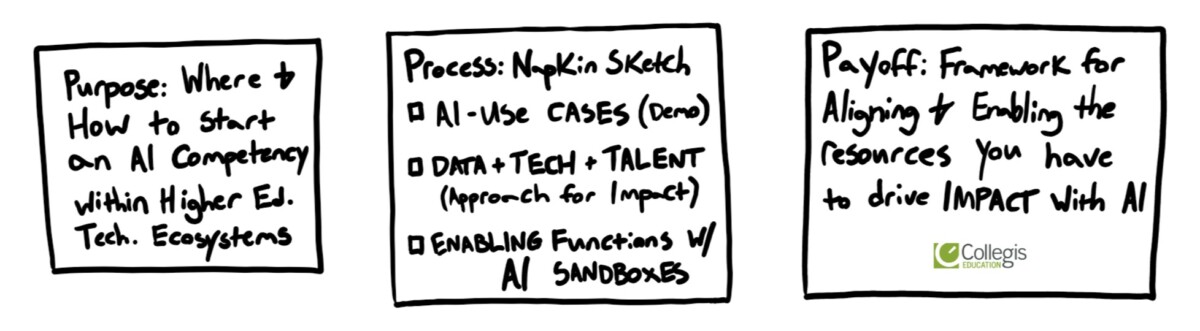
What you’ll walk away with:
- A thorough understanding of how AI fits into the broader ecosystem (add-ons vs. platform)
- A model for making decisions on when to build and when to buy
- A clear understanding of the role tech and data play in AI enablement
Who should attend:
- Presidents + Provosts
- CFOs + COOs + CMOs
- Enrollment + Marketing leaders
The coming year promises to be transformative for higher education as institutions find new ways to manage enrollment targets, operating costs, and shifting student expectations. Several existing and emerging trends have the potential to alter the higher ed landscape as we know it in 2025.
Disruption isn’t necessarily a bad thing. It often leads to innovation and more efficient ways to meet the needs of students, faculty, and administrators. The good news is we have the tools and the know-how to address these challenges head-on. Institutions focused on building foundational capabilities in the coming months are best positioned to leverage technology effectively and position themselves for continued success.
Here are the trends I predict will significantly impact higher ed this year and what we can do to take advantage of them.
Trends Shaping the Future of Higher Education in 2025
- More Urgent Digital Transformation Plans
Institutions need access to valid, reliable, and meaningful data to operate effectively. Thousands of schools still rely on proprietary, on-premise student information systems (SIS) with fragmented data sources, which limits their ability to make data-enabled decisions. Given that migrating to cloud-based solutions can take 18+ months, it’s important for schools to start the process now. Although the process is difficult given the significant change management associated with large cloud migrations, it will enable them to operate more efficiently and compete more effectively. I anticipate we’ll see SIS cloud migrations at the top of the priority lists at many institutions. - Heightened Focus on Cybersecurity
Cyber attackers have targeted higher education for years because they know they are a rich source of student and institutional data and the digital infrastructures at most schools are outdated. Hackers continue to find new ways to access networks and data, especially as the number of connected devices and applications swells. Institutions need to stay vigilant to cyber threats while also complying with various data privacy laws. I count 18 states with privacy regulations in addition to U.S. federal and European Union requirements. It’s an extremely complex situation only made more difficult by the shortage of cybersecurity professionals, especially at smaller schools. In 2025, institutions will focus on automating network security protocols and finding outside resources to augment their security capabilities. - Expanded Use of Shared Services
Smaller schools need access to the same technology and technical expertise as larger schools, just on a reduced scale with a more limited budget. I anticipate that smaller schools will seek strategic partners to manage critical IT and other specialized services to support data access, reliability, and usability. It’s a smart way to reduce costs while maintaining essential day-to-day services, enhancing security protocols, and being prepared for technology advancements. - Continuation of Mergers and Acquisitions
Financial pressures and the threat of closures will continue to drive acquisitions of some smaller schools. Mergers create significant challenges to combine the data, applications, and systems of the two institutions. However, the benefits to both sides are worth it in streamlining operations, retaining existing students, and growing enrollment. Given the breadth and depth of our functional and technical expertise, we can help schools to navigate the challenges and drive positive results. - Adoption of Data-Enabled Technologies
As institutions embrace digital transformation, they build out the foundation needed to take advantage of data-enabled technologies such as artificial intelligence (AI). With the initial hype of AI behind us, I anticipate in 2025 that schools will start to deploy AI-enabled solutions that feed off rich data sources to personalize recruitment efforts, improve retention, invigorate online classes, and predict demand for course offerings, as a few examples. - Refinement of Enrollment and Retention Strategies
The declining number of high school graduates and international enrollments continues to intensify the effort to recruit and retain students. I expect to see schools expand how they leverage data to personalize recruitment campaigns, target secondary audiences (such as adult learners and transfer students), and nurture existing students. The success of this strategy relies heavily on having the right infrastructure in place to support centralized data access, emerging technologies, and analytic tools. - Shift to Career-Focused and Flexible Learning Opportunities
Like changing recruitment and retention methods, institutions will continue to adapt their academic programs to meet the evolving needs of the workforce. They will highlight outcomes based on data about job placement rates, alumni success stories, and collaborations with area businesses to illustrate tangible benefits. They will evaluate current course offerings and pivot when it makes sense to expand hybrid learning models, professional development programs, and skill-based credentials. This effort may involve launching new programs in high-demand fields, such as data science and cybersecurity, or retooling existing programs to incorporate emerging technologies. - Consolidation of Ed-tech Solution Providers
Many higher education software and service providers have discussed how they could combine forces to serve colleges and universities better. I think we’ll see M&A activity pick up over the next two years. These consolidations will further the need for institutions to standardize business processes and accelerate cloud migrations as legacy systems will eventually become unsupported.
I’m excited about the positive impact these eight trends might make in 2025. Higher education institutions that prioritize foundational improvements by aligning their data, technology, and talent are best suited to successfully address mounting challenges like demographic shifts and affordability concerns.
I can’t wait to see how schools that adopt AI and predictive analytics are able to improve decision-making and enhance student experiences. However, the real breakthrough will come from integrating systems and breaking down data silos. Institutions that invest in building these foundational capabilities will be better positioned to leverage emerging technologies, drive measurable outcomes, and fulfill their mission to support lifelong learners.
— Kim Fahey, CEO Collegis Education
Innovation Starts Here
Higher ed is evolving — don’t get left behind. Explore how Collegis can help your institution thrive.
Higher education is evolving, and institutions need innovative strategies to keep up with shifting learner expectations. That’s why Collegis Education is excited to attend the 2025 UPCEA Annual Conference, the premier event for leaders in professional, continuing, and online education. This conference brings together experts and decision-makers to explore the latest trends, technologies, and strategies that are transforming higher ed.
Event Details
- Dates: March 24-26, 2025
- Location: Denver, CO
- Venue: Sheraton Denver Downtown Hotel
- Learn More: UPCEA Annual Conference Website
Why Attend the 2025 UPCEA Annual Conference?
This conference is a must-attend event for higher ed leaders looking to stay ahead of the curve in online learning, workforce development, and digital transformation. Key themes include:
- Data-Driven Decision-Making – Leveraging analytics to improve student outcomes and enrollment strategies.
- Technology & Digital Transformation – Implementing scalable solutions to enhance the student experience.
- Workforce-Aligned Learning – Creating programs that meet the evolving needs of students and employers.
- Marketing & Enrollment Growth – Adapting strategies to attract, engage, and retain today’s learners.
Collegis Education brings the expertise and proven strategies to help institutions overcome enrollment challenges, optimize operations, and drive sustainable growth.
Where to Find Us
Our team will be on-site, ready to connect and discuss how Collegis can help your institution navigate the complexities of online education, marketing, and student success.
Want to meet up? Let’s schedule a time to chat! Contact us to book a meeting.
We look forward to seeing you in Denver!