Higher Ed’s Next Move: The Top Five Lessons Coming Out of DisruptED26 Denver
What can leaders do now to protect revenue, control costs while expanding capacity, and modernize with purpose?
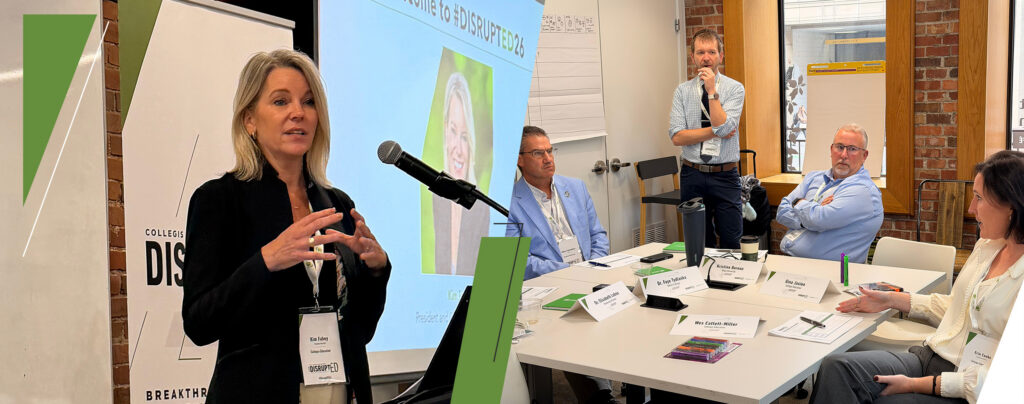
This question was at the center of the conversation at Collegis Education’s biannual higher education leadership summit. This latest installment of DisruptED26 brought institutional leaders and industry experts together in Denver for candid conversations about the challenges facing higher education and what it takes to move forward.
Presentations from Phil Hill, Nathan Grawe, Paul Friga, and Collegis President and CEO Kim Fahey explored these issues from different angles. Together, they made a compelling case for connecting revenue strategy, resource decisions, and modernization rather than treating them as separate priorities.
What stood out to me was the emphasis on making choices. Where should an institution invest? What should it stop doing? And how can it create the capacity to follow through?
Here are five lessons from Denver that can help leaders answer those questions.
1. Protect the revenue already within reach
When we talk about growth, it’s natural to start with new students, new programs, or new markets. Those opportunities matter. But they shouldn’t overshadow potential students who have already expressed interest or are already enrolled.
Nathan Grawe brought that opportunity into focus, emphasizing that investing in retention over recruitment can deliver a stronger ROI. He recommended prioritizing student belonging, academic support, and financial aid, reinforcing that helping students succeed and complete their degrees is essential to institutional growth.
Kim Fahey extended that thinking across the student lifecycle. Before spending more to generate demand, understand where interested students stall. Before treating retention as a separate departmental responsibility, recognize its connection to student success and institutional revenue. And before pursuing new markets or degree programs, use data to determine where investments will deliver the greatest return.
Personally, the takeaway is straightforward: A strong growth strategy looks beyond new student recruitment to address the gaps in enrollment, retention, and student success that limit institutional growth.
That means asking some important questions at every stage of the student journey:
- Are admitted students getting the guidance they need to start?
- Is follow-up timely and relevant?
- Can teams recognize when an enrolled student needs help and coordinate a response?
At Collegis, we approach revenue protection as more than a marketing challenge. It requires a connected view of demand, conversion, persistence, and program relevance. Generating interest is important, but a stronger strategy also helps students act on that interest and reach their goals.
2. Put program performance on the cabinet agenda
Phil Hill’s presentation focused on the regulatory environment and how institutions can successfully navigate key changes, particularly the new programmatic “earnings premium” rules. He recommended assessing the potential impact across all academic programs and making these findings a priority for institutional leadership and board discussions.
Paul Friga urged cabinets to understand four key measures: net tuition revenue per enrolled student, changes in discount rates, term-to-term retention by cohort, and fully loaded cost per completion by program.
This approach moves beyond traditional headcount measures to ask more meaningful questions:
- Are we enrolling more students but generating less net tuition per student?
- Are particular cohorts facing barriers that institution-wide averages conceal?
- Do we understand what it costs to help students complete a program?
Friga’s framework considers demand and mission fit alongside financial performance, giving institutional leaders a clearer picture of the trade-offs behind strategic decisions.
A useful next step is ensuring academic, enrollment, and finance leaders are working from the same definitions and data. Before deciding where to invest, the cabinet needs a shared understanding of current performance.
That’s where data alignment becomes more than a technical project. It becomes the foundation for protecting revenue and making informed decisions about the institution’s future.
3. Cost control should create room to grow
One of Friga’s strongest messages was that revenue initiatives, cost optimization, and execution discipline must work together. Cost optimization creates capacity. Revenue initiatives fuel growth. Execution sustains both. His point about sequencing was clear: free up the resources needed for growth initiatives before launching them.
That reframes the cost conversation.
Instead of asking only, “Where can we cut?” leaders should also ask, “Where are money, time, and expertise tied up in work that could be done differently?”
Friga highlighted opportunities such as demand-driven scheduling, shared services, process automation, and eliminating duplicative functions. He also emphasized the importance of showing where savings will be reinvested, connecting cost decisions to the institution’s long-term vision.
Fahey applied that thinking to the IT operating model, emphasizing the importance of accessing the right expertise at the right time. By combining on-campus and shared resources, institutions can direct more of their investment toward strategy, modernization, and growth.
At Collegis, this is where we connect cost management with expanded capacity. The goal isn’t simply to reduce budget or add more work to already-stretched teams. It’s about creating a more effective operating model that reduces duplication, better uses specialized talent, and frees up time for higher-value work.
4. Modernization needs an outcome — not just a technology
Fahey offered a practical starting point for modernization: identify a strategic outcome, then map the people, processes, technology, and data required to achieve it. It sounds simple, but it shifts the focus from “What should we buy?” to “What do we need to make possible?”
That distinction is especially relevant when it comes to AI. Fahey emphasized the importance of trusted data, integration, governance, adoption, and measurable institutional impact. She also reinforced that AI alone won’t fix a fragmented operating model.
Consider an institution that wants to identify students who need support earlier. The work doesn’t end when a tool flags a concern. That raises a few important questions about what happens next:
- Which information should inform that signal?
- Who is responsible for responding?
- How will the appropriate team know what’s already been done?
- How will the institution determine whether the intervention helped?
These are operational considerations, not just technology questions.
The takeaway is you don’t need to wait for every system to work perfectly before pursuing innovation. Rather, focus on identifying a clear outcome and building the foundation needed to achieve it responsibly.
For Collegis, we champion this approach to institutional modernization by aligning data, technology, and people. Connect the information, clarify responsibilities, equip the right teams, and measure the results. Ultimately, a new capability delivers value when it helps the institution do something better.
5. Make room to finish what matters
Perhaps the most useful question from Friga’s presentation was also one of the simplest: What will the institution stop doing?
His framework called for limiting priorities, pausing lower-impact work, assigning an executive owner to each initiative, and establishing clear decision rights and success measures. Together, these steps create an operating rhythm that turns strategy into action.
It’s a useful question for any leadership team. Before adding another initiative, consider whether the people responsible for delivering it have the time, authority, and resources to succeed.
Friga also offered a practical way to build momentum: choose one visible improvement you can complete in 90 days, see it through, and establish a regular cabinet review focused on execution. That early win gives the institution something concrete to build on.
The right starting point will vary by institution, but every initiative needs a clear purpose, a designated owner, and a realistic path to completion.
Fahey emphasized that institutional ownership doesn’t require building every capability internally. A strategic partner can provide expertise, capacity, and execution support while the institution retains control over its mission, priorities, decisions, and outcomes.
The goal is to create the capacity and focus needed to deliver the work that matters most.
The next move should connect the dots
My biggest takeaway from Denver is that revenue, cost optimization, capacity, and modernization belong in the same conversation.
An initiative to improve persistence should account for the staff time, data, and workflows needed to support it. A cost decision should consider how it affects capacity. And a technology investment should connect to a clear institutional outcome.
That connected approach is at the heart of our work at Collegis. We help institutions protect and strengthen revenue, control costs while expanding capacity, and accelerate modernization by aligning data, technology, and talent.
But meaningful progress starts with understanding where your institution stands today. Where is revenue being lost or put at risk? Where are inefficient processes limiting capacity? And where is technology falling short of institutional priorities?
Our three institutional diagnostics — Revenue, Operations & Student Experience, and IT — are designed to answer those questions. Each provides a clearer picture of current challenges, identifies opportunities for the greatest impact, and helps leadership teams prioritize a practical path forward.
The right next move will look different for every institution. If your leadership team is ready to turn these insights into action, let’s talk about your priorities and how Collegis can help you determine where to focus next.
Innovation Starts Here
Higher ed is evolving — don’t get left behind. Explore how Collegis can help your institution thrive.