Student expectations have changed. Has your engagement strategy?
Today’s students expect personalized, connected experiences throughout their journey, from their first interaction with your institution through graduation. Yet many colleges and universities still struggle with disconnected systems, siloed communication, and fragmented engagement efforts.
This eBook explores how institutions can create more connected, responsive, and human-centered experiences that strengthen enrollment, improve retention, and support student success.
What You’ll Learn:
- Why traditional engagement models no longer meet student expectations
- How to create a connected engagement ecosystem across the student lifecycle
- Strategies for personalizing engagement at scale through data and AI
- Why human connection remains essential to student success
- How connected technology and data improve engagement outcomes
- Practical steps for building a future-ready engagement strategy
Who Should Read This eBook:
This resource is designed for higher education leaders focused on enrollment, retention, student success, and institutional strategy, including:
- Enrollment and admissions leaders
- Student success and retention professionals
- Marketing and communications teams
- Academic and advising leaders
- CIOs and technology leaders
- Presidents, provosts, and executive leadership teams
Download the eBook
Student engagement is no longer a series of isolated interactions. It’s a connected, institution-wide strategy that shapes enrollment, retention, and long-term student success.
Download the eBook to learn how your institution can create more meaningful student experiences through a connected, data-informed approach to engagement.
Submit the form on the top right to get your free copy.
Most higher education institutions aren’t struggling to generate interest. They’re struggling to turn that interest into enrollment, revealing a growing challenge within higher education lead generation today.
For many institutions, inquiry numbers look strong on paper, but downstream conversions are telling a different story. As a result, marketing teams are under pressure to deliver more leads. Enrollment teams are tasked with converting them faster. And institutional leaders are left asking the same question: Why isn’t this working the way it used to?
The answer is simple — and uncomfortable. Visibility alone doesn’t drive enrollment growth. Viability does.
To compete in today’s enrollment environment, institutions must move beyond lead volume and focus on attracting, engaging, and converting the right inquiries. This is an essential shift in student lead optimization.
The disconnect between inquiry growth and enrollment results
For years, success in higher ed marketing was measured by reach and response. More impressions. More clicks. More inquiries. But rising acquisition costs and shifting student expectations have exposed the limits of that approach.
Institutions now face a familiar set of challenges:
- Inquiry growth that doesn’t translate to applications or enrollment
- Increased spend on channels with diminishing returns
- Limited visibility into which prospects are truly enrollment-ready
- Enrollment teams overwhelmed by volume but underpowered by insight
The result? Teams work harder, pipelines look fuller, and outcomes stay flat. This isn’t a performance problem. It’s a strategy problem, one that requires more intentional enrollment pipeline growth strategies across marketing and enrollment teams.
Redefining what inquiry success really means
Inquiry success can no longer be defined by volume alone, especially in modern higher education lead generation efforts. Viable inquiries are students who demonstrate clear program interest, academic fit, and intent to move forward.
That shift changes everything.
Instead of asking, “How do we get more leads?”, institutions must ask:
- Who is most likely to enroll and why?
- Which channels attract students with long-term potential?
- Where are we losing qualified prospects in the funnel?
Answering those questions requires more than tactics. It requires alignment across research, marketing, and enrollment.
How market research strengthens inquiry quality
Institutions can’t improve inquiry quality without understanding the market they’re recruiting from. Higher ed market research provides that clarity.
Done well, it reveals:
- True demand for programs and modalities
- How prospective students perceive value, outcomes, and cost
- Where competitors are winning — or overreaching
- What motivates students to inquire, apply, and enroll
This insight informs smarter decisions before dollars are spent. Messaging becomes more precise and channel strategy becomes more intentional. This ensures program positioning aligns with real student needs, not assumptions.
Market research turns recruitment from reactive to strategic. And it ensures institutions invest in visibility that attracts viable demand.
Ready for a Smarter Way Forward?
Higher ed is hard — but you don’t have to figure it out alone. We can help you transform challenges into opportunities.
Marketing strategies that prioritize fit and intent
Marketing still plays a critical role in enrollment growth, but its role has evolved.
Effective higher ed marketing doesn’t just attract attention. It plays a critical role in student lead optimization by qualifying interest before a student ever submits an inquiry.
That shift demands a more disciplined approach that requires:
- Data-informed audience segmentation
- Messaging that balances inspiration with transparency
- Channel strategies that integrate paid and organic performance
- Measurement tied to downstream enrollment outcomes, not surface-level metrics
When marketing is aligned to enrollment viability, institutions see fewer unqualified inquiries and stronger funnel progression. Brand visibility becomes a lever for enrollment efficiency — not just awareness.
The role of enrollment execution in inquiry conversion
Even the most qualified inquiry can be lost without the right follow-up experience.
Once a student raises their hand, expectations are high. Delays, generic outreach, or disconnected communication quickly erode momentum. And when enrollment teams lack insight into inquiry intent, prioritization becomes guesswork.
High-performing higher ed enrollment operations focus on:
- Personalized, multichannel engagement aligned to student preferences
- Clear prioritization of high-intent inquiries
- Seamless coordination between marketing and admissions
- Visibility into funnel behavior and progression
Inquiry quality doesn’t end at the form fill. It’s reinforced — or undermined — by every interaction that follows.
The power of alignment across the enrollment lifecycle
The most successful institutions don’t treat inquiry quality as a single-team responsibility. They treat it as a system.
Market research informs marketing strategy. Marketing insights guide enrollment engagement. Enrollment outcomes feed continuous optimization across the funnel.
When teams operate in silos, inquiry viability suffers. When they align around shared data, goals, and outcomes, institutions gain clarity and control over enrollment performance.
This integrated approach enables institutions to:
- Reduce wasted spend
- Improve conversion efficiency
- Strengthen collaboration across teams
- Build a sustainable enrollment pipeline
Alignment isn’t just operationally efficient. It’s strategically essential.
Building an inquiry strategy that scales — and converts
Enrollment growth doesn’t come from chasing volume. It comes from intentional visibility, informed by insight, and reinforced through experience. While many institutions are already working toward this alignment, sustaining it can be challenging without the right infrastructure, integrated data, and capacity to support ongoing optimization.
At Collegis Education, we partner with institutions to help connect strategy, data, and execution across the entire enrollment lifecycle. Through our Connected Core® platform, we bring marketing, enrollment, and institutional data together into a shared, actionable view — enabling clearer insight, smarter prioritization, and more consistent conversion. The result is greater efficiency and momentum, without adding unnecessary complexity for internal teams.
If this approach aligns with your enrollment goals, our team is ready to connect and explore what’s possible.
Innovation Starts Here
Higher ed is evolving — don’t get left behind. Explore how Collegis can help your institution thrive.
Fraud in higher education is evolving quickly and institutions are feeling the impact.
What was once considered a rare occurrence has become a growing operational challenge across higher education enrollment teams. Since 2019, the federal government has uncovered more than $350 million in student aid fraud tied to “ghost student” schemes, according to the U.S. Department of Education Office of Inspector General.
At Collegis, conversations about fraudulent applicants are no longer occasional. They’re happening weekly with our partner institutions as they work to manage increasing volumes of suspicious applications entering the enrollment funnel.
While enrollment teams often feel the impact first, fraudulent applications also create financial, operational, and strategic challenges across the institution.
What are ‘ghost applicants’?
Fraudulent applicants, also called ghost applicants, generally fall into two categories:
- Applicants using completely fake identities
- Applicants using stolen personal information to impersonate real individuals.
In both cases, the goal is the same: Gain access to federal financial aid funds through FAFSA eligibility before disappearing from the enrollment process.
Some fraudulent applicants are relatively easy to identify. Their information may contain obvious inconsistencies, such as mismatched email addresses and applicant names, invalid phone numbers, or limited responsiveness beyond email communication.
Others are much more sophisticated.
In cases involving true identity fraud, applications can appear legitimate at first glance. Contact information may work properly, documents may seem authentic, and applicants may even participate in full enrollment conversations while posing as prospective students. These applicants often move rapidly through the enrollment process, progressing from application start to submission in an unusually short period of time.
As fraud tactics evolve, institutions are finding that many of the traditional red flags alone are no longer enough.
Why this issue is accelerating
The rise in fraudulent applications is closely tied to broader shifts in higher education enrollment.
Programs that are fully online, high volume, and designed with streamlined admissions processes are often the most vulnerable. While those characteristics are essential for improving access and scalability, they can also create opportunities for misuse.
Fraudulent actors understand where low-friction processes exist and how to move through them quickly with limited interaction.
The continued expansion of online learning, combined with increasing sophistication in fraud tactics, has only accelerated the issue. Institutions that rely heavily on manual review processes or reactive fraud prevention measures are finding it increasingly difficult to keep pace.
And where there is one fraudulent application, there are often many more behind it.
The institutional impact goes beyond financial loss
The financial implications of fraudulent applicants are significant, but the operational and strategic consequences can be even more damaging.
Enrollment teams are already working under tight resource constraints. When staff members spend time reviewing suspicious records, validating questionable documentation, or conducting outreach to fraudulent applicants, they are pulled away from engaging legitimate prospective students.
That operational strain compounds quickly.
Fraudulent applications can overwhelm staff capacity, slow response times, and create unnecessary friction across the enrollment process. In some cases, institutions may even adjust staffing models, recruitment strategies, or marketing investments based on inflated application numbers that do not reflect actual enrollment opportunity.
The impact on institutional data is equally concerning.
Enrollment and admissions leaders rely on application and pipeline data to forecast performance, allocate budgets, and make strategic decisions. When ghost applicants artificially inflate application volume or enrollment projections, institutions risk operating from an inaccurate understanding of pipeline health.
In today’s increasingly competitive enrollment environment, institutions often have less time and margin for error to recognize and respond to those shifts before enrollment goals are impacted.
Ready for a Smarter Way Forward?
Higher ed is hard — but you don’t have to figure it out alone. We can help you transform challenges into opportunities.
Why fraud is becoming harder to detect
One of the biggest challenges institutions face today is that fraudulent behavior is becoming more sophisticated and more difficult to identify.
Many of the traditional warning signs institutions once relied on are becoming less reliable. Fraudulent applicants are increasingly mimicking legitimate student behavior and progressing further into the enrollment funnel without obvious indicators of concern.
Still, there are several patterns institutions should watch closely, including:
- Mismatched applicant names and email addresses
- Duplicate phone numbers used across multiple applications
- Invalid or disconnected phone numbers
- Inconsistent transcripts, resumes, or supporting materials
- IP address locations that do not align with stated geographic information
- Near-instant progression from application start to completion
The challenge is that identifying these signals manually does not scale effectively, especially when institutions are managing high application volumes.
Moving from reactive to proactive
Fraudulent applications are no longer a one-off issue that can be handled through occasional manual review. Institutions need systematic, scalable approaches to fraud detection that balance security with the student experience.
One of the most effective strategies is implementing earlier identity validation within the enrollment process. Emerging tools and technologies, including solutions like Stripe Identity, now allow institutions to introduce scalable verification checkpoints before significant staff time and institutional resources have already been invested.
Equally important is adopting a risk-based approach to review.
Rather than manually investigating every application, institutions can use known fraud indicators and behavioral patterns to identify higher-risk records that require additional scrutiny. This allows enrollment teams to focus attention where it is most needed while maintaining momentum for legitimate students.
At Collegis, we’re actively developing a fraud risk scoring methodology designed to help institutions identify potentially fraudulent applications based on known application and behavioral patterns. The goal is not to create unnecessary barriers for students, but to help institutions scale fraud detection efforts in a way that is operationally sustainable and minimally disruptive to the enrollment experience.
Protecting access, integrity, and outcomes
Institutions are working hard to expand access to education and create seamless enrollment experiences for prospective students. Fraudulent applicants undermine that mission by diverting resources, distorting institutional data, and creating operational risk.
As fraudulent activity continues to evolve, institutions need scalable, proactive approaches to identity verification and fraud detection. At Collegis, we’re committed to helping partners stay ahead of this challenge through data-informed strategies and smarter enrollment solutions that protect both institutional integrity and student experience.
If your institution is navigating challenges related to fraudulent applicants or enrollment integrity, reach out to the Collegis team to learn how we can help.
Innovation Starts Here
Higher ed is evolving — don’t get left behind. Explore how Collegis can help your institution thrive.
Higher education leaders are navigating a more complex landscape than ever before. Enrollment pressure is rising. Student expectations are shifting. And teams are being asked to do more with fewer resources, while continuing to deliver meaningful outcomes.
At the center of these challenges is the student journey. Too often, it’s treated as a series of disconnected moments: marketing hands off to enrollment, enrollment hands off to student support, and retention becomes a downstream concern. But when you approach the journey as a connected, data-informed lifecycle, you create momentum that improves both enrollment and persistence.
Reimagining the student journey isn’t about adding more tactics. Aligning strategy, technology, and teams moves you from fragmented efforts to intentional execution and leads to student journey optimization across the entire lifecycle.
How student expectations are reshaping the enrollment journey
Today’s learners don’t follow a straight path from inquiry to enrollment. They research across channels, pause and restart their journey, and expect you to recognize them at every step. When systems and teams aren’t aligned, friction becomes unavoidable, and even strong enrollment conversion strategies lose effectiveness.
These misalignments often show up as:
- Marketing and enrollment teams working from different data sets
- Manual handoffs that slow follow-up and limit personalization
- Limited visibility into where students disengage or stop out
These breakdowns don’t just impact enrollment metrics. They affect student confidence, momentum, and long-term success. Addressing them starts with a full-funnel view of the student lifecycle.
4 Tactics to improve enrollment and persistence outcomes
Reimagining the student journey requires more than isolated improvements. These four tactics focus on aligning data, strategy, and execution across the student lifecycle to reduce friction, strengthen engagement, and drive measurable enrollment and persistence outcomes. Together, they form a practical framework for student journey optimization.
1. Use data to see and support the entire funnel
If your data lives in silos, it’s difficult to understand what’s really happening across the student journey. When CRM, SIS, LMS, and marketing platforms operate independently, your ability to act proactively is limited.
A data-enabled approach gives you clarity.
To support the full lifecycle, you need to:
- Unify data from across the student journey into a single, trusted environment
- Use predictive analytics to identify enrollment and persistence risk earlier
- Equip teams with real-time dashboards that support informed decisions
When your data is integrated and accessible, you move beyond reactive reporting. You gain insight into what’s driving conversion, where students struggle, and how to intervene before challenges escalate. That visibility allows you to invest resources more strategically across both enrollment and retention, strengthening your enrollment conversion strategies while reducing stop-out risk.
2. Design marketing for the entire student lifecycle
Higher education marketing doesn’t stop at inquiry, and neither should your strategy. The messages you deliver before enrollment shape expectations that carry into the student experience.
To support enrollment and persistence outcomes, your marketing efforts should:
- Align messaging across prospect, applicant, and enrolled student stages
- Personalize outreach based on behavior, intent, and academic goals
- Balance brand-building with conversion and yield-focused campaigns
When your marketing reflects the full student journey, you attract better-fit students and reinforce trust at every interaction. That consistency supports stronger conversion rates and helps students arrive more informed and engaged.
All of this sets a stronger foundation for persistence. These lifecycle-based enrollment conversion strategies also play a critical role in persistence by setting clearer expectations from the start.
3. Modernize enrollment operations to reduce friction
Every unnecessary step in your enrollment process increases risk. Complex applications, delayed follow-up, and inconsistent communication all contribute to melt, and it strains your teams in the process.
Modern enrollment operations prioritize clarity, speed, and relevance.
That often means:
- Streamlining inquiry-to-application workflows
- Delivering personalized, multichannel communication at scale
- Using enrollment data to prioritize outreach and staffing decisions
When enrollment operations are designed to reduce friction, you improve conversion while freeing your staff to focus on high-impact engagement. Counselors spend less time managing manual tasks and more time guiding students forward with confidence.
4. Shift retention from reactive to proactive
Retention efforts often begin when a student is already struggling. By then, engagement has dropped and options are limited. Improving persistence outcomes requires earlier, more intentional support.
A proactive retention strategy allows you to:
- Identify risk through academic, engagement, and behavioral data
- Deliver scalable coaching and advising before issues compound
- Create coordinated onboarding and first-term experiences that build belonging
When retention is embedded into the student journey (not treated as a separate initiative), you create continuity. Students feel supported earlier, challenges are addressed sooner, and persistence becomes a shared responsibility across teams. These proactive approaches form the foundation of effective student persistence solutions.
The power of connecting strategy, services, and teams
Improving enrollment and persistence outcomes doesn’t come from optimizing one area in isolation. Your greatest gains happen when marketing, enrollment, retention, and analytics operate as a connected system.
This alignment allows you to:
- Share goals and metrics across teams
- Act on insights instead of assumptions
- Scale personalized support without overextending staff
It also reflects a broader shift in higher education, moving away from fragmented solutions and toward a lifecycle-based strategy. True student journey optimization depends on this level of coordination. You don’t need more tools. You need stronger alignment across data, technology, and talent.
Designing the student journey for long-term impact
Institutions that strengthen enrollment and persistence outcomes don’t chase trends. They make intentional decisions about how the student journey is designed, supported, and measured.
That work starts by breaking down silos and committing to data-informed decision-making across the lifecycle. It also requires a foundation that brings systems, insights, and teams together. Collegis built our Connected Core® platform to support this kind of alignment, unifying institutional data into a single, actionable environment that helps you see the full student journey and act with confidence.
Reimagining the student journey isn’t a one-time initiative. It’s an ongoing commitment to meet students where they are, guide them forward with clarity and care, and ensure every touchpoint reflects a cohesive experience.
When you take that approach, enrollment improves, persistence strengthens, and the student experience becomes a true differentiator.
Innovation Starts Here
Higher ed is evolving — don’t get left behind. Explore how Collegis can help your institution thrive.
Enrollment growth doesn’t happen by chance. It’s the result of intentional strategy, aligned execution, and the ability to turn insight into action.
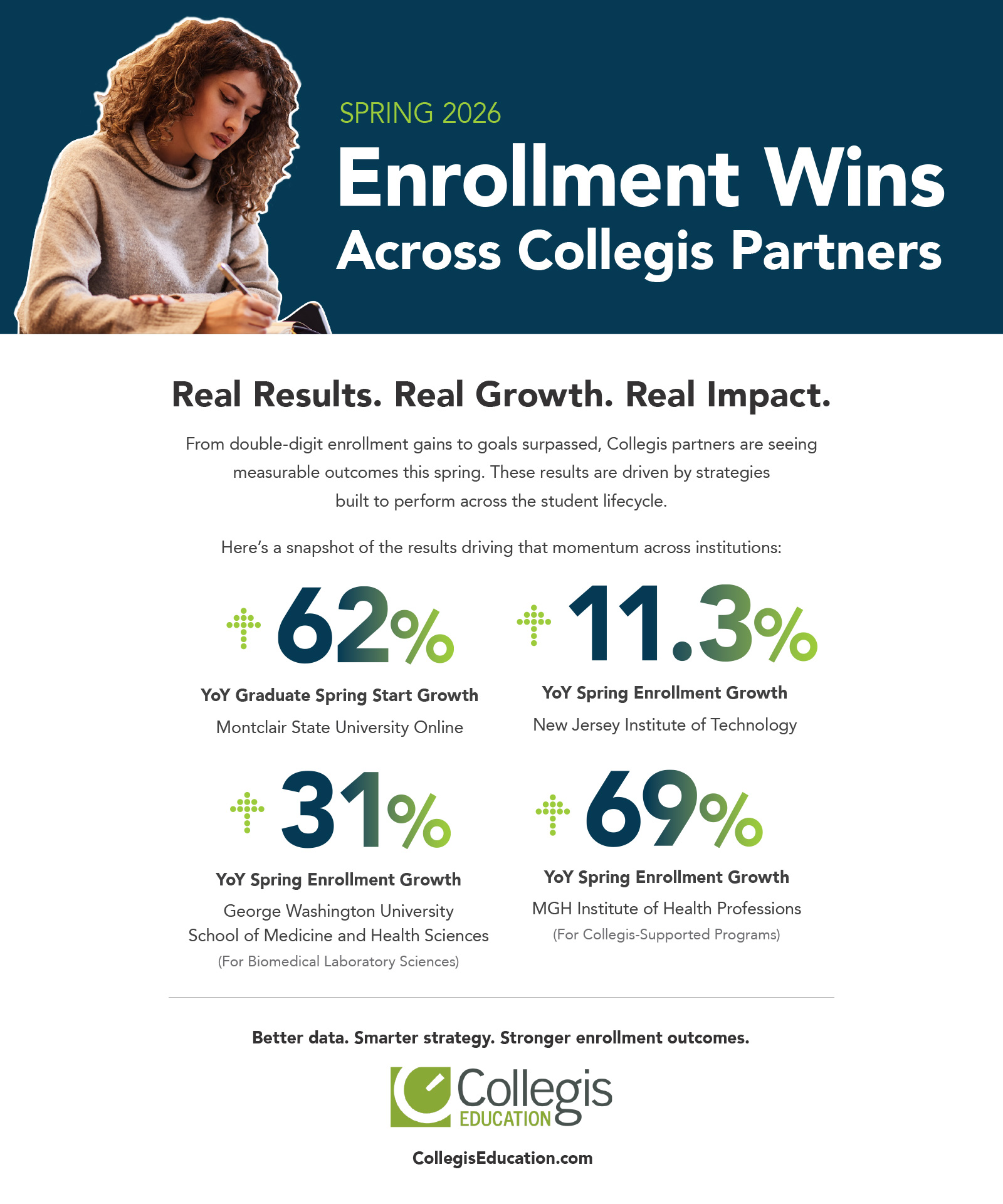
This spring, Collegis Education partners delivered standout enrollment performance across institutions. Our partners are exceeding goals, accelerating year-over-year growth, and strengthening their position in an increasingly competitive landscape. These outcomes reflect what’s possible when data, technology, and talent work together across the student lifecycle.
Translating strategy into results
Below, we highlight a snapshot of recent Spring 2026 enrollment wins and the measurable impact our partners are achieving.
A smarter approach to sustainable enrollment growth
These results reflect more than short-term gains. They demonstrate what institutions can achieve with the right strategy, the right support, and a partner invested in outcomes.
At Collegis, we work alongside colleges and universities to build sustainable enrollment strategies that drive performance today and position institutions for long-term success. From inquiry to enrollment and beyond, our approach is designed to deliver measurable impact at every stage of the student journey.
Ready to accelerate enrollment at your institution? Let’s start the conversation.
Innovation Starts Here
Higher ed is evolving — don’t get left behind. Explore how Collegis can help your institution thrive.
Fueling Graduate Enrollment with High-Intent Content
How The University of Scranton leveraged SEO-optimized content to attract prospective students, earn AI overview visibility, and convert engagement into measurable actions.
As The University of Scranton launched a new graduate microsite following its transition away from an online program management (OPM) partnership, establishing organic traction was critical. Collegis partnered with Scranton to build its graduate admissions blog, creating a high-intent, SEO-driven content strategy designed to accelerate visibility, attract qualified prospective students, and support graduate inquiries.
Rebuilding Organic Visibility After an OPM Transition
As Scranton exited its OPM partnership and launched a new graduate microsite, it faced a critical moment. The institution needed to quickly establish organic authority and visibility for its graduate programs, without the infrastructure previously supporting digital recruitment.
That meant:
- No existing blog or organic content engine tied to the new microsite
- Limited organic traction for graduate-focused search terms
- No structured strategy to capture high-intent prospective student searches
- A need to rebuild search visibility and inquiry pathways from the ground up
With a new digital presence in place, Scranton needed more than pages — it needed momentum. Establishing organic credibility quickly was essential to supporting graduate inquiry growth and long-term enrollment stability.
A Strategic, SEO-Driven Content Engine to Accelerate Visibility
To support the launch of Scranton’s new graduate microsite, Collegis partnered closely with Scranton to develop and execute a focused content strategy designed to rapidly build organic authority, capture high-intent search demand, and drive inquiry momentum.
The approach included:
- Building the graduate blog to anchor the new microsite
- Targeting high-intent, SEO-driven keywords
- Developing program-aligned, enrollment-focused content
- Structuring content to drive discovery and inquiry
This wasn’t content for content’s sake. It was a strategic effort to establish organic traction, rebuild search visibility, and position Scranton’s new graduate microsite as an authoritative destination for prospective students.
The Collegis Impact
Within the first six months of launch, the blog delivered:
- 7,300+ new users driven by organic content
- 568 conversions driven by the blog
- 800+ keywords ranked on page one
- 86 appearances in Google AI overviews
From zero presence to hundreds of page-one rankings, the blog quickly became a powerful visibility and inquiry driver for graduate admissions.
The Takeaway: Organic Content Isn’t a Tactic — It’s a Growth Strategy
When institutions invest in strategic, SEO-aligned content built around prospective student intent, organic traffic becomes predictable. And predictable traffic drives measurable inquiry growth. A well-built blog isn’t a marketing add-on. It’s enrollment infrastructure.
Ready to Build Your Content Engine?
If your graduate programs aren’t visible in search, you’re missing qualified prospects every day. Collegis partners with institutions to design data-enabled marketing strategies that turn organic search into sustainable enrollment growth. Let’s build a content engine that drives results.
Let’s Start Writing Your Success Story
See what’s possible when strategy, creativity, and execution come together. Partner with Collegis to turn your challenges into outcomes worth sharing.
Transform Challenges Into Opportunities
Facing challenges in enrollment, retention, or tech integration? Seeking growth in new markets? Our strategic insights pave a clear path for overcoming obstacles and driving success in higher education.
Unlock the transformative potential within your institution – partner with us to turn today’s roadblocks into tomorrow’s achievements. Let’s chat.
Driving More Engagement with Smarter Navigation
How Collegis helped the College of Western Idaho boost CTA clicks through conversion-focused website optimization and A/B testing.
The College of Western Idaho (CWI) partnered with Collegis to enhance website navigation and increase engagement with key calls to action. Key navigation and calls to action were only accessible at the top of the page, requiring users to scroll back up to take action.
To reduce friction and improve the user experience, Collegis recommended testing a persistent “sticky” navigation system that keeps essential navigation and conversion elements visible as users scroll. The goal was to create a more intuitive browsing experience while increasing interaction with high-value calls to action.
Improving Navigation Without Disrupting User Experience
CWI’s existing website required users to scroll back to the top of the page to access navigation and key calls to action (CTAs), creating unnecessary friction for prospective students exploring programs.
Key considerations included:
- Improving access to navigation and CTAs without disrupting the browsing experience
- Demonstrating the value of sticky navigation to stakeholders before development
- Ensuring the new functionality worked seamlessly across desktop and mobile experiences
- Managing technical constraints while running an A/B test within the existing site environment
Balancing usability improvements with technical feasibility required careful design, development, and testing.
Testing Persistent Navigation to Improve Engagement
Collegis implemented an A/B test to evaluate the impact of persistent navigation and conversion elements across CWI’s website.
Key components included:
- Sticky header navigation designed to keep key menu items accessible as users scroll
- Sticky mobile footer providing persistent access to high-value CTAs on smaller screens
- A/B testing through VWO to compare the existing site experience against the sticky navigation variant
- Collaborative design and development to prototype, test, and implement the solution within the client’s technical environment
This approach allowed the team to validate the impact of sticky navigation before full deployment.
The Collegis Impact
The A/B test ran for 29 days and achieved a 99.98% confidence level, confirming the effectiveness of the sticky navigation experience.
Key results included:
- 31% increase in clicks on primary CTAs, significantly exceeding the 10% target
- 2,250% increase in mobile ‘taps’ on the “Call CWI” CTA after replacing “Give to CWI”
- 18% increase in application starts from program page
- Sticky navigation improved wayfinding while increasing engagement with key conversion actions
Based on these results, CWI moved forward with full implementation of the sticky global header and mobile footer across the production site.
The Takeaway: Strategic Web Optimization Drives Measurable Engagement
Small improvements to website navigation can have a significant impact on how prospective students engage with institutional websites. By testing persistent navigation and optimizing access to key calls to action, Collegis helped the College of Western Idaho create a more intuitive user experience that drives measurable engagement and conversion improvements.
Optimize Your Website Experience to Drive More Student Action
The College of Western Idaho case demonstrates how data-driven testing uncovers opportunities to improve website performance and deliver more personalized digital experiences. From UX optimization and conversion strategy to development and experimentation, Collegis partners with institutions to turn website insights into measurable enrollment outcomes.
Let’s Start Writing Your Success Story
See what’s possible when strategy, creativity, and execution come together. Partner with Collegis to turn your challenges into outcomes worth sharing.
Transform Challenges Into Opportunities
Facing challenges in enrollment, retention, or tech integration? Seeking growth in new markets? Our strategic insights pave a clear path for overcoming obstacles and driving success in higher education.
Unlock the transformative potential within your institution – partner with us to turn today’s roadblocks into tomorrow’s achievements. Let’s chat.
Here’s how the student digital twin framework helps institutions personalize at scale and operate with precision.
Higher education is navigating a perfect storm.
The demographic cliff is shrinking the traditional undergraduate market. Inflation is intensifying scrutiny around the ROI of a degree. Competition is fierce, and prospective students expect the same seamless, personalized experiences they receive from companies like Amazon and Netflix. As one recent Forbes piece described it, higher education is entering its own “Netflix moment” — a shift that demands more intuitive, data-driven, and personalized digital experiences. Institutions that fail to adapt risk falling behind.
This pressure has prompted institutions to invest heavily in data and technology, but higher ed doesn’t have a data problem. It has a data activation problem.
Collecting data is no longer the challenge. Using it intelligently, in real time, and at the individual level, is what separates institutions that grow from those that stall.
That’s where the concept of a “student digital twin” changes the equation.
A smarter way to humanize institutional data
The student digital twin isn’t a product or a single platform. It’s a strategic approach to using institutional data with intention.
At its core, it’s a dynamic, evolving view of each student or prospect. This is built from behavioral, academic, engagement, and operational signals, and it’s designed to drive action.
Simply put, it humanizes your data, enabling you to activate insight at the individual level and deliver best-in-class experiences for current and prospective students.
Instead of relying on static funnels or backward-looking reports, you gain a living model that answers the questions that matter most:
- Who is most likely to apply?
- Who is disengaging?
- Who is at risk before classes even begin?
- Where are we missing opportunities in the funnel?
More importantly, this framework doesn’t stop at insight. It enables action.
Here are some practical ways institutions can apply the student digital twin concept across the student lifecycle.
Enrollment marketing strategies powered by real-time student data
Enrollment leaders face mounting pressure to do more with less. Teams are stretched, inquiries fluctuate, and not every lead carries equal intent.
The student digital twin approach helps institutions prioritize with precision.
1. Lead scoring that drives real action
Rather than treating every inquiry the same, institutions can score incoming leads based on behavioral signals, academic interest, engagement patterns, and likelihood to apply.
This can result in:
- Counselors prioritizing outreach to high-probability applicants.
- Marketing budgets shifting toward channels producing qualified interest.
- Human capital focusing where it drives the greatest ROI.
It’s not about replacing people. It’s about empowering them to spend time where it matters most.
2. Dynamic website personalization
Today’s students expect relevant, tailored experiences. A one-size-fits-all website no longer meets that standard. Through a student digital twin model, institutions can dynamically modify website content based on:
- Program interest
- Funnel stage
- Prior engagement
- Geographic location
For example, a nursing prospect can see clinical placement outcomes. An MBA candidate sees career advancement data. A returning adult learner sees flexible scheduling options.
Relevance increases engagement, and engagement increases conversion.
3. Proactive disengagement signals
Disengagement rarely happens all at once. It shows up in subtle shifts — missed emails, stalled applications, reduced website visits.
The student digital twin framework can identify these signals early and support in the following ways:
- Automated nudges at the right moment
- Personalized outreach aligned to the student’s needs
- Escalation to a human advisor when necessary
Instead of reacting to melt after it happens, institutions intervene before it does.
Ready for a Smarter Way Forward?
Higher ed is hard — but you don’t have to figure it out alone. We can help you transform challenges into opportunities.
Data-driven student retention and proactive support
Retention strategies often rely on lagging indicators, such as midterm grades, financial holds, or formal withdrawal requests.
By then, recovery is harder. The student digital twin approach enables earlier intervention in the following ways.
1. Identifying high-risk students before day one
Risk patterns often appear before classes start. This could be in the form of delayed registration, incomplete onboarding, or inconsistent communication.
The student digital twin model allows institutions to flag these students and align onboarding support accordingly, ensuring they enter the term with clarity and confidence.
2. Automating support for stalled registration
When a student delays course registration, that’s a signal. Instead of waiting for staff to manually monitor reports, institutions can use automated workflows to:
- Send targeted reminders
- Provide registration guidance
- Escalate to an advisor if inaction continues
When small friction points are addressed quickly, they prevent larger retention issues.
3. Scheduling support based on behavioral insight
Attendance inconsistencies, LMS inactivity, and declining engagement can indicate academic or personal challenges.
The student digital twin approach surfaces these signals and can prompt the following actions:
- Advisor check-ins
- Coaching conversations
- Targeted academic resources
This blend of automation and human interaction ensures students feel supported, not surveilled. Retention becomes a coordinated, data-enabled effort rather than a series of isolated interventions.
Data-enabled institutional decision-making
For presidents and provosts, the value extends beyond individual interactions. The student digital twin concept strengthens institutional clarity.
1. Real-time funnel diagnostics
Rather than discovering enrollment gaps after a start date is missed, institutions can identify weaknesses mid-cycle and glean insight:
- Are applications stalling at a particular stage?
- Is yield underperforming in a specific program?
- Are certain segments disengaging?
Leadership can adjust marketing spend, staffing, and messaging before outcomes are locked in.
2. Smarter allocation of human capital
Not every touchpoint requires a counselor. Not every student needs the same level of intervention.
By aligning insight with action, institutions can:
- Automate low-risk interactions
- Prioritize high-impact outreach
- Reduce staff burnout while improving outcomes
Efficiency and personalization no longer compete. Instead, they reinforce one another.
3. Academic and program-level visibility
Patterns tied to course performance, withdrawal rates, or engagement trends can surface early warning signals.
Institutions can gain visibility into:
- Courses that may require review
- Programs with emerging demand
- Support structures that need strengthening
This elevates your data from a reporting obligation to a strategic asset.
Insight is powerful. Activation is transformative.
Many analytics initiatives focus on connecting data and visualizing trends. But visualization alone doesn’t change outcomes.
The student digital twin is best understood as an operating model — one that moves beyond integration and toward activation. It aligns data, technology, and talent to automate outreach at the right moment, prioritize human intervention when it matters most, and personalize engagement at scale.
It’s not about adding another system. It’s about rethinking how institutions use the systems they already have.
Activate your data. Accelerate your results.
Data collection is table stakes. Personalization is expected. Operational efficiency is required to compete.
The institutions that win in the coming years won’t be those with the most data. They’ll be those that activate it faster and more intelligently than their competitors. Institutions that humanize and activate their data deliver experiences that feel intentional, relevant, and supportive at every stage. In today’s market, that’s not a luxury. It’s a necessity.
At Collegis, we’ve built and operationalized this model alongside our partners, aligning data, technology, and talent to make individual-level activation achievable at scale. If you’re ready to move beyond reporting and start driving measurable enrollment and retention impact, we’re ready to help make those wins yours.
Innovation Starts Here
Higher ed is evolving — don’t get left behind. Explore how Collegis can help your institution thrive.
Colleges and universities are pouring more budget and bandwidth into recruitment and not seeing the return. Funnels are stalling. Costs are climbing. Yield is unpredictable. And students are checking out without warning. It’s not a lack of effort. It’s a system that isn’t built for how students decide now. Put simply, the model is broken.
Institutions are operating in a fundamentally different environment than the one this recruitment playbook was built for. Attention is fragmented. Expectations are higher. And personalization that stops at a first name is no longer enough. Continuing to rely on outdated recruitment models doesn’t just slow progress, it puts institutions at a competitive disadvantage.
The legacy model doesn’t match how students decide today
Many recruitment strategies still rely on a familiar set of assumptions:
- Students move predictably through a linear funnel
- Stage-based triggers signal readiness to advance
- Communication plans can be prebuilt and scaled
- Historical reports provide enough insight to guide what comes next
This model was designed for a time when student journeys were more linear and decision-making was easier to anticipate. But that’s not the reality institutions are recruiting into today.
Today’s learners don’t follow a neat path from awareness to enrollment. They research across devices. They pause and re-engage on their own timelines. They evaluate cost, outcomes, flexibility, reputation, and support — often all at once. And they expect institutions to recognize their needs without forcing them to repeat themselves at every step.
When recruitment strategies rely on stage-based signals alone, they miss what actually matters: behavior.
Two students may both be labeled “inquiry stage,” but one may be ready to apply while the other is still building trust. Treating them the same doesn’t create efficiency. It creates friction.
This is where the traditional recruitment playbook breaks down. Funnels show movement, but they don’t explain motivation. They don’t reveal intent. And they don’t equip institutions to respond in the moments that matter most.
Higher education leaders are increasingly naming this gap as an inflection point. As Arizona State University President Michael Crow has argued, institutions face an “evolve or die” moment, one that underscores the risk of continuing to rely on models built for a different era. His framing isn’t about alarmism. It’s about recognizing when long-standing approaches no longer align with how learners actually discover, evaluate, and choose where to enroll.
Recruitment sits squarely inside that challenge. When institutions continue to optimize outdated models rather than rethink them, they reinforce systems that no longer reflect how students decide today.
Shifting from funnel management to student experience
Forward-looking institutions are changing the question. Instead of asking, “Where is this student in the funnel?” they’re asking, “What does this student need right now?”
That shift requires more than new messaging or additional channels. It requires a different recruitment model — one built around experience, not sequence.
It calls for a model that brings marketing, enrollment, and engagement together into a single, coordinated system that uses data not just to report outcomes, but to guide decisions in real time and respond to students as individuals rather than averages.
Turning student data into actionable intelligence
What leading institutions are moving toward isn’t a new tool or platform. It’s a more sophisticated way of understanding students, and it starts with data.
Think of it as creating a “digital twin” of each student — a living, continuously evolving model that reflects how an individual actually engages across channels, systems, and moments in time. Rather than relying on static personas or stage-based assumptions, this approach combines behavioral signals, engagement data, and institutional context to surface real insights into student intent.
What does that enable?
- Website behavior that signals readiness or hesitation
- Device usage that informs how (and where) to engage
- Content engagement that reveals what matters most to the student
- Patterns over time that help predict next best actions
With this level of intelligence, institutions don’t have to wait for students to raise their hands or move to the next stage. They can anticipate needs and respond with relevance. Outreach becomes more timely, conversations feel more personal, and trust builds earlier in the journey.
This isn’t about automation or scale for its own sake. It’s about using data intentionally—to create recruitment experiences that reflect how students actually make decisions.
Why most providers can’t deliver this
Many service providers talk about personalization, but few can operationalize it.
Traditional models are constrained by their structure: email-heavy communication, predefined workflows, and limited visibility into what’s actually happening across the recruitment journey. Even when data is collected, it’s often siloed, static, or disconnected from human engagement.
A model built on real-time student intelligence requires something fundamentally different:
- Unified data environments grounded in actual behavior
- Transparent access to insights within institutional systems
- Multichannel engagement guided by data, not dictated by it
- Human expertise embedded alongside technology
It also requires the ability to scale personalization without sacrificing experience, supporting thousands of students while still treating each one as an individual.
What a modern recruitment partner looks like
As recruitment models evolve, expectations of partnership must evolve with them.
Institutions need partners who do more than generate demand. They need partners who help convert it. Partners who embed alongside internal teams bring a strategic perspective and adapt as student behavior shifts. Partners who can support across learner types and enrollment moments, not just the most profitable ones.
Most importantly, institutions need partners with a proven approach — one grounded in data, enabled by technology, and delivered by people who understand the complexity of enrollment today.
It’s time for a new recruitment playbook
The institutions that succeed next won’t recruit harder. They’ll recruit smarter.
They’ll move beyond linear funnels and static campaigns. They’ll replace assumptions with insight. And they’ll design recruitment experiences that reflect how students actually make decisions — not how we wish they did.
The rules of recruitment have already changed. The only question is whether institutions will continue running the old plays or adjust to a game plan built for what comes next.
Innovation Starts Here
Higher ed is evolving — don’t get left behind. Explore how Collegis can help your institution thrive.
Colleges and universities are under growing pressure to do more with less, and automation often feels like the fastest path to efficiency. Naturally, that includes deploying technology to handle key parts of the recruitment process, from lead scoring to chatbots to self-service portals.
But in the rush to digitize, many institutions are making a critical mistake: scaling back live, person-to-person outreach. It’s an easy budget line to trim, but a costly one.
Despite the rise of AI and self-service tools, students still crave human support, especially when they hit a moment of uncertainty or decision. That’s when they want a real person, with real answers, to guide them forward.
The challenge: Institutions are pulling back at the wrong time
Institutions are under more pressure than ever to grow enrollment, yet many are deprioritizing the very human touchpoints that move students through the funnel. It’s a paradox.
Prospective students are more selective and less responsive than they used to be. They’re not eager to talk on the phone or attend live events — until they are. And when that moment arrives, institutions need to be ready.
As I often tell partners, “Prospective students don’t want to talk to you until they need to talk to you.” But when they do, it’s not an automated email or AI chatbot they’re hoping for. It’s a knowledgeable voice that can answer questions, solve problems, and build confidence in their decision.
The power of human outreach
Strategic, human outreach isn’t an outdated approach. It’s a proven one.
Live conversations give prospective students what digital tools can’t: clarity, empathy, and connection. That’s especially important for students navigating financial aid, transfer credits, or personal life hurdles.
Technology enables scale, but people deliver reassurance. Even the most sophisticated AI can’t replace the feeling of being understood by someone who’s walked hundreds of students through the same decision before.
And when that interaction is powered by strong data — right student, right time, right message — it becomes a high-converting moment that no automated sequence can replicate.
How scalable outreach drives real enrollment growth
One large public university partner of Collegis offers a real-life example of how human outreach can scale effectively. They’ve invested in a large-scale outreach operation, deploying hundreds of enrollment coaches who make and receive thousands of calls every day. A significant portion of that team is staffed by Collegis.
The enrollment gains speak volumes about what’s possible when outreach is resourced and prioritized.
This institution has reported consistent year-over-year growth, even as peer institutions face enrollment declines. According to state-level data, the broader university system recently hit a record high, with enrollment increasing by 1.6% over the prior year. Online program enrollment alone has grown 11.7% year over year and 41% over five years — a clear sign that scalable, strategic outreach works.
When other schools are scrambling to fill classes, those kinds of results speak volumes.
Ready for a Smarter Way Forward?
Higher ed is hard — but you don’t have to figure it out alone. We can help you transform challenges into opportunities.
Rethinking your recruitment structure
If your institution is struggling to connect with prospective students, the issue may not be messaging — it may be structure.
Before scaling back or shifting strategy, consider asking these key questions:
- Do we have enough trained staff dedicated to meaningful student conversations?
- Are our outreach efforts fully integrated with CRM and student data platforms?
- Are we supporting students throughout the journey, not just at the top of the funnel?
- Are we tracking and optimizing the impact of live interactions?
- Have we clearly defined where automation ends and human engagement begins?
Many institutions have over-indexed on automation, expecting tools to do what only people can: build trust.
That doesn’t mean swinging the pendulum back toward high-touch everything. Instead, it’s about building a hybrid recruitment model that reserves human interaction for the moments that matter most.
Reinvest in the human advantage
The most successful institutions aren’t choosing between people and technology. They’re integrating both in a way that meets today’s student expectations.
Prospective students want to receive relevant, personalized information that is delivered efficiently and in the formats they prefer, whether that’s email, text, voice, or even AI-powered communication. At Collegis, we help our partners achieve this through platforms like Connected Core® and student digital twins, which enable personalized, multichannel communication grounded in real-time data.
But here’s the catch: Students also expect to speak with a real person the moment they need to. If institutions rely too heavily on automation without the infrastructure to support live, skilled human interactions, they risk creating a disconnected, frustrating experience.
Strike the right balance for enrollment success
The best recruitment models balance data, technology, and talent. Automation can open the door, but it’s trained people — backed by insights — who help students walk through it with confidence.
Finding that balance isn’t easy, but it’s essential. And it’s exactly where Collegis can help support your team.
If you’re rethinking how to connect with today’s students, we can help you build a balanced outreach strategy that’s powered by data, enabled by technology, and delivered by people.
Innovation Starts Here
Higher ed is evolving — don’t get left behind. Explore how Collegis can help your institution thrive.