A Guide to Exiting from Your OPM
Are you looking for ways to position your institution for long-term success? Perhaps it’s time to consider if your current OPM is still the right fit. Black box marketing tactics, non-transparent revenue share models and regulatory pressure are among the many reasons institutions are looking to alternative solutions to the traditional OPM. Whatever your reasons may be, planning a transition entails navigating a complex and multifaceted process that requires careful planning and execution.
Gathered from our experience helping other schools in similar situations, we have developed 8 steps to consider when exiting your OPM relationship.

What’s Inside?
This guide provides an overview of key considerations and tasks for exiting an OPM relationship:
- Identifying your motivations
- Evaluating internal capacity
- Understanding institutional impact
- Building a transition team
Download Now




Transform Challenges Into Opportunities
Facing challenges in enrollment, retention, or tech integration? Seeking growth in new markets? Our strategic insights pave a clear path for overcoming obstacles and driving success in higher education.
Unlock the transformative potential within your institution – partner with us to turn today’s roadblocks into tomorrow’s achievements. Let’s chat.
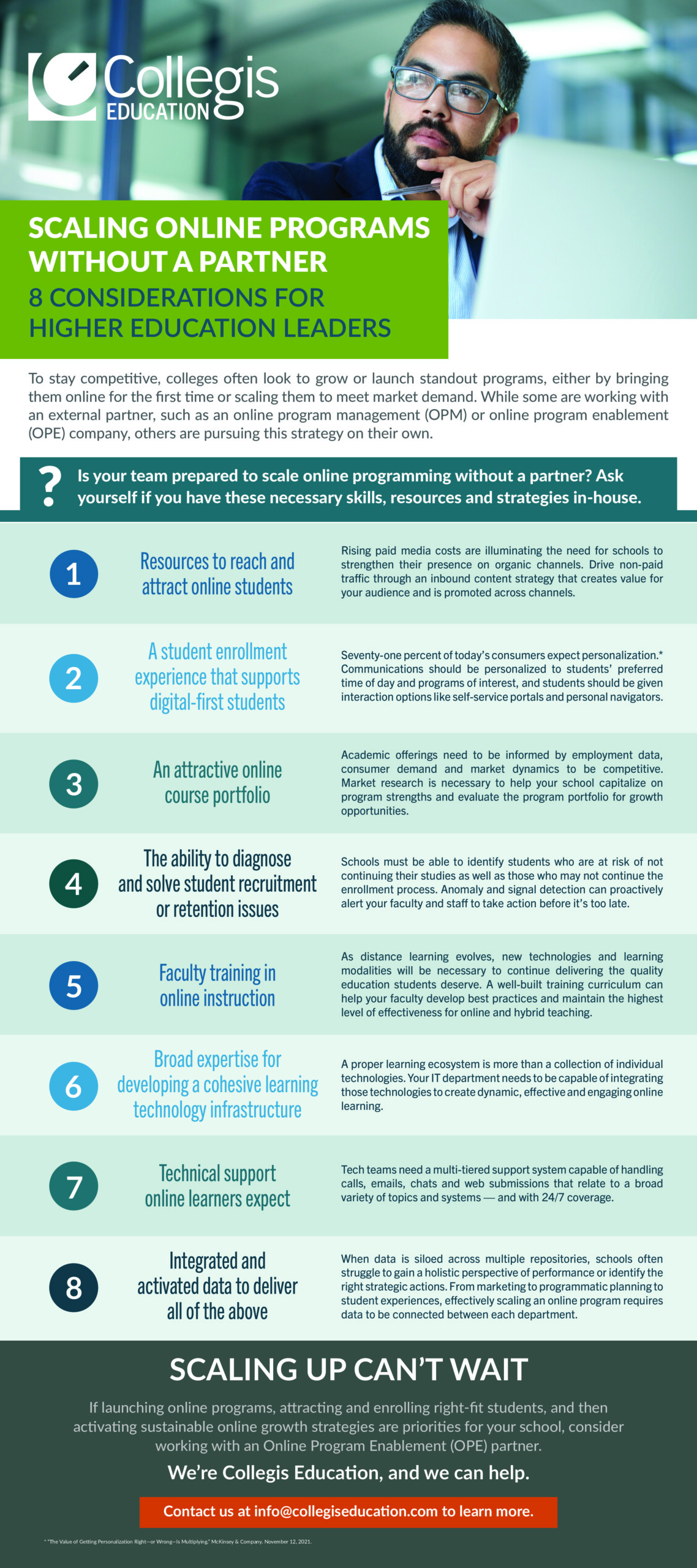
As demand for online education continues to grow, many institutions are looking to expand their online programs to reach more students, drive enrollment, and stay competitive. While some schools work with online program management (OPM) providers, others are choosing to scale online learning in-house.
If your institution is considering launching or growing online programs independently, our latest infographic outlines the critical skills, resources, and strategies you’ll need for success.
Innovation Starts Here
Higher ed is evolving — don’t get left behind. Explore how Collegis can help your institution thrive.
More than 500 employers share their perceptions
As the workforce evolves, many employers are considering the relevance and use of alternative credentials for upskilling or reskilling employees. This reimagining of workforce education provides an opportunity for higher ed leaders to partner with employers on microcredential programs that drive a funnel of enrollments.
Collegis teamed up with UPCEA to survey more than 500 employers about their perceptions of microcredentials and interest in partnering with colleges and universities on these non-degree programs.
Download the report to receive insights on:
- What incentivizes employers to work with higher ed institutions
- Employer valuation of alternative credentials
- Employer use of alternative credentials in lieu of degrees in the hiring process
Download Now
Transform Challenges Into Opportunities
Facing challenges in enrollment, retention, or tech integration? Seeking growth in new markets? Our strategic insights pave a clear path for overcoming obstacles and driving success in higher education.
Unlock the transformative potential within your institution – partner with us to turn today’s roadblocks into tomorrow’s achievements. Let’s chat.
Part one of a three-part series.
As the popularity of online higher education programs grows, the need to have the right infrastructure and processes in place to attract, support and retain these students – and understand how they differ from on-campus students – grows more important. Most institutions are not equipped to support, at scale, the kinds of flexible online and hybrid courses and programs that today’s online students require.
That’s why so many colleges and universities have sought the help of online program management (OPM) companies to transition their established on-campus programs online in exchange for a share of tuition over a set number of years. However, as competition increases and views on traditional degree formats shift, these revenue-share agreements may be hurting institutions in the long run.
6 Reasons OPMs Can Hurt Schools in the Long Run
One of the primary reasons online program management companies appear attractive is that, under a revenue-share model, schools can largely bypass the upfront costs required to quickly launch new online programs. While this partnership model worked well when competition in the online space was smaller, it is now proving to have big risks and long-term limitations for institutions. These include:
1. Long-term, restrictive contracts that are difficult to terminate.
Most OPM contracts are between five and ten years with limited remediation options for institutions when enrollment objectives aren’t met.
2. Complete lack of transparency around performance.
Due to the nature of revenue-share contracts, an OPM company has no incentive to share its strategies and data (especially in marketing and admissions). Schools may not know what tactics are driving performance. This prevents the school from learning the operational and analytical nuances of operating at scale and understanding why certain decisions are made.
3. Conflicting objectives.
OPMs typically focus their efforts on the specific programmatic offerings with the highest profit margin and are highly selective in what they are willing to support, which may not align with an institution’s mission and needs. OPMs also may not align with a school’s culture; for example, some OPMs’ tactics taken on behalf of an institution may be seen as aggressive and not in line with a school’s ethos. In addition, some tactics OPMs use are in direct competition with tactics the institution is already employing to recruit students for non-OPM–supported programs.
4. No development of internal online infrastructure.
OPMs operate in a very closed, “black-box” manner. Strategies are not shared with the school and technology benefits are only realized by the OPM. When the relationship ends, schools are left without the capabilities, expertise and recruiting pipeline, as well as the data, insights or knowledge of what worked or what it took to launch their online programs and grow their enrollments.
5. Lack of control around decisions and strategies.
In a revenue-share agreement with an OPM, the company often has ultimate decision-making authority on non-academic processes. This can cause friction with faculty – and leave schools with no way to intervene.
6. Less revenue generation over the long ter
While OPMs help schools see revenue right away as enrollments grow, revenue-share agreements eat away at revenue over time. OPMs often collect more than 50 percent of revenue over the course of several years.
There’s a Better Way.
If your institution is already working with an OPM to support online programs, or is looking for help doing so, an online program enablement (OPE) company may be a better option to improve your institution’s long-term health and innovation, as well as enable you to own the future of your online programs.
OPE companies differ from their online program management counterparts in several ways, including the types of services offered, the programs supported and the approaches used to achieve results. Most notably, OPEs offer unbundled services and do not rely on revenue-share agreements to fund the partnership. Because of this, OPEs are an ideal partnership option for schools since the institution is able to build internal capacity and intelligence that can be leveraged across the organization and programs to improve marketing, enrollment and support services.
An OPE provider like Collegis Education can help schools successfully own the future of their online courses and programs.
This article is part of a series about OPMs and OPEs. Read part two, OPE: A Better Alternative for Long-Term Growth.
Innovation Starts Here
Higher ed is evolving — don’t get left behind. Explore how Collegis can help your institution thrive.
With student expectations shifting and competition increasing, colleges and universities are being forced to revisit their value propositions. The key to success will be transforming operations and experiences to be digital-first through the efficient and optimized use of technology. Or in other words, institutions need to rethink their technology ecosystem and how they accelerate project velocity to improve student and staff experiences.
This is no easy task – especially in an era of flat or declining enrollments, limited budgets and scarce resources. However, there’s a model that’s gaining traction in higher ed that may offer a solution. This article outlines how variable staffing with shared services can be a cost-effective and strategic option to achieve transformation quickly and looks at the key considerations and requirements for implementing this model.
What are shared services in higher ed?
Shared services in higher ed can be defined as a shared staffing or variable staffing model in which institutions can leverage fractional headcount where internal capacity is lacking or unavailable, particularly in IT, admissions, and enrollment departments. Another model is leveraging a common platform that is shared by two or more institutions to accomplish a particular task (or aspect of a task). In a shared services consortium, a group of institutions collaborate to pool their resources and share common back-office technologies and services. Common shared services include finance and accounting, human resources, and information technology.
Some examples of institutions that formed consortia to share services include:
- Four Midwestern universities collaborating to consolidate back-office services onto one platform for finance, accounting, IT and human resources to make the schools more efficient and reduce costs.
- The Pennsylvania State System of Higher Education consolidating six state universities into two to share enrollment management strategy and student support services, as well as enhancing information systems for cross-collaboration.
- Five New Mexico colleges collaborating to establish a common platform for student and financial services.
- 15 Iowa community colleges collaborating to create a shared development center that provides faculty with the knowledge and tools to best educate students, whether in the classroom or virtually.
- 26 institutions in the University System of Georgia rely on a Shared Services Center to streamline and standardize administrative functions for HR and payroll and monitor and mandate compliance risk.
Why are shared services gaining traction in higher ed?
What’s behind the increased adoption of consortial/shared services in higher ed? The answer: student expectations. Today’s students expect consumer-grade experiences in education that mirror the 24/7, multi-channel, personalized access they have with all other aspects of daily life – all powered by technology. This technology requires regular upgrades, expert staff, and the ability to collect, connect, and activate data to inform continuous innovation. These data, tech, and talent evolutions can be extremely challenging to implement from a change management standpoint.
However, while the way each institution chooses to fulfill its mission may differ, many of the business and operational functions they use may not be so unique. This common foundation offers institutions the opportunity to pool their resources and share the cost of purchasing and maintaining basic back-office technologies and services, allowing each individual college and university to focus more on better serving their students and educators in a digital-first way.
What are the benefits of sharing services?
Since much of the technology that is needed to support, run, manage and drive an institution is the same (e.g., student information systems, customer relationship management systems, etc.), it’s redundant and costly for each institution to own and manage their own core technologies and infrastructure.
Sharing services and software purchases between institutions can achieve the following:
- Streamlined and simplified essential business processes
- Maximized individual cost savings
- Standardized workflows to enable efficiency, scale and growth
- Enhanced program and service quality
- Improved operational productivity
- Prioritized resources for mission-oriented or strategic activities
- Reduced data enablement costs with multi-tenant Google Cloud architecture
- Fractional headcount to reduce cost on full time generals and obtain specialists as needed
By sharing common services and technologies, institutions can enhance their student support, improve the student experience and ultimately, increase academic success because they are now focusing more on their own core competencies.
Technology: A prime opportunity for fractional headcount
At a time when resources are scarce, supporting transformation initiatives – which often includes expensive technological infrastructure and human expertise – is hard. And untangling the legacy of technology systems and tools to achieve a streamlined, integrated ecosystem is no small task.
Adequately staffing a college or university IT department that will help lead strategic change can mean filling 17 distinct IT roles with a cumulative annual cost of up to $1.5M. As institutions continue to balance innovation with operational efficiencies a shared service model that leverages experienced fractional headcount could be the answer. Rather than hiring generalists who must fulfill several roles at once, risking excessive workloads and burnout, you get the specialized expertise you need at a fraction of the cost.
Key considerations for enabling shared services
The creation of a shared services partnership can have its own pitfalls, however. And the challenges involved are not simply about technology. Sharing services requires significant cooperation across multiple institutions, internal and external teams, as well as third-party providers.
To be successful, these relationships require thoughtful considerations around the following factors:
- Significant coordination of people, processes and technology
- Shared vision
- Change management considerations
- Standardization of workflows
- Integration, user support, and ongoing optimization
- Agreement on common applications
- Limited customizations
- Expectations of the shared resource partner that is managing the relationships
- Funding options
Shared governance is critical
Ultimately, the goal is that customization and personalization will happen at the individual campus level, while standardization and optimizations are happening up at the shared services organizational level. The only way this can happen is if a shared governance structure exists where there’s a common agreement between the involved parties so each have equal say in the decisions being made at each level.
If your institution is interested in exploring a shared services relationship but doesn’t know where to start, Collegis Education can help. We facilitate a partnership between your school and others to address the needs listed above – allowing you to maximize the delivery of your school’s value proposition. If your school is feeling constrained, this solution can help you stabilize, optimize and innovate student experiences – enabling you to thrive in this competitive landscape. Let’s talk about where to start.
Innovation Starts Here
Higher ed is evolving — don’t get left behind. Explore how Collegis can help your institution thrive.
It’s nearly impossible to discuss higher education today without acknowledging rising tuition costs. Students, parents and institution leaders themselves all face struggles related to the cost associated with earning a degree. It’s no wonder some colleges are considering enacting a tuition freeze for one or more years.
Appeasing cost-sensitive students is certainly nothing new. But as an increasing number of learners find themselves facing an unstable financial future, colleges are reconsidering their posted tuition rates for the coming years. To get more insight on the topic, we spoke with seasoned experts from Collegis Education, including Bob King, executive vice president of partner strategy.
Perhaps holding the price steady will encourage more students to apply and enroll in the near term, but this doesn’t address the larger issue. The fact remains that a reckoning for college tuition pricing is on the horizon – even raising fees in the current economic landscape is rife with risk. While implementing a tuition freeze is a good start, it should be accompanied by many other considerations.
Methods institutions use to freeze tuition
While the concept of keeping tuition steady is fairly simple, it isn’t always straightforward in practice. For starters, a freeze can last for just one semester or for multiple years. It’s also important to illustrate that the definition of this tactic can vary across institutions.
Brad Frank, chief marketing officer at Collegis Education, offers a number of examples. The first option is to keep the total cost of attendance for students the same. Another variation involves charging students the same rate for every year throughout their education. Some colleges even go the route of charging students the same amount, but only if those students pay for subsequent years upfront. It’s also worth noting a freeze could mean that tuition costs stay the same from one year to the next, but other expenses are still subject to change.
“Tuition is only a portion of the cost of attendance,” explains J. Michael Locke, higher education consultant and Collegis Education board member. This is clear in the cost breakdowns illustrated in a report from the College Board. “Room, board and other fees can account for 50 percent or more of the total cost,” Locke adds.
How a tuition freeze could affect institutions
It’s true there are numerous ways a tuition freeze could affect an institution. However, private nonprofit schools will likely find themselves under increased financial strain if they don’t adjust other expenses. This is not only because tuition accounts for a large share of total cost, but also because there’s a high likelihood that school is offering tuition discounts. A report from the National Association of College and University Business Officers (NACUBO) shows the discount rate among private nonprofit institutions has grown more than 10 percentage points over the last decade.
“What this does, in effect, is cause some students to pay more while the average student is still paying the same price,” Frank says.
Further complicating the situation, many colleges and universities are already facing financial difficulties. Some are doing away with varsity sports. Others are closing academic departments. Yet, as Locke points out, some institutions are limited in how many changes they can make that affect faculty employment due to labor contracts as well as politics.
Unfortunately, some institutions have recouped losses by raising other student-facing costs. That could materialize in the form of higher fees, housing that is more expensive and other hidden expenses. Some schools have even offset tuition adjustments in the past by reducing the amount of institutional aid they award students.
Schools that are thinking about enacting a tuition freeze in the immediate future have the right idea. But those institutions would be wise to start thinking about a long-term plan that has a more permanent impact.
“Tuition freezes may not be that effective,” Locke suggests, “but I do think that, fundamentally, we are going to need a reset of pricing in higher education.”
Creating a sustainable plan for tuition pricing
Making a good-faith effort to keep higher education costs down for students is commendable. To truly make a change that will attract students, though, institutions need to differentiate themselves and start developing longer-term pricing strategies. This is important, because economists predict there will be a steep decline in the college student population in the next five or so years. This means those learners will have more say in the cost of higher education than ever before.
“The power is going to shift to the consumer because of shrinking demand,” Frank says. “Students are going to start negotiating better prices for themselves.”
More than ever, schools need to convey what it is that makes them stand out. Some institutions will inevitably charge more for tuition than others. The only way this remains feasible, though, is if schools are able to prove their price points.
“Consumers make decisions not just on price, but on what they get for that price,” Locke says. “Schools need to show the return on investment that students get by explaining what happens to alumni and conveying how they deliver a better student experience.”
Institutions also have a real opportunity to rethink the way tuition is priced. This is especially true as more classes move to fully online and hybrid models. Some institutions have already found ways to leverage technology to create more affordable online versions of their residential offerings. The right tools can also reduce costs elsewhere across institutions since, as Locke points out, investing in technology solutions drives labor efficiencies. However they go about it, colleges need to take a radically different approach to tuition pricing.
A new approach to tuition
Individual schools clearly need to assess how a tuition freeze could affect their students and the institution as a whole. Regardless of whether this particular tactic makes sense, it is wise to start thinking about different approaches to pricing and how to be more affordable.
Tuition has always been a major point of concern, but the pandemic has amplified this factor even more. In these challenging times, colleges need to prove the value of their price points now more than ever.
Innovation Starts Here
Higher ed is evolving — don’t get left behind. Explore how Collegis can help your institution thrive.
Understanding the Financial Impacts of Partnership for Online Programs
Online programs are a relatively recent addition to the overall higher education timeline, but they’ve rapidly grown in popularity over the last several years. More and more students are finding they prefer the flexibility and convenience that distance education provides. Now, institutions that are just beginning to embrace the virtual classroom are facing a pivotal moment as they determine what it will take to successfully launch online offerings.
For most schools, the way forward comes down to choosing between two methods. The first option is to select an online program management (OPM) company, which provides a full suite of services for no initial payment in return for a considerable portion of tuition revenue later on. The other method is an unbundled approach that involves a school bolstering their internal efforts while partnering with one or more fee-for-service vendors to fill gaps — and it requires significant upfront investments.
From a financial perspective, it can be difficult to determine which of these two options is the better fit for any given institution. The decision of whether to choose an OPM or an unbundled approach really boils down to evaluating six key elements:
- Upfront investments
- Potential risks
- Needed services
- Who has decision-making authority
- Contractual restrictions
- Future earnings
Clearly, choosing a method for bringing programs online is a complex decision that requires input from numerous stakeholders and a firm understanding of the institution’s needs, vision for the future and current economic standing. Find out how to frame important conversations related to online program enablement and choose the path that meets your objectives by downloading this complimentary resource.
Begin to explore your online program enablement needs
Complete the form to begin crafting your strategy for launching online program offerings.
Download Now
Transform Challenges Into Opportunities
Facing challenges in enrollment, retention, or tech integration? Seeking growth in new markets? Our strategic insights pave a clear path for overcoming obstacles and driving success in higher education.
Unlock the transformative potential within your institution – partner with us to turn today’s roadblocks into tomorrow’s achievements. Let’s chat.
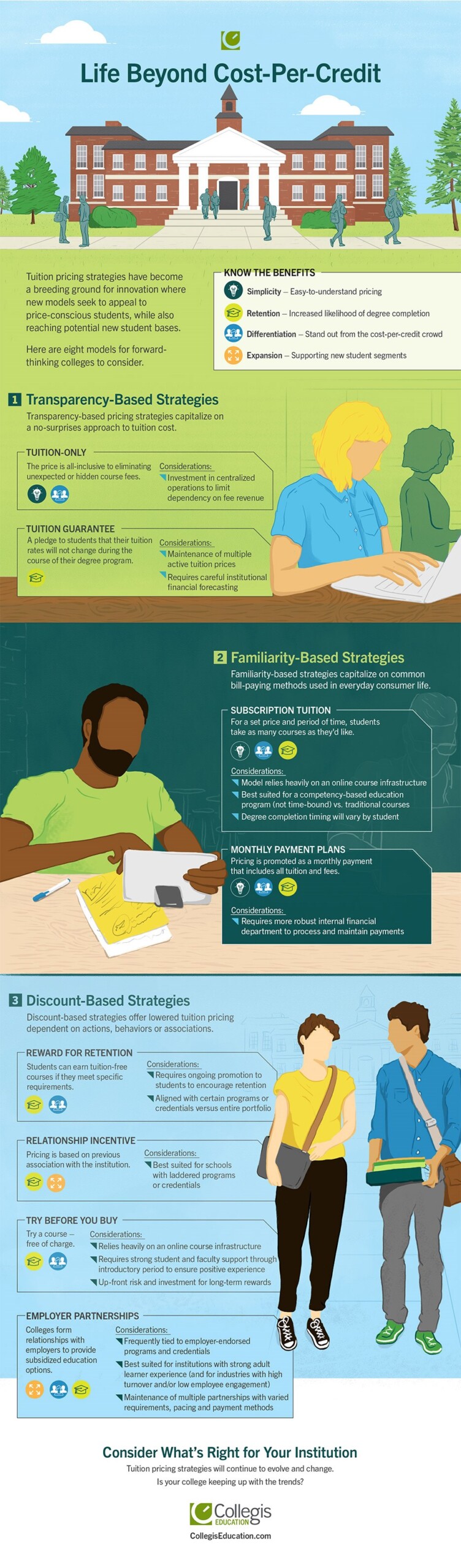
Today’s students prioritize cost and value, pushing colleges to balance affordability with revenue. With cost-per-credit becoming outdated, new tuition models aim to attract price-conscious and new student bases.
Explore eight emerging higher ed pricing trends to help institutions explore the best-fit strategies.
Reinventing college tuition
While college degrees have never been more important, they have also never been more expensive. According to the U.S. Department of Education, over the past three decades, tuition at public four-year colleges has more than doubled, even after adjusting for inflation.
New tuition pricing models offer colleges and universities many advantages to set themselves apart from the intense competition for student enrollment. As we reviewed various emerging pricing strategies, we identified potential benefits in the following areas:
- Simplicity – Transparent and simplified pricing is not just a benefit to prospective students seeking to understand the cost of their college degree. It also allows college staff to clearly articulate degree costs. Streamlined costs can breed efficiencies within the institution in admissions, financial aid and student support.
- Retention – Strategies that encourage or incentivize persistence and completion have the ability to increase your retention rates. With increased retention, your institution could see revenue gains over time.
- Differentiation – There are more than 4,000 degree-granting colleges and universities in the United States—and nearly all utilize cost-per-credit pricing. Offering a different way of calculating or understanding your degree cost can be a key point of differentiation that elevates your institution and attracts new students.
- Expansion – As the traditional college-seeking student population continues to decline, expanding your reach to new student segments is a critical opportunity. Pricing models that cater specifically to a new revenue stream will become increasingly important.
As you consider adopting a new tuition pricing strategy, keep these benefits in mind.
Investigating alternative tuition pricing strategies
Models of tuition pricing are constantly evolving, but we have broken down the emerging trends in higher education to help college leaders evaluate different options to find what’s right for their institution. Learn more about eight models that fall under three overarching strategies: transparency, familiarity and discounting.
Transparency-based strategies
Today’s college students are cost-savvy and want to know the total financial investment they will make up front. Transparency-based pricing strategies capitalize on a no-surprises approach to tuition cost. These types of models provide students with a measure of financial predictability.
1. Tuition-only
Tuition-only pricing models eliminate course and comprehensive fees, presenting students with an all-inclusive price that ensures clarity in program cost.
Benefits:
- Simplicity
- Differentiation
Considerations:
- Investment in centralized operations to limit dependency on fee revenue
2. Tuition guarantee
Institutions utilizing the tuition guarantee model pledge to students that their tuition rates will not change during the course of their degree program. Oftentimes, students must stay continuously enrolled to capitalize on this benefit.
Benefits:
- Retention
Considerations:
- Maintenance of multiple tuition prices yearly
Familiarity-based strategies
A college degree is one of the top five largest purchases a person will make in their lifetime. Familiarity-based strategies capitalize on common bill-paying methods used in everyday consumer life. These types of models create peace of mind for students by relating to things they already do.
3. Subscription tuition
Subscription tuition models eliminate cost-per-credit and instead allow students to take as many courses as they’d like over a set period of time (term), for a set price. In most cases, the faster they complete their coursework, the more affordable their degree program becomes.
Benefits:
- Simplicity
- Retention
- Differentiation
Considerations:
- Model relies heavily on an online course infrastructure
- Best suited for a competency-based education program (not time-bound) vs. traditional courses
- Degree completion timing will vary by student
4. Monthly payment plans
Payment plan models promote cost-per-degree as a manageable, monthly payment that is all-inclusive of tuition and fees. These models spread costs out over time, allowing students to budget monthly versus taking on student loan debt.
Benefits:
- Simplicity
- Retention
- Differentiation
Considerations:
- Requires more robust internal financial department to process and maintain payments
Discount-based strategies
Many pricing models offer students discounted tuition pricing dependent on actions, behaviors or associations. Most often, these models have increased overall student retention, allowing institutions to grow revenue over time. These types of models directly target the “deal” or “savings” seekers.
5. Reward for retention
Reward for retention models allow students to earn tuition-free courses based on meeting certain requirements. These types of programs are generally tied to specific programs or credentials versus an entire portfolio, and are usually offered during the final year of degree work to encourage persistence. An alternative is to offer a free course for a certain number completed versus holding all until the end.
Benefits:
- Retention
- Differentiation
Considerations:
- Requires ongoing promotion to students to encourage retention
- Aligned with certain programs or credentials versus entire portfolio
6. Relationship incentive
Relationship incentivized models provide discounted tuition on additional courses/programs of study to a school’s alumni—and sometimes their family. Pricing is based on previous association with the institution in order to receive a discount.
Benefits:
- Retention
- Expansion
Considerations:
- Best suited for schools with laddered programs or credentials
7. Try before you buy
Try-before-you-buy models actually give away courses free of charge to give students a taste of the education they could receive. Some models offer a risk-free period versus a whole course, i.e., 3 weeks of an 11-week course. Oftentimes, this model is only offered in high-demand programs or credentials with large revenue potential.
Benefits:
- Retention
- Differentiation
Considerations:
- Relies heavily on an online course infrastructure
- Requires strong student and faculty support through introductory period to ensure positive experience
- Up-front risk and investment for long-term rewards
8. Employer partnerships
Employer education partnerships form relationships between a college and corporate employer to provide affordable, outcomes-focused education options to the employees of the corporate partner. These relationships frequently improve employee engagement, community awareness and student retention. These models also typically rely on subsidized costs from the employer or discounted tuition—or a combination of both.
Benefits:
- Expansion
- Retention
- Differentiation
Considerations:
- Frequently tied to employer-endorsed programs and credentials
- Best suited for institutions with strong adult learner experience (industries with high turnover and/or low employee engagement
- Maintenance of multiple partnerships with varied requirements, pricing and payment methods
Consider what’s right for your institution
Tuition pricing strategies are continuing to evolve and change. Some of the mentioned models will expand to institutions across the country—while others will beget new options. As your institution seeks out ways to grow revenue and differentiate itself, consider how a new pricing model could fulfill your strategic objectives.
Innovation Starts Here
Higher ed is evolving — don’t get left behind. Explore how Collegis can help your institution thrive.