More than 500 employers share their perceptions
As the workforce evolves, many employers are considering the relevance and use of alternative credentials for upskilling or reskilling employees. This reimagining of workforce education provides an opportunity for higher ed leaders to partner with employers on microcredential programs that drive a funnel of enrollments.
Collegis teamed up with UPCEA to survey more than 500 employers about their perceptions of microcredentials and interest in partnering with colleges and universities on these non-degree programs.
Download the report to receive insights on:
- What incentivizes employers to work with higher ed institutions
- Employer valuation of alternative credentials
- Employer use of alternative credentials in lieu of degrees in the hiring process
Download Now
Additional Resources




Transform Challenges Into Opportunities
Facing challenges in enrollment, retention, or tech integration? Seeking growth in new markets? Our strategic insights pave a clear path for overcoming obstacles and driving success in higher education.
Unlock the transformative potential within your institution – partner with us to turn today’s roadblocks into tomorrow’s achievements. Let’s chat.
How SLU Reached Record Enrollment Results
Many institutions are turning to alternative credentials to attract diverse student audiences, grow enrollment, find new ways to generate income and advance their reputations as providers of high-quality academic programs designed to meet learner and workforce needs.
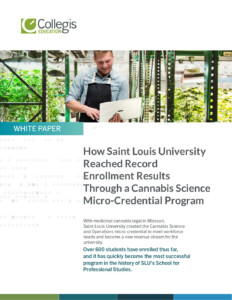
In this white paper, you’ll learn how Saint Louis University (SLU), partnered with Collegis Education to develop and launch its Cannabis Science and Operations micro-credential program that allowed SLU to:
- Respond to local and national workforce demands
- Increase overall enrollment
- Engage and enroll more diverse online learners
The program quickly became the most successful program in the history of the university’s School for Professional Studies, providing record results for the institution.
Download Now
Additional Resources
Transform Challenges Into Opportunities
Facing challenges in enrollment, retention, or tech integration? Seeking growth in new markets? Our strategic insights pave a clear path for overcoming obstacles and driving success in higher education.
Unlock the transformative potential within your institution – partner with us to turn today’s roadblocks into tomorrow’s achievements. Let’s chat.
From shifting student demographics to distance learning and competency-based courses, higher continues to evolve to meet the needs of today’s students and tomorrow’s workforce.
The emergence of microcredentials as a new form of certification is driven by the skills gap in today’s 21st century workforce. Let’s talk about the purpose of micro-credentials and what they mean for students and higher education institutions alike.
What are micro-credentials?
The National Education Association describes micro-credentials as a “competency-based digital form of certification.”
Sometimes referred to as “badges,” microcredentials are hyper-focused and typically comprised of sub-competencies. These skills are outlined within a rubric, along with the specific criteria required of each. It is earned once a student successfully demonstrates each competency.
Micro-credentials typically align with soft skills that are valued by employers. They recognize an individual’s proficiency in areas like oral communication, initiative or even empathy. Once earned, the recipient can add it to their LinkedIn profile and resume as a way to formally recognize their aptitude in that area.
What’s driving the need for micro-credentials?
Microcredentials are gain traction because there’s a growing disconnect between what employers want and what candidates have to offer — especially when it comes down to their soft skills.
In Monster’s The Future of Work 2021: Global Hiring Outlook report, employers asked to name the top skills they want in employees cited soft skills such as dependability, teamwork/collaboration, flexibility and problem-solving.
This is where microcredentials can help fill the skills gap.
How are micro-credentials helping meet demand?
Most college degree programs are built to train students on the technical skills needed to perform the duties related to their desired profession. Training on the transferable skills that help individuals succeed beyond the most basic job duties is less prevalent.
For example, aspiring data analysts will master technical skills like SQL, Tableau and data mining in a degree program. But employers are also seeking candidates with a demonstrated proficiency in problem-solving, communication and project management. These skills make them more collaborative, productive employees, and are areas in which microcredentials can make an impact.
Because these certifications are built upon competencies, they carry more weight with employers. Anyone can list “communication, critical thinking and empathy” in a paragraph on a resume. But displaying a microcredential serves as concrete evidence that you’ve demonstrated proficiency in that area.
Micro-credentials are a promising solution for students and employers alike, but credentials may eventually need to undergo some sort of standardization process — both to increase its validity, and also to set expectations of students and employers.
With many institutions already adopting the microcredential method in various ways, it seems to be a trend that won’t be fading anytime soon.
Who are the early adopters of microcredentials in higher education?
It hasn’t been long since micro-credentials first made their entrance in the higher ed world. Though they are still in their infancy, a handful of institutions have already acknowledged their value and incorporated them into their suite of offerings.
For example:
- Colorado State University offers an array of soft-skill badges which include subjects such as teamwork, conflict resolution and stress management.
- George Mason University established a resilience badge, which demonstrates a student’s ability to positively deal with stress, change, uncertainty and adversity.
- California Community Colleges (CCC) now offer “21st Century Skills badges” throughout their campuses, covering skills such as collaboration, digital fluency, entrepreneurial mindset and social/diversity awareness.
These are just a few examples of how forward-thinking institutions have adopted the microcredential method to help provide additional development opportunities for the modern student.
Filling the soft skills gap
Higher ed continues to evolve to meet the needs of students and the workforce. With the increasing desire for job candidates with stronger soft skills, microcredentials and digital badges stand to benefit graduates and employers alike. We anticipate more schools will join the soft skills movement by incorporating micro-credentials into their program portfolios.
The increasing implementation of microcredentials is just one of many trends emerging in higher education. Learn more about what else is on the horizon in our article, “Reimagining Higher Ed for the 21st Century.”
Curious about how your institution might incorporate microcredentials into your program mix? We’d love to chat about the opportunities! Contact us at info@collegiseducation.com.
Innovation Starts Here
Higher ed is evolving — don’t get left behind. Explore how Collegis can help your institution thrive.
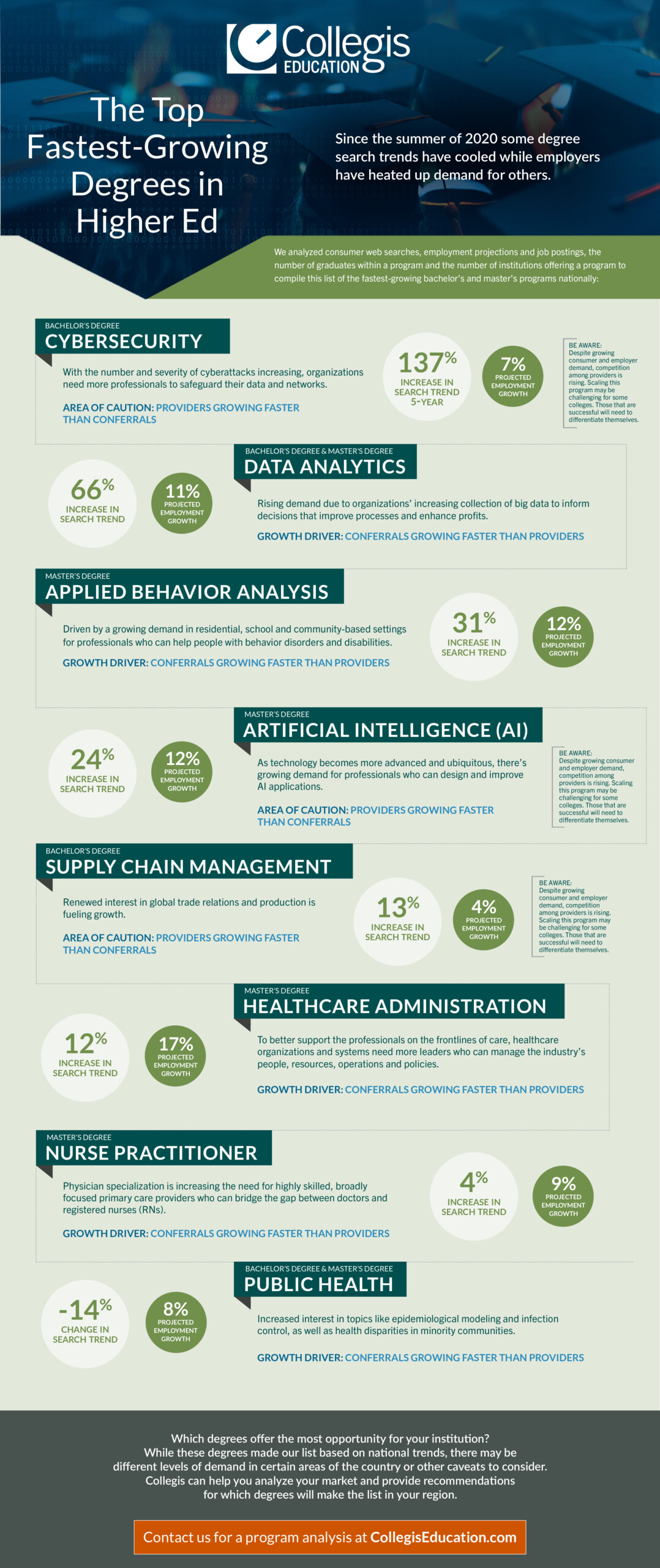
As student demand and workforce needs evolve, institutions must stay ahead of shifting degree trends to attract enrollments and align programs with job market demand. While some academic fields are experiencing rapid growth, others are becoming more competitive as more providers enter the space.
This infographic highlights the top bachelor’s and master’s programs gaining traction based on consumer searches, employment projections, job postings, and degree conferrals.
Innovation Starts Here
Higher ed is evolving — don’t get left behind. Explore how Collegis can help your institution thrive.
Up until the last several years, the typical high school senior was certain of at least a few things. They were sure that obtaining a degree was a worthwhile investment. They were also assured they could find career success regardless of which field they chose as their primary area of study.
But as Generation Z learners, those born sometime in the mid-1990s through about 2012, enter their college-going years, it’s clear that a different mindset is now prevailing. These “traditional” college students are anything but. Today’s prospects are far more skeptical of higher education – they want proof that pursuing a degree will be worth it in the long run.
Because there are so many institutions to choose from, students are in a position to shop around like never before. To remain competitive, schools are having to adjust to meet the expectations of Generation Z college students. And the entire higher education experience is changing as a result.
6 ways Generation Z college students are changing higher education
Now that Generation Z is attending (or thinking of enrolling in) college, everything from program offerings to institutional priorities are evolving. Take a look at some of the most notable shifts they’ve driven over the last several years.
1. Programs are more career-focused than ever
College used to be seen as a time to explore – to focus on passions that weren’t necessarily pointing toward a specific career path. Students felt like they could take their time to figure out what they wanted to do for a living, even if that meant pursuing a job opportunity that was entirely unrelated to their undergraduate major. Attitudes have certainly changed.
According to a survey conducted by ECMC Group and VICE Media, 74 percent of polled high school students say they think an education that focuses on developing hard skills – like those related to nursing or science, technology, engineering and math (STEM) – makes sense. Additionally, more than 50 percent of respondents say they’re open to pursuing something other than a four-year bachelor’s degree to prepare for their futures.
The desire to gain skills that can prepare them for a stable career is already playing out in the first few Gen Z cohorts to graduate from college. Our 2020 program analysis shows that there’s growth among bachelor’s degrees awarded in healthcare, science and technology. For instance, the number of bachelor’s degrees in computer science increased by about 14,000 from 2014 to 2018.
2. Sophisticated technology solutions are now necessary
Generation Z students are the first true digital natives to attend college. This means they’re incredibly tech-savvy and expect schools to similarly embrace technology. Nielsen research indicates that 97 percent of Gen Z individuals own smartphones, so it’s safe to assume they want to access everything from campus maps to course materials using these mobile devices. This certainly explains why a growing number of institutions have released simple, easy-to-use mobile apps.
Generation Z students want the latest technology to be incorporated into their classroom experiences as well. A report from Barnes & Noble College indicates these learners crave interactive experiences and see a lot of value in tools like digital textbooks, online videos and game-based learning.
3. Tuition pricing is evolving
While increasing tuition prices have always been concerning for students, Generation Z is particularly wary of how much it costs to obtain a degree. Research indicates they’re more worried about being able to afford their education and less willing to accumulate debt that millennials.
Today’s students simply want education that’s more affordable. Given that more and more learners are flocking to large institutions that are known for providing comparatively low-cost options, it seems students are getting their way. It’s also important to note that many of these large schools, often called “mega-universities,” are completely rethinking their tuition models. Some examples include subscription pricing, monthly payment plans and charging a flat rate that’s inclusive of all fees and additional costs.
4. Diversity and inclusion are becoming top priorities
The students starting college today are more diverse than ever before. The Pew Research Center reveals that only 52 percent of Gen Z students are white, a stark difference from previous generations. They’re also more likely to value gender identity equity and have a favorable view of societal change.
What this means for colleges and universities is that it’s no longer sufficient to talk about the value of diversity and inclusion – students want to see actual progress in the form of initiatives and organizations. Some institutions have made progress by creating distinct departments or joining multi-school alliances to promote diversity and inclusion.
5. Living off-campus is no longer unusual
Online learning has long been viewed as the go-to option for adult learners, but it’s steadily been growing in popularity among younger students as well. Data from the National Center for Education Statistics (NCES) shows the portion of undergraduate students between the ages of 15 and 23 who participate in any online courses increased from just 12 percent in in 2004 to 37 percent in 2016.
It’s also worth considering that not all Generation Z students attending in-person classes will live in the residence halls. Attending a traditional program doesn’t necessarily equate to living on campus. One survey indicates that nearly 20 percent of Generation Z college students who plan to attend an in-state school intend to live at home and commute to campus.
6. Mental health services are seen as essential
Generation Z college students are keenly aware of mental health issues. According to a recent survey, 70 percent of teenagers report that anxiety and depression are major issues among people their age. While the actual prevalence of mental health problems might not actually be significantly greater than it was among previous generations, today’s college students are certainly more aware of psychological problems and more open to seeking available resources.
As students have made their emotional and psychological needs known, institutions have responded by ramping up their mental health services. Depending on the school, students may be able to make use of counseling, group therapy, workshops, yoga and a variety of other wellness-focused offerings.
Evolve with your students
Now that digital natives account for such a large share of the prospective student pool, higher education institutions need to think about whether they’re adjusting accordingly. Schools must provide the type of experience Generation Z college students demand, or those learners will simply move on. There are plenty of other options out there.
Providing an exceptional student experience is clearly essential, and it actually starts before a prospective student even starts filling out an application. Learn more about how to effectively engage with today’s learners by reading our article “Communicating with College Students: Adapting Your Admissions Approach for Gen Z.”
Innovation Starts Here
Higher ed is evolving — don’t get left behind. Explore how Collegis can help your institution thrive.
The workforce has changed. And with its transformation, workers have evolved their qualifications to meet new demands.
These changes are driven by technology — and the workforce must respond. Higher education institutions must also adapt to provide relevant, capable graduates who are properly equipped for today’s corporate landscape.
We’re in the information age, in which the economy is shaped by technology — a significant departure from manufacturing-focused industrialism. With new innovation comes exciting promise, but also a unique set of challenges for today’s graduates.
There’s a new skillset today’s students need in order to succeed, and these have been dubbed “21st century skills.” Keep reading to learn more about why 21st century skills are so critical and what it means for higher education.
What are 21st century skills?
What specialized skills does one need to succeed in today’s information age? That’s the ideology behind the concept of 21st century skills. 21st century learning can be broken out into three main groups, each comprising different sets of competencies:
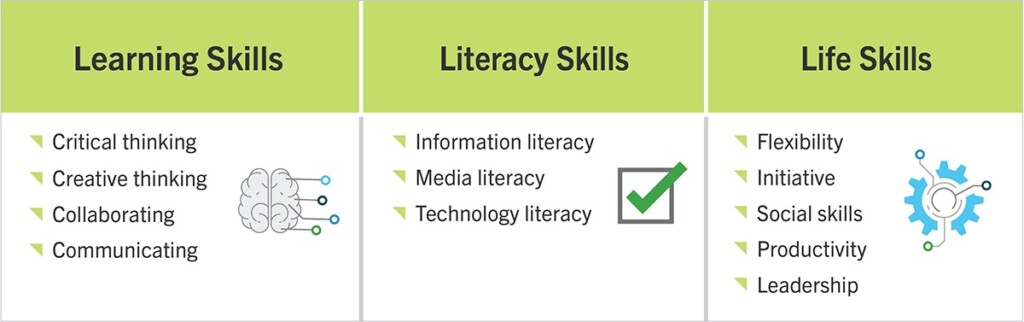
The 21st century skills movement caught on around the beginning of the millennium, when the National Education Association established the Partnership for 21st Century Skills (P21) and developed a “Framework for 21st Century Learning.”
This framework outlined different skills deemed especially valuable and necessary to prepare today’s students for tomorrow’s workforce. Numerous states have since joined P21 through the years and have built these 21st century skills into their school districts’ curriculums.
21st century skills were specifically selected and deemed critical to modern workplaces. Advancements in technology have changed not only the type of work that’s done, but how it’s done. Because of this, the human element is growing more important than ever before.
This is especially true with emerging technologies, such as machine learning and artificial intelligence. With technology taking on more and more of the repetitive, task-based work, it means that humans are left to tackle more dynamic issues that require creativity, critical thinking and collaboration.
What do employers think of 21st century skills?
The term “soft skills” is slowly being replaced by “21st century skills.” Competencies like communication and collaboration have long been characterized as soft skills, and remain important through the evolution into 21st century skills. These are skills that employers are seeking in job candidates.
In fact, a majority of employers find these skills to be just as important as technical skills. In LinkedIn’s 2019 Global Talent Trends Report, over 90 percent of surveyed employers reported that soft skills are just as or even more important to hire for than hard skills.
And in a recent survey of 400 employers, 85 percent reported wanting to hire individuals with a broad range of knowledge and skills, as compared to field-specific skills. These employers listed leadership, written communication, verbal communication, flexibility and teamwork as some of the most-desirable attributes in candidates.
Unfortunately, only 11 percent of business leaders agree that today’s college graduates have the skills needed for today’s dynamic workforce. On the other hand, 96 percent of college academic officers believe in their school’s ability to prepare students for the workforce.
As you can see, there’s a disconnect between academia and corporate America. So what can be done to connect the needs of employers with the qualifications of college graduates?
What role does higher education play in developing 21st century skills?
Some universities or particular programs naturally incorporate these kinds of transferable skills into their curriculum. Liberal arts programs, for example, are notorious for emphasizing soft skills like leadership, communication and teamwork. But 21st century skills aren’t only valuable for communications or philosophy majors.
Even the most technical fields – like computer science or accounting – are in need of professionals who can collaborate, adapt, think critically and take initiative. So how can schools equip students with these types of 21st century skills without overhauling their entire curriculum?
Several higher education institutions have acknowledged the need to better prepare students for the modern workforce using a more innovative approach. This includes new offerings, such as digital badges and micro-credentials, which help arm their graduates with the 21st century skills employers are seeking.
Digital badges can cover anything from blogging to time management or even initiative – competencies that until now have not been formally recognized on resumes or LinkedIn profiles.
Students earn digital badges in a similar manner to competency-based courses. A digital badge typically contains sub-competencies that are outlined within a rubric, and students must prove their proficiency in the specified skill in order to earn the badge. From there, they can add it to their LinkedIn account, website, portfolio or resume.
As many as one in five schools now offer some form of digital badges. And many of these offerings address the interpersonal, transferable-skill emphasis that aligns with the 21st century skillset.
Consider the following examples:
- Colorado State University offers soft skill badges in teamwork, conflict resolution and stress management.
- Johnston Community College in North Carolina offers an intercultural fluency badge.
- George Mason University offers a resilience badge.
- California Community Colleges (CCC) now offer “21st Century Skills Badges” in subjects such as collaboration, digital fluency, entrepreneurial mindset and social/diversity awareness.
Prepare your graduates for the professional world
The workforce has evolved, and higher education must follow suit. Today’s graduates are entering a different type of workforce, so make sure you’re setting yours up for success.
Learn more about how some colleges are adapting to meet this need in our article, “What Are Micro-Credentials? How Colleges Are Adapting to the Modern Workforce.”
Innovation Starts Here
Higher ed is evolving — don’t get left behind. Explore how Collegis can help your institution thrive.
It’s fair to say that students still value higher education. Total college enrollment has hovered around 20 million students since 2013, and the National Center for Education Statistics (NCES) expects that to remain true in the coming years. But the nature of enrollment is shifting.
Consider how greater access to flexible learning has opened the door to those who aren’t able to commit to being a full-time student. About 38 percent of undergraduate students and 43 percent of graduate students are enrolled part time. And a handful of mega-universities are garnering an ever-larger portion of the market share, driven in part by their emphasis on part-time adult students.
It’s also worth mentioning that the student body itself is changing. Tomorrow’s college attendees are expected to be far more diverse than today’s.
All this is to say a business-as-usual mindset isn’t going to work going forward, because the higher education landscape is rapidly changing. Terri Nierengarten, senior director of academic solutions at Collegis Education, thinks colleges are already aware of how their future student body will shift.
“I think everybody acknowledges that the demographics are changing,” she says. “I don’t think many schools have translated that into what it means in terms of how they may have to change as an institution.”
While there are numerous steps higher education institutions can take to ensure they’re meeting future students’ needs, it’s first important to dig into how the population is changing.
A look at where student demographics are heading
Today’s student body is already different than it was a few decades ago. Projections show an even more diverse future. The U.S. Census Bureau’s population reports estimate that, by 2020, less than half of children under the age of 18 will be non-Hispanic white. By 2060, that number is projected to be less than one-third.
When we look at high school graduates, in particular, 68 percent were white in 2003 compared to a projected 51 percent in 2021. That obviously means there will be growth in the proportion of minority students in the prospective-student pool. The most notable change is for Hispanic students, who are expected to go from 13 percent of high school graduates in 2003 to a projected 25 percent in 2021. And this isn’t a one-off event. These trends are expected to continue well into the future.
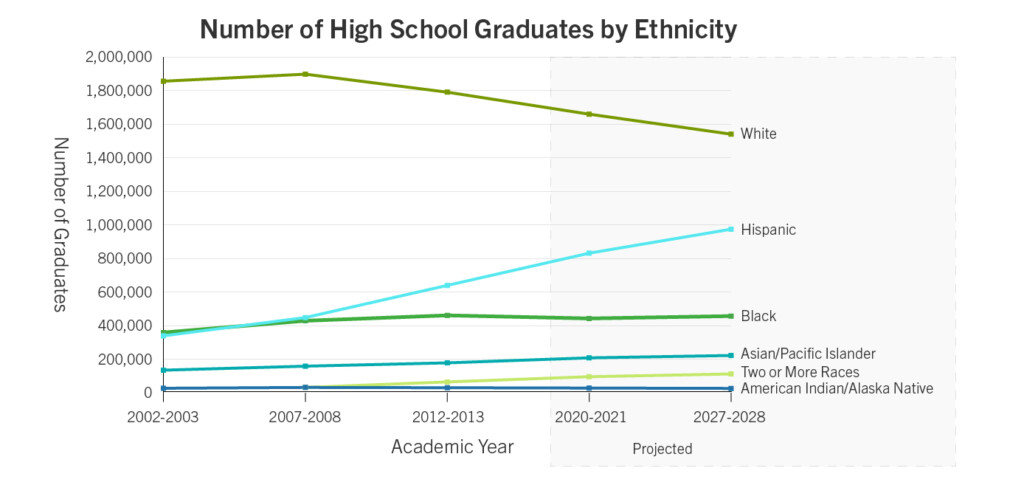
*National Center for Education Statistics. Projections of Education Statistics to 2027.
February 2019 report.
Understandably, there are regional differences to take into consideration, as well. U.S. Census Bureau data shows some areas have a higher proportion of certain populations. In the Plains region — Iowa Kansas, Minnesota, Missouri, Nebraska, North Dakota and South Dakota — 72 percent of the population is white while only 9 percent is Hispanic. Compare that to the Southwest — Arizona, New Mexico, Oklahoma and Texas — where 35 percent of the population is white and 42 percent is Hispanic.
It’s important, too, to notice how enrollment among recent high school graduates varies by race and ethnicity. While the percentage of students who enroll in college immediately following high school has grown to 67 percent, recent graduates who are black or Hispanic fall short of that number.
And, when considering those students who start college as adults or have otherwise experienced some sort of education gap, it’s important to remember that they also have different needs based on that experience. Consider, for example, that some adult students may have families and be working full time.
“There’s a big difference in a student whose path goes directly from high school into college and someone who has a break,” Nierengarten points out. “Schools that do a good job of recognizing that break — whether it be through effective onboarding of new students, transfer credit policies, or lifestyle friendly learning options — will find they are at an advantage to serving this audience.”
Given these changes from the primarily white, just-out-of-high-school demographics of the past, it’s vital that institutions consider these factors in regards to learning support, marketing strategies and flexible delivery models.
Changing demographics mean changing perspectives
As the student population becomes more diverse, it’s important to recognize that race and ethnicity can significantly affect your prospective students’ experiences and overall mindset. Pew Research Center’s “Races in America 2019” survey found significant differences in how a person’s race affects their life. Key highlights from this report include:
- 52 percent of black individuals say their race has hurt their ability to get ahead.
- 45 percent of white individuals say their race has helped their ability to get ahead.
- Black individuals, followed by Hispanics, are most likely to say people have acted suspicious of them or as if they weren’t smart.
- A majority of both black and Asian individuals say they’ve experienced discrimination.
- 74 percent of black individuals, 59 percent of Hispanic individuals and 56 percent of Asian individuals see their race as central to their identity.
Students don’t simply leave these experiences behind when they enroll in a degree program. Their backgrounds shape their identity, their choices.
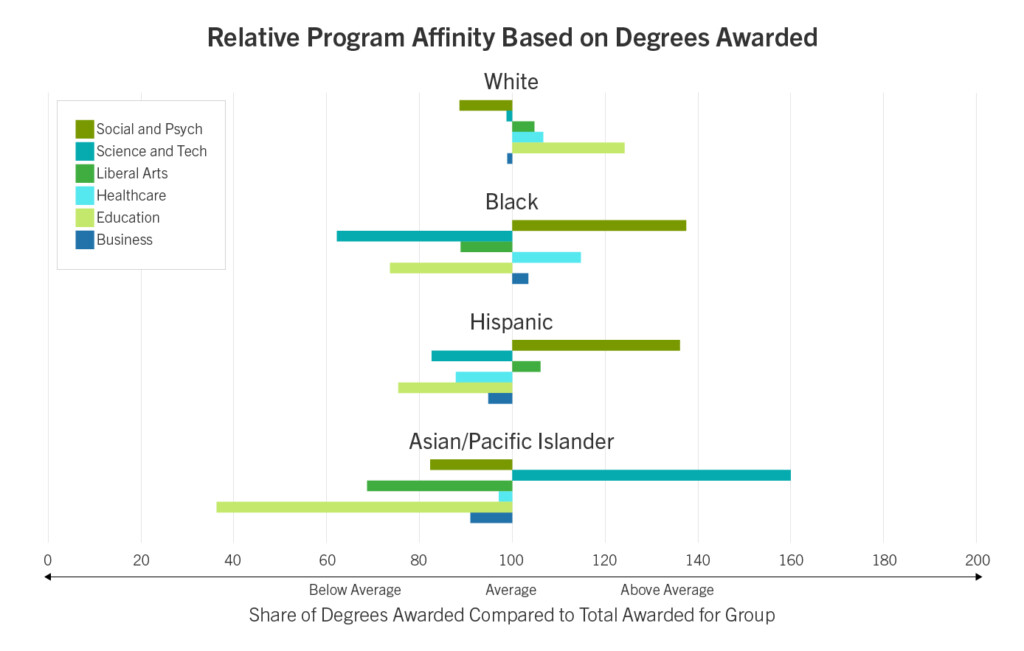
One of the most noticeable ways we see varying life experiences play out in the college setting is through program selection. There appear to be preferences among different racial and ethnic populations. The index below illustrates these distinctions by showing how the share of degrees awarded to a particular racial or ethnic group in a given field compares to the average share of total degrees awarded to that group. (Within the following graph, a number higher than 100 is greater than average for that particular ethnic group while a number below 100 is less than average for that group.)
*Digest of Education Statistics, Table 322.30; https://nces.ed.gov
You’ll notice that black and Hispanic students, for example, show a noticeable preference for the social and psychological sciences. And minority students as a whole don’t show strong affinity for studying education-oriented degree programs.
What this means for colleges
Today’s high school students are tomorrow’s college-bound adults. Unlike most segments of the market, higher education institutions have the rare benefit of being able to see who their future consumers will be. We already have a fairly good picture of what college enrollment by ethnicity will look like in the next decade.
But taking action to meet that audience where they are is essential. Colleges need to address, but not pander to, these different audiences. The key is that outreach – and its follow-through – has to be authentic.
“Speak to things like a degree program that will work for more complicated life needs or a degree structure that will meet students wherever they are in their career or learning journey with solutions that accelerate their ability to capitalize on their time at your school,” Nierengarten suggests.
It might sound intimidating, but bear in mind that some institutions are already succeeding in meeting diverse students’ needs. The numbers reflect this if you study them a bit to uncover which types of institutions different groups typically choose for enrollment. Hispanic students have traditionally shown a strong affinity for two-year public schools. And black students have the highest propensity of all ethnicities to enroll in for-profit schools.
Instead of being intimidated by this news, colleges should see this as an opportunity to learn and consider how they can adjust to meet the needs of their future students. At the very least, schools should consider what they can do to remove barriers that contribute to students dropping out. They may need to think about implementing some sort of onboarding program for adult students or considering how degree preferences among different racial and ethnic groups should inform program offerings.
Institutions can also look to adopt tactics like providing more robust support services, such as online office hours, and flexible learning models. Even making it easier for adult students to transfer credits makes a difference.
“That’s a really big deal, especially for someone who may have been in a scenario where they had to stop and then re-start college,” Nierengarten offers.
And remember that the job isn’t done once a student enrolls in a program. Continuing to support those students throughout their entire education journey is essential.
If you’d like help navigating the changing marketplace or evaluating your program offerings, get in touch. You can reach us at info@collegiseducation.com.
Innovation Starts Here
Higher ed is evolving — don’t get left behind. Explore how Collegis can help your institution thrive.