Higher education is entering 2026 in a period defined by rapid change, mounting pressure, and meaningful opportunity. Institutions are being asked to do more with less, meet rising expectations from students and families, and adapt quickly to shifting policy, technology, and market conditions.
From enrollment volatility and evolving student behavior to emerging policy changes and the next wave of AI adoption, colleges and universities will need to be more agile than ever. And all of this while staying focused on what matters most: serving learners and delivering results.
10 Higher ed trend predictions from Collegis leaders
We gathered insights from Collegis leaders across disciplines to share their perspectives on where higher education is headed. Below are the trends we believe will shape higher education in 2026, and practical ways institutions can prepare for what’s next.
1. The Efficiency Era of enrollment: scaling results without scaling staff
Enrollment teams are under growing pressure to meet goals with leaner resources. In 2026, institutions will focus on improving the fundamentals: speed-to-lead, workflow efficiency, conversion rates, and the overall experience from inquiry through enrollment.
How to prepare: Identify friction points across the enrollment funnel and use automation to streamline manual processes, strengthen follow-up, and improve conversion at every stage.
2. IT resilience becomes a competitive necessity: managed services fill the gap
As expectations for digital experiences grow, stable and secure systems are no longer “behind the scenes”. They’re central to institutional performance. In 2026, more colleges and universities will lean on managed services to access technical expertise, strengthen support, reduce downtime, and maintain momentum on modernization without expanding internal IT teams.
How to prepare: Assess critical systems and service levels, then determine where managed IT services can improve reliability and reduce risk.
3. AI-powered cyber threats accelerate: stronger protections become unavoidable
Cyberattacks are becoming more sophisticated as bad actors use AI to scale phishing, social engineering, deepfake fraud, and automated vulnerability scanning. In 2026, institutions will need to strengthen security quickly, using improved detection and monitoring while also tightening user protections.
That will likely mean more visible changes for end users, including stronger password requirements, broader multi-factor authentication, and increased security training.
How to prepare: Enhance threat detection, enforce stronger access controls, and invest in ongoing training to reduce risk across the institution.
4. Federal policy disruption reshapes affordability strategy (Big Beautiful Bill Act)
Policy shifts tied to the One Big Beautiful Bill Act could influence affordability and student borrowing in 2026, particularly impacting how students evaluate graduate and professional programs. Institutions may see shifts in demand and increased sensitivity to cost and ROI.
How to prepare: Monitor changes closely, model potential enrollment impacts, and align recruitment messaging around value, outcomes, and support.
5. AI moves from experimentation to proof: outcomes over hype
Many institutions have experimented with AI tools, but 2026 will be about results. Schools will prioritize AI use cases that improve speed, consistency, and efficiency across marketing, admissions, student support, and operations — all while establishing clearer governance.
How to prepare: Focus on practical applications, set policies and guardrails, and measure impact from the start.
6. Real-time performance analytics becomes a necessity
Institutions have access to more data than ever, but many still struggle to translate it into timely action. In 2026, successful teams will rely on real-time insight into marketing and enrollment performance to adjust faster, spend smarter, and improve outcomes.
How to prepare: Strengthen reporting and dashboards, unify key data sources, and build a culture of continuous optimization.
7. The “all-in-one platform” promise fades as tech stacks fragment
The idea that one tool can do everything is fading. Institutions are increasingly building ecosystems across CRM, marketing automation, student success platforms, and analytics tools — creating new challenges around integration, ownership, and execution.
How to prepare: Prioritize interoperability, clarify responsibilities across systems, and align technology decisions to student lifecycle goals.
8. OPM unbundling accelerates: partnerships become modular
Institution-partner relationships are evolving quickly. Rather than relying on a single end-to-end model, more institutions are taking a modular approach — selecting partners based on specific goals like enrollment, student support, analytics, or program growth.
How to prepare: Identify where internal resources are stretched and where specialized support can create the biggest measurable impact.
9. Retention becomes the new enrollment growth strategy
With acquisition costs rising and competition intensifying, more institutions will shift focus from “recruiting more students” to keeping more of the students they already have. In 2026, retention efforts will expand beyond early alerts and advising to include stronger proactive outreach, clearer pathways, and more support for students balancing work, family, and financial stress.
Re-engaging stop-outs will also become a priority as schools look for realistic ways to stabilize enrollment and improve outcomes.
How to prepare: Strengthen lifecycle engagement strategies, identify high-risk points in the student journey, and build scalable support models that keep learners moving forward.
10. Competition intensifies: performance marketing + differentiation + responsiveness win
Competition for students is increasing, and prospective learners expect clear value, relevant communication, and fast responses. In 2026, institutions will need sharper differentiation, stronger outcomes storytelling, and more consistent engagement across the student journey.
How to prepare: Refine program positioning, improve speed-to-response, and optimize recruitment efforts based on performance (not assumptions.)
Looking ahead: Turning 2026 pressure into progress
2026 will reward institutions that move quickly, remain focused, and keep students at the center of every decision. Collegis Education helps colleges and universities translate change into progress — supporting enrollment growth, student success, data-driven decision-making, and operational resilience.
If you’re ready to strengthen outcomes this year, we’re ready to help.
Innovation Starts Here
Higher ed is evolving — don’t get left behind. Explore how Collegis can help your institution thrive.
As the number of high school graduates declines, more and more colleges and universities are looking to the Some College, No Credential (SCNC) population as an opportunity for growth. According to the National Student Clearinghouse, there are 36.8 million people in this group, an increase of 2.9% from the previous year.
While many SCNC individuals stop out of higher education due to cost concerns, life changes, and mental health challenges, there is a segment of this population that has been forced to discontinue their degree program for reasons outside of their control.
Increased closures and mergers in higher education
The higher education landscape has been undergoing significant upheaval in recent years, with an increasing number of colleges and universities facing financial challenges and being forced to close or merge with other institutions. This trend has been driven by a variety of factors, including the looming “enrollment cliff” — a projected decline in the number of high school graduates due to demographic shifts — as well as rising costs, changing student preferences, and the lasting impacts of the COVID-19 pandemic.
For those of us following higher education news and trends, it can feel like a new school closure is announced every week. Higher Ed Dive publishes a tracker that indicates 118 colleges have been impacted by closures or mergers since 2016 (as of June 18, 2024).
Closures often leave students in a precarious position, scrambling to find alternative paths to complete their education. Tragically, a staggering 53% of students from closed colleges ultimately give up on their education altogether, according to a study by the State Higher Education Executive Officers Association (SHEEO). The challenges of navigating the transfer process, coupled with the loss of credits and mounting financial obligations, can become overwhelming, leading many students to abandon their academic aspirations.
Those who do manage to transfer to another institution often face additional hurdles. Fewer than half of the students who transfer stay long enough to earn their degrees, further highlighting the difficulties they encounter in adapting to a new academic environment and overcoming the setbacks caused by the college closure.
Understanding students affected by college closures
The SHEEO study shows the similarities and differences at an aggregate level of students from closed colleges versus students at open colleges. Students from closed institutions are more likely to be black, female, and federal Pell Grant recipients, which are awarded to students from low-income families. They are also likely to be under age 24 and attending college full-time.
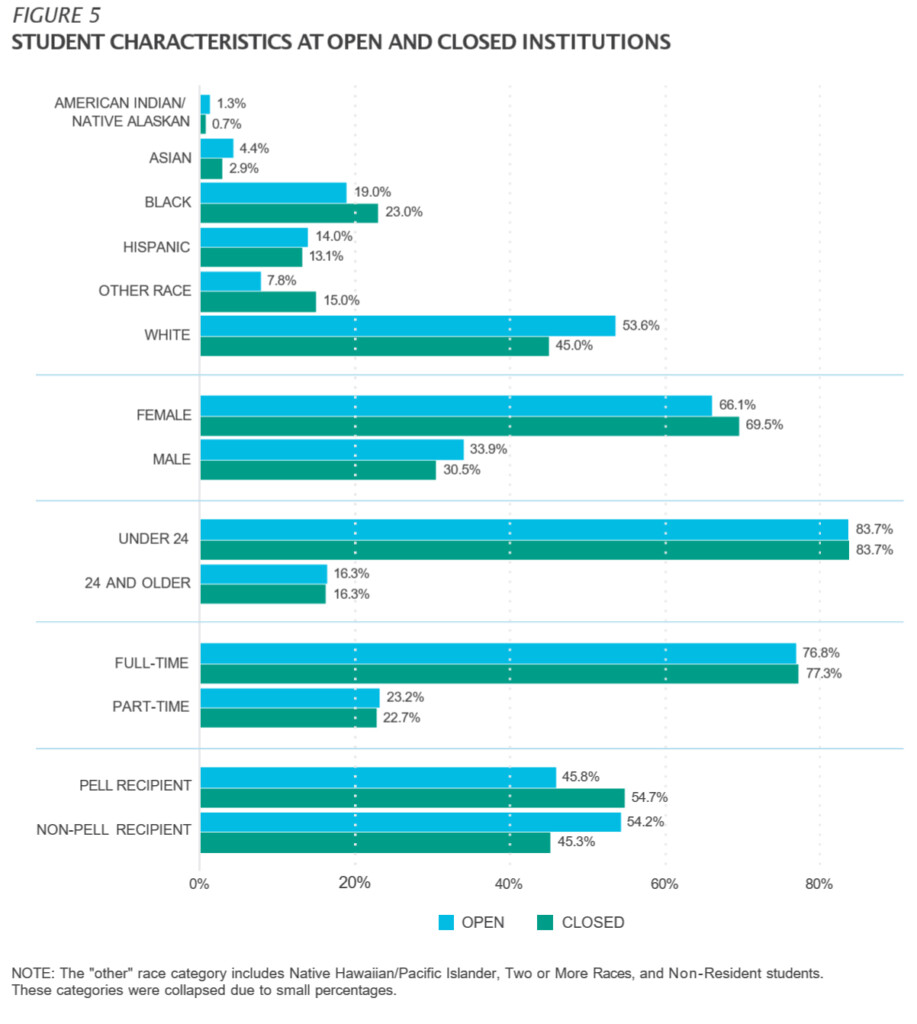
Students who experienced college closures but enrolled within 120 days of closure were mostly female, white, and older than 30 at the time of closure.
Challenges faced by students impacted by school closures
The biggest hurdle students face is understanding their options and next steps. This requires having access to experienced advisors to help them understand and navigate these options. They need guidance on how to access their academic transcripts, which colleges will accept their previously earned credits, and what the implications are for their financial aid and student loans. These are complex issues that can overwhelm students. For those blindsided by their school’s closure, attempting to navigate this landscape alone often leads to confusion and frustration, and many ultimately give up on completing their degree.
Supporting impacted students: Transfer strategies for colleges and universities
Here are some recommendations your school can adopt to support students impacted by closures in your region.
Understand the mindset of students impacted by school closures
Having your school shut down in the midst of your degree program is an incredibly disruptive experience. The path forward seems unclear and daunting. Students impacted by these closures often feel a mix of emotions: anger at the situation, sadness over the loss of their school community, fear about their future prospects, and a sense of hopelessness or of being cheated out of their educational journey.
Many start to question whether continuing to pursue a degree is worth the effort. They may feel the same stresses and anxieties they experienced as high school seniors, having to re-evaluate options, navigate application processes, and make major life decisions all over again. And they’ll be looking for signs of stability and program viability in their next school.
Partner with schools in financial trouble to support student transfers
The more notice a student has of their school closing, the better they do. Unfortunately, some schools have given as little as two weeks’ notice. Students impacted by schools that were transparent about the challenges they were facing, and the possibility of closure, have been able to navigate their experience with more resilience. Proactively offering to partner with schools in financial distress to develop transition plans for their students will not only provide a lifeline for students but also demonstrate your commitment to higher education and the well-being of the community at large.
Transition plans should outline clear pathways for seamless credit transfers, financial aid assistance, and academic advising. By working together, you can ensure that students’ academic progress is not disrupted and their hard-earned credits are recognized.
Engage students impacted by closures and offer transfer options
Help students navigate this challenging time by activating a marketing strategy that provides resources to students who’ve been impacted by a school closure. Key questions students will be asking themselves:
- Does my school have a teach-out plan to help me complete my degree?
- Which schools will accept the credits I have already earned?
- How do I get official copies of my transcript?
- What is the status of my financial aid?
- Can I/should I discharge my student loans?
We recommend including the following tactics in your marketing strategy to reach these students:
- Create a landing page specifically for the identified school with messaging that speaks to their students. Messaging should encourage them to continue with their studies while offering support and detailing the options available at your school. Be as specific as possible around teach-out/transfer details. All marketing activities should direct students to this page.
- Create organic social media posts offering support to students from the identified school. Feature testimonials of transfer students from the closed school if available.
- Prepare statements for leadership and faculty to share on their own social media channels.
- Distribute the messaging and approach for managing inquiries with the admissions team.
- If applicable, plan targeted media campaigns for the geographical area in paid search and paid social channels.
Streamline credit transfer policies and maximize credit acceptance
Ensure your transfer policies are straightforward and lean toward accepting as many credits as possible. Take the time to evaluate course-substitution options from the closing institution to maximize the number of credits that can transfer.
Your admissions team should also be prepared to suggest alternative degrees if they are more aligned with the student’s existing credits. When possible, work with the closing school to receive students’ transcripts to take that burden off the student. Promise students prompt transfer evaluations, ensuring that internal operations are organized to complete evaluations in 24 hours or less.
Waive application fees to remove barriers
You may charge nominal fees during the application process to demonstrate an applicant is serious about wanting to attend the institution. But paying those fees often requires accessing unfamiliar systems and can be one more cumbersome hurdle these transfer students don’t need while their lives are in upheaval.
Ensure support services facilitate adjustment to your school
Students who are motivated to transfer right away are focused on their goal of finishing their degree. They need an institution that is willing and able to move quickly. Identify a core group of employees who can be dedicated to ensuring these students are accommodated. Streamline your admissions process to remove unnecessary requirements for students in this circumstance.
Provide additional support for their transition to your program, understanding that the majority are younger full-time students. Help residential students find appropriate housing or adapt from on-campus learning to an online program.
Once impacted students express interest, create an automated communication journey to help them move through the process of application, transfer evaluation, scholarship and financial aid packages, and enrollment.
Build an agile, student-centered transfer process
According to Jospeh Sallustio, senior vice president for Lindenwood Global at Lindenwood University, schools that can be agile will have increased administrative and academic expenses; but in the long run, they will enjoy a stronger brand through earned respect of their students and alumni.
As you plan to support transfer students from closing schools in your region, Collegis can help you navigate this complex landscape. Through close collaboration with our partners, we meticulously craft processes and messaging that instill confidence in students as they chart their path forward. By testing the effectiveness of our messaging and adapting to their preferred engagement styles, we guide students seamlessly through the enrollment process and illuminate the profound impact that your programs can have on their careers and lives.
To ensure an effective, student-centered approach, we can also map your enrollment process, identify opportunities, and execute strategies that prioritize these students’ unique needs. As an extension of your team and institution, we’ll build a collaborative approach to help students from closing colleges and universities beat the odds and continue their education. Contact us to learn more.
Innovation Starts Here
Higher ed is evolving — don’t get left behind. Explore how Collegis can help your institution thrive.