Last month, presidents, chancellors, and cabinet-level leaders, along with some of the most influential voices in higher education, joined Collegis Education at Arizona State University for #DisruptED26 — an executive-level summit where leaders came together to confront higher ed’s toughest challenges, from enrollment pressure and regulatory disruption to AI readiness and student experience.
It was a day of courageous conversations on how to shift the balance of power in our space from being disrupted to being the disrupters of higher ed. We discussed what it takes to operationalize innovation and how to redesign the student experience around the realities of modern higher education.
One message came through consistently: Institutions cannot afford to respond to today’s challenges with yesterday’s models. Here are some of the key insights and takeaways from #DisruptED26.
5 Key insights shaping higher ed’s next chapter
The conversations at #DisruptED26 surfaced several themes that will shape how institutions respond to enrollment pressure, technological disruption, and evolving student expectations.
1. Student behavior has changed faster than institutional design has kept pace.
The traditional student of today is non-traditional. Their expectations, behaviors, and preparation levels have evolved just as quickly. Students now search and browse differently — 60% of searches end in zero clicks — learn with AI, and arrive differently prepared, with reading levels the lowest in 30 years.
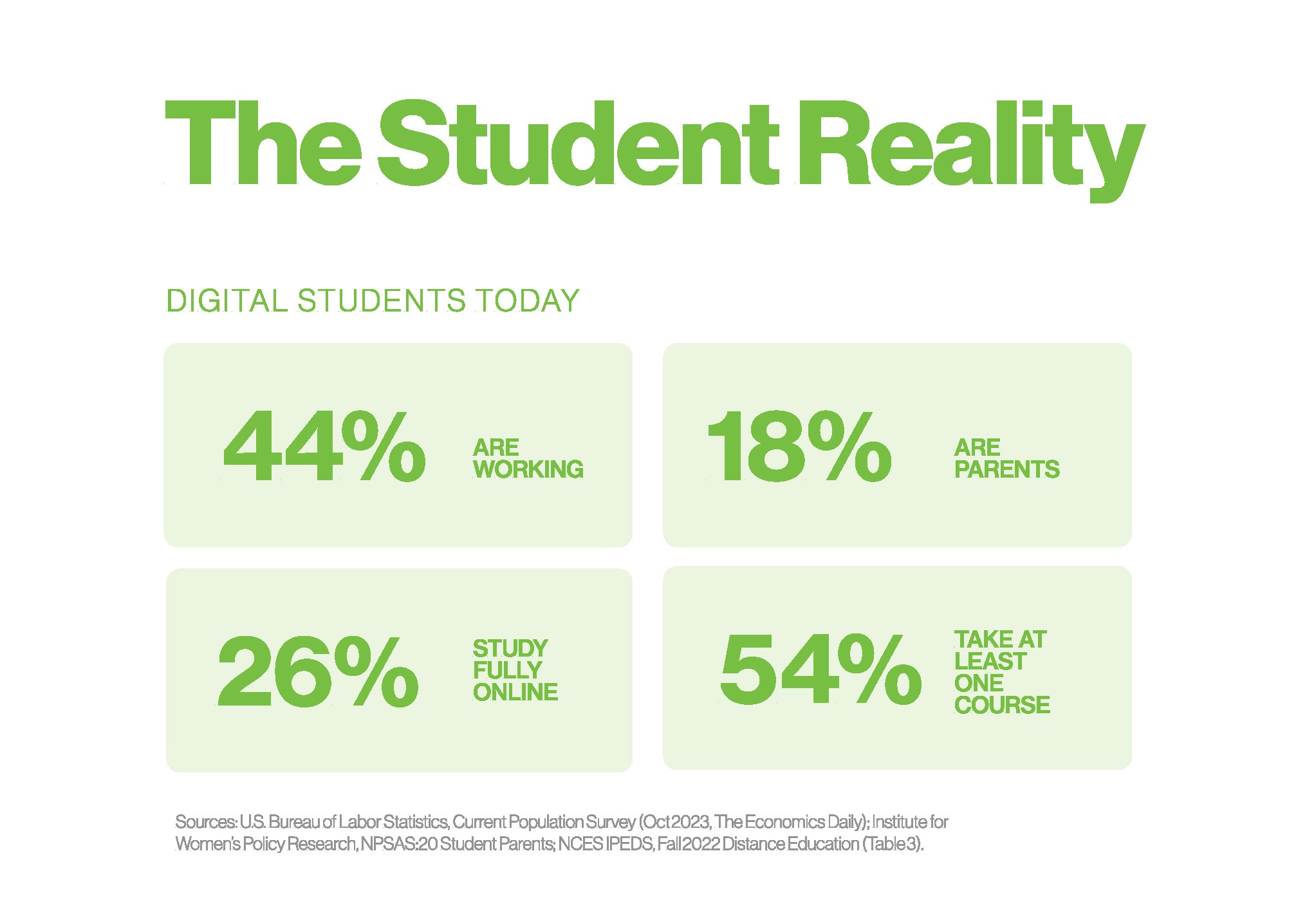
But here’s the problem: Institutions are still designing experiences for learners from 10 to 20 years ago. AI, technology, and a global pandemic rewired our behaviors, yet higher ed models remain relics of another era. We’ve reached a watershed moment, and as Michael Crow, President of Arizona State University, boldly states. Higher ed must evolve — or risk dying.
Institutions need to start thinking and operating more like businesses, treating their students as customers, and delivering products, experiences, and services that meet student expectations while staying mission-aligned. We’ve reached our Netflix moment.
2. The 60-year ‘Golden Age’ of enrollment growth is gone
The challenge is bigger than the demographic cliff alone. Wage compression, declining consumer confidence in higher ed, and graduates not being immune to lengthy periods of unemployment are all contributing to a decline in matriculation.
As Nathan Grawe, author and professor of economics at Carleton College, warned, “Institutions cannot simply recruit their way out of this problem.” The traditional-age higher ed market will continue to tighten. Recent projections show a 10% decline nationally from 2025 to 2041, requiring institutions to chase the same shrinking pool, potentially intensifying discounting and competition.
3. Experience is the new differentiator and it requires systems thinking and design thinking
To win the long game, schools must look at the end-to-end student experience, not just course design and curriculum. Fixing one piece of the student journey will do you no good if the surrounding student experience remains broken.
How do you accomplish this? To start, higher ed needs to adopt a systems-thinking and design-thinking mindset. It enables leaders to evaluate their tech, data, and institutional infrastructure while keeping solutioning and innovation student-centered. When system health is balanced with end-user delight, friction is reduced, outcomes improve, and exceptional experiences emerge.
4. The OPM era is giving way to a more accountable partnership model
Institutions are facing new program-level accountability requirements and need to shift from dependency to empowerment in their online and hybrid strategies. This is less about abandoning partnerships and more about pursuing balanced, transparent partnerships that build institutional capability over time.
As Marc Austin, Vice Provost and Managing Director of Montclair Unbound, stated at a previous Collegis summit, “Invest internally in your current centers of excellence, and look to partner where capacity and expertise may be limited.”
5. The higher ed regulatory environment is not episodic; it is cumulative
From January 2025 through early 2026, there’s been a regulatory tsunami — a rolling sequence of federal actions spanning DEI, funding freezes, IES cuts, Department of Education restructuring, accreditation, workforce development, AI, admissions transparency, and negotiated rulemaking.
The key insight is operating volatility: Leaders are not responding to one rule change but to continuous policy churn. Accountability is moving closer to program economics and outcomes, with earnings thresholds, disclosure requirements, and potential loss of direct loan eligibility, thereby shifting risk from the institutional level to the program level.
Rewriting the rules of higher education
From the first session to the final conversation, #DisruptED26 proved that a packed agenda need not come at the expense of engagement. The day prioritized session quality over quantity, bringing together senior leaders for honest, candid, and deeply interactive discussions.
Rather than delivering presentations from a distance, speakers and SMEs engaged participants in a true dialogue — one that challenged assumptions, invited debate, and sparked the kind of collaboration that rarely happens in larger conference settings. As Amanda Gulley, Chief Product and Experience Officer at ASU EdPlus, said, “This is some of the best content I have seen at a higher ed conference.”
If #DisruptED26 made one thing clear, it is that higher ed leaders are hungry for spaces where real challenges can be met with real conversation. We’re already looking ahead to the next DisruptED on September 23 in Denver, Colorado, with more details to be announced soon. We hope to see you there!
Innovation Starts Here
Higher ed is evolving — don’t get left behind. Explore how Collegis can help your institution thrive.
Technology expectations in higher education have never been higher. Students expect seamless digital experiences, faculty rely on stable, integrated systems to teach and conduct research, and institutional leaders need real-time data to make informed decisions.
Yet many colleges and universities remain stuck, held back by aging infrastructure, limited budgets, or the belief that maintaining the status quo is safer than change.
From where I sit, that belief is one of the most expensive misconceptions in higher ed today.
IT inaction isn’t neutral. Standing still doesn’t preserve resources; it quietly drains them. Over time, those costs compound in ways that are harder to see, harder to control, and far more disruptive than proactive modernization.
The hidden costs of doing nothing
When institutions delay IT investment, the consequences rarely show up as a single line item. Instead, they surface as inefficiencies spread across budgets, teams, and timelines.
Legacy systems are a prime example. Redundant platforms often require duplicated effort, separate maintenance contracts, and manual reconciliation between systems that should be integrated.
Hardware that’s past its lifecycle can lead to unexpected outages and emergency spending that exceeds planned budgets. Older systems also demand specialized support, which is increasingly difficult and expensive to find as vendors phase out end-of-life technology.
What’s most costly, though, is time.
IT teams spend countless hours keeping outdated systems afloat by troubleshooting avoidable issues, applying workarounds, and responding to preventable failures. That’s time not being spent on strategic initiatives that improve efficiency, student experience, or institutional resilience.
I often describe it this way: Maintaining legacy systems is like pouring money into a leaky boat just to stay afloat, not to move forward.
Security vulnerabilities and reputational risk
When it comes to cybersecurity, the cost of inaction is especially serious.
Legacy systems that lack consistent monitoring pose a heightened security risk. Outdated software, fragmented technology environments, and limited visibility create prime opportunities for cyberattacks — particularly for institutions that handle sensitive student, faculty, and financial data.
Compliance becomes more difficult in these conditions. Meeting FERPA, HIPAA, and other regulatory requirements is far more complex when systems aren’t integrated or consistently managed. Non-compliance doesn’t just carry financial penalties. It can threaten accreditation and erode institutional trust.
The fallout of a breach extends well beyond remediation costs. Reputational damage can deter prospective students, strain donor relationships, and take years to repair.
Simply put, institutions don’t want to make headlines because of a cybersecurity lapse they could have prevented.
Ready for a Smarter Way Forward?
Higher ed is hard — but you don’t have to figure it out alone. We can help you transform challenges into opportunities.
Missed opportunities for strategic growth
IT inaction doesn’t just introduce risk. It actively limits growth.
Students move seamlessly across digital platforms in every part of their lives. When institutional systems don’t integrate, the student experience becomes fragmented, support slows down, faculty shoulder unnecessary administrative burdens, and leaders lose the data visibility needed to intervene early or plan strategically.
I’ve seen institutions stuck on legacy SIS infrastructure that prevents modern integrations altogether. The result is manual reporting, delayed insights, and staff hours spent pulling data instead of using it.
Outdated environments also restrict access to emerging technologies like AI, automation, and advanced analytics. These are tools that could drive efficiency, personalize engagement, and support enrollment and retention strategies. Without a scalable IT foundation, even well-intentioned growth initiatives increase cost and complexity instead of reducing them.
IT staff burnout and talent drain
The impact of chronic IT underinvestment is deeply human.
Internal IT teams in under-resourced environments operate almost entirely in reactive mode. They’re constantly firefighting by responding to outages, security alerts, and system failures, all while knowing the underlying risks remain unresolved.
That’s exhausting, and over time, it erodes morale.
Talented IT professionals want to innovate. They want to build, improve, and contribute strategically. When their work is limited to keeping aging systems alive, frustration builds, and burnout follows. Eventually, institutions lose people they can’t easily replace.
Recruitment becomes harder as well. Prospective hires can quickly identify an organization with no clear IT roadmap. They understand what that environment demands, and many choose to look elsewhere.
This is where managed IT support can fundamentally change the equation.
By shifting routine monitoring, maintenance, and after-hours support to a trusted partner, institutions reduce daily stressors on internal teams. Proactive management prevents crises before they escalate. Internal staff regain the capacity to focus on strategy, innovation, and meaningful institutional impact.
Inaction is a choice (an expensive one)
One of the biggest misconceptions I hear from higher ed leaders is that modernizing IT is too expensive, too complex, or too disruptive.
The reality is that institutions are already paying for IT. They’re just paying in less visible and far less controlled ways. They’re paying through staff turnover, downtime, security exposure, and through leadership time spent managing exceptions instead of advancing strategy.
Modern IT investment isn’t about chasing the latest technology. It’s about stabilizing operations, reducing risk, and making costs predictable. It’s a decision about institutional capacity, long-term resilience, and the people who make both possible.
If I had 60 seconds with a higher ed president or CFO, I’d say this: The decision isn’t whether you’re spending on IT. That spend is already happening. The real question is whether you want it to be controlled and strategic, or hidden and reactive.
Moving forward with confidence
Higher education is navigating unprecedented change. Institutions that succeed won’t be the ones that avoid investment. They’ll be the ones that built strong, flexible foundations capable of supporting their mission long-term.
If your institution is feeling the strain of outdated systems or reactive IT, now is the time to act. Collegis partners with colleges and universities to stabilize operations, reduce risk, and build IT environments designed for what’s next through our Managed IT Services for higher education.
Innovation Starts Here
Higher ed is evolving — don’t get left behind. Explore how Collegis can help your institution thrive.
Are your retention efforts aligned with what today’s adult learners actually need?
Many colleges and universities are doubling down on student retention, but the results aren’t always there. New research from Collegis Education and UPCEA reveals why: A persistent disconnect between institutional strategies and what online adult learners say actually helps them stay enrolled.
This report shares the voices of more than 1,000 adult online learners and 50+ institutional leaders to uncover where support systems fall short — and how to close the gap.
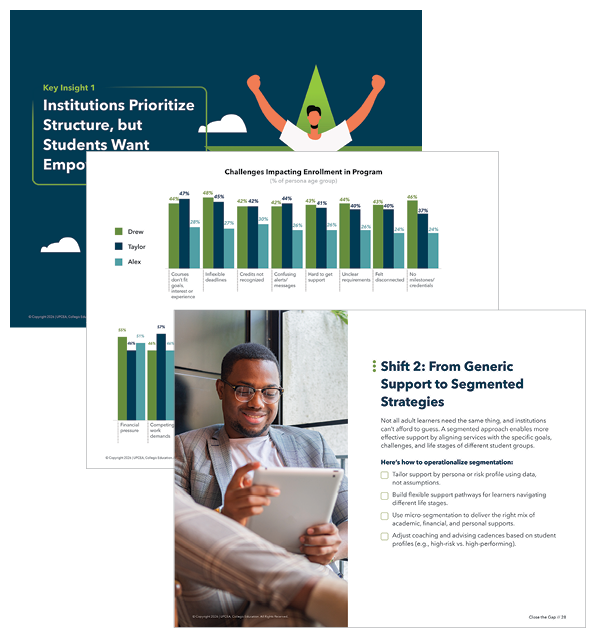
What you’ll learn:
- The top reasons adult learners consider leaving — and how institutions can better address them
- What adult learners rate as the most helpful support strategies (hint: it’s not what most institutions are prioritizing)
- Where institutional leaders are “flying blind” when it comes to measuring online retention
- Three strategic shifts to help you personalize support, use data more effectively, and drive real gains in persistence
This report is designed for:
- Provosts and academic leaders
- Retention and student success teams
- Online program administrators
- Enrollment and institutional strategy professionals
Understand what adult learners need, uncover what your institution might be missing, and start closing the gap.
Submit the form on the top right to get your free copy.
In today’s higher education landscape, the pressure to adapt has never been higher. Institutions are facing increased demands for transparency, affordability, and accountability from both students and the federal government. To thrive amid this scrutiny, colleges and universities must shift from periodic academic program reviews to an “always-on” portfolio management approach.
The institutions that succeed in the coming years won’t be those with the biggest catalogs. They’ll be the ones with the most disciplined, data-informed portfolios. Those that are regularly evaluated and refined to meet student, market, and regulatory expectations.
3 market trends forcing a new approach to program strategy
The following trends are reshaping how institutions must approach academic program strategy. Each highlights why traditional review cycles are no longer enough, and why a continuous, data-informed portfolio management model is essential.
- Student affordability sensitivity is rising: Students and families are making more value-conscious decisions. They want proof that an academic program will lead to career outcomes that justify the investment. Programs with unclear value propositions face enrollment decline and reputational risk.
- Labor market and skills cycles are accelerating: The pace of change in the workforce means skills needs are evolving faster than ever. If academic offerings don’t keep pace, institutions risk graduating students into irrelevance. Agility is crucial for staying aligned with industry demand.
- Program-level scrutiny is intensifying: New regulations, such as those proposed in the bipartisan OBBB bill, formalize expectations around gainful employment and financial value transparency. These changes mark a shift from access-based accountability to market- and outcomes-based accountability. They require institutions to know, show, and grow the value of every program they offer.
A new operating rhythm: Annual program review
Many institutions still operate on a five-year program review cycle, a cadence that no longer supports sustainable decision-making. In a faster-moving environment, annual review is the new standard.
“Program review must evolve into a dynamic, ongoing process. Institutions need a defined, strategic, and systematic rhythm — one that uses valid data to ensure alignment with student demand, workforce needs, and financial sustainability.”
— Dr. Tracy Chapman, Chief Academic Officer
A modern review process should include:
- Internal metrics: enrollment trends, revenue contribution, cost of delivery, and student learning outcomes
- External data: student and employer demand, competitive positioning, and alignment with learner expectations
- Financial performance: program profitability, tuition pricing, and resource optimization
When done consistently, this evidence-based practice can help institutions scale what’s working, fix what’s slipping, and sunset programs that no longer serve students or the institution.
Make market research a strategic discipline
Just as accreditation is a continuous, evidence-based process tied to institutional decisions, so too should market research. It cannot be treated as a one-time validation for new programs or a compliance box to check. It should be embedded into institutional strategy.
That means investing in:
- Reliable, valid data sources
- Systems and platforms that connect market signals to internal performance
- Skilled analysts and decision-makers who can interpret and act on insights
What it takes to operationalize strategic program management
To make continuous portfolio management a reality, institutions need the following:
- Time: Strategic prioritization of program review as a leadership function
- Talent: Cross-functional collaboration across academic, enrollment, finance, and IT teams
- Technology: Data platforms like Collegis Connected Core® to unify insights and enable evidence-based decisions at scale
For institutions that have yet to build the internal expertise or data infrastructure to support this work, Collegis Education brings the strategy, technology, and insight needed to support this type of transformation. From market research and academic portfolio development to data integration and instructional design, we help colleges and universities move from reactive review cycles to proactive portfolio optimization.
Disciplined portfolios drive sustainable growth
Whether the White House and Congress tilt red or blue, regulatory oversight of higher education isn’t going anywhere. The institutions that are best suited for long-term success will be those that treat program portfolio management not as a reactive task, but as a continuous, strategic discipline.
It’s time to make market analysis a routine leadership practice. Protect your students. Protect your resources. And double down on the programs that deliver the most value — to students, to employers, and to your institution’s future.
Reach out to learn how we can help you make this shift with confidence and clarity.
Innovation Starts Here
Higher ed is evolving — don’t get left behind. Explore how Collegis can help your institution thrive.
For many independent colleges, the notion of “resilience” has long conjured images of tradition, legacy, and steadfast leadership. But in 2026, that definition is due for a rewrite.
At this year’s CIC Presidents Institute, I joined a powerful workshop alongside fellow higher ed leaders and strategists to confront a hard truth: the pressures facing small and mid-sized private institutions are no longer theoretical. They’re here, and they’re intensifying.
It’s time to meet this moment not with tweaks around the edges, but with bold, informed action.
A financial picture that’s tough to ignore
Paul Friga, a trusted strategist in higher ed finance, shared a sobering overview of the economic reality. Consider just a few of the trends:
- Undergraduate enrollment remains 15% below 2010 levels, despite a modest recent bump primarily driven by community colleges.
- The sector has added more capacity than it can fill, resulting in an estimated 3–5 million excess seats, and an annual cost of up to $50 billion to maintain them.
- Independent institutions with under 5,000 students are among the most vulnerable, with many operating in a “danger zone” marked by financial fragility.
Meanwhile, legacy cost structures, declining demographics, and fragmented strategies are making it harder for leaders to balance the books, let alone invest in the future.
Single solutions won’t save us
What’s clear from the data — and from conversations with dozens of presidents — is that no one lever alone will restore financial sustainability. Not another round of cost-cutting. Not a new marketing campaign. Not even a promising program launch.
Real resilience requires coordinated action across three interconnected dimensions:
- Revenue growth, rooted in programs that align with workforce demand and nontraditional learner needs.
- Cost optimization, through more efficient tech systems, staffing structures, and academic portfolios.
- Execution discipline, ensuring initiatives are prioritized, resourced, and tracked with the right accountability frameworks.
Together, these dimensions form a practical roadmap, and they align closely with what we’ve seen in our work with institutions across the country. Those that adopt a multi-lever approach are better positioned to move beyond crisis response and build a more sustainable, mission-aligned future.
What independent institutions must do now
During our session, I spoke about how Collegis partners are navigating these challenges with clarity and purpose. Institutions that are making meaningful progress are focusing on a set of clear, coordinated actions:
- Build transparency and alignment. Sharing financial and enrollment realities across campus fosters a culture of shared responsibility. When faculty and staff understand the stakes, they become part of the solution.
- Use faster financial signals to guide decisions. Tracking indicators like net tuition revenue, tuition discount rate drift, retention risk by term, and cost per student on a monthly basis equips leaders to act quickly — protecting 1 to 3 percent of net revenue.
- Prioritize based on ROI. Reassess low-enrolled courses, identify programs with strong demand and sustainable margins, and shift resources accordingly. Transparent, data-informed decisions strengthen both financial health and mission delivery.
- Simplify the student experience. Complexity increases both expense and attrition. Streamlining high-friction processes, reducing redundant technologies, and eliminating manual workarounds can save $500 to $1,500 per student and improve retention.
- Assign ownership for retention. Student success requires more than good intentions. Giving executive-level leaders visibility into open student issues, resolution timelines, and effective intervention can lead to retention gains of 2 to 3 percent.
- Eliminate overlap and inefficiency. Marketing and enrollment operations often reveal duplication and misalignment. Consolidating efforts and focusing on conversion can yield higher impact at lower cost.
- Start small and move fast. Institutions that limit focus to a few initiatives with clear ownership drive early wins and build lasting momentum.
- Choose the right partner. Independent colleges don’t have to go it alone. Strategic partners bring the scale, data infrastructure, and experience to accelerate transformation without sacrificing institutional identity — and can help reduce fixed costs by 5 to 10 percent or more.
Resilience requires reinvention, not routine
True resilience isn’t about weathering storms using the same tools and tactics. It means rethinking how we operate, how we lead, and where we invest. That shift must be driven by urgency and clarity.
Independent institutions have always played a transformative role in higher education. To continue that legacy, leaders need a new approach. The greatest risk now is standing still.
Those willing to rethink, realign, and act with purpose won’t just survive — they’ll help shape a stronger, more sustainable future while still protecting their mission.
Innovation Starts Here
Higher ed is evolving — don’t get left behind. Explore how Collegis can help your institution thrive.
New research from UPCEA and Collegis Education reveals a growing misalignment between how institutions approach retention and what adult learners actually need to succeed. While many institutions are investing in retention, strategies still over-rely on structured oversight and under-deliver on the flexibility, visibility, and autonomy adult online learners say they need most.
The Retention Disconnect: What Adult Learners Need and What Institutions Miss
Wednesday, February 11
1:00 pm ET / 12:00 pm CT
Join Dr. Tracy Chapman, Chief Academic Officer at Collegis Education, and Emily West, Senior Market Research Analyst at UPCEA, as they break down key findings from the national survey and explore how institutions can realign support strategies to improve outcomes, protect revenue, and meet adult learners where they are.
Expert Speakers

Dr. Tracy Chapman
Chief Academic Officer
Collegis Education

Emily West
Senior Market Research Analyst
UPCEA
What you’ll learn:
- Why nearly half of institutional leaders can’t report their online retention rate — and why that matters
- The disconnect between staff-led interventions and student-preferred tools like dashboards and self-service
- How to shift from compliance-based models to empowerment-driven support
- The importance of segmentation based on life stage, not just demographics
- Three strategic shifts institutions can act on now
Who should attend:
This session is ideal for higher ed leaders focused on student success, enrollment, and retention strategy, including:
- Academic leadership (CAOs, provosts)
- Enrollment and student affairs leaders
- Online and adult learner program managers
- Institutional researchers and data strategists
- IT decision-makers
- Presidents, CFOs, and strategic planning teams
If you’re working to improve outcomes for adult online learners or reduce attrition, this webinar is for you.
Complete the form on the top right to reserve your spot. We look forward to seeing you on Wednesday, February 11.
Higher education is entering 2026 in a period defined by rapid change, mounting pressure, and meaningful opportunity. Institutions are being asked to do more with less, meet rising expectations from students and families, and adapt quickly to shifting policy, technology, and market conditions.
From enrollment volatility and evolving student behavior to emerging policy changes and the next wave of AI adoption, colleges and universities will need to be more agile than ever. And all of this while staying focused on what matters most: serving learners and delivering results.
10 Higher ed trend predictions from Collegis leaders
We gathered insights from Collegis leaders across disciplines to share their perspectives on where higher education is headed. Below are the trends we believe will shape higher education in 2026, and practical ways institutions can prepare for what’s next.
1. The Efficiency Era of enrollment: scaling results without scaling staff
Enrollment teams are under growing pressure to meet goals with leaner resources. In 2026, institutions will focus on improving the fundamentals: speed-to-lead, workflow efficiency, conversion rates, and the overall experience from inquiry through enrollment.
How to prepare: Identify friction points across the enrollment funnel and use automation to streamline manual processes, strengthen follow-up, and improve conversion at every stage.
2. IT resilience becomes a competitive necessity: managed services fill the gap
As expectations for digital experiences grow, stable and secure systems are no longer “behind the scenes”. They’re central to institutional performance. In 2026, more colleges and universities will lean on managed services to access technical expertise, strengthen support, reduce downtime, and maintain momentum on modernization without expanding internal IT teams.
How to prepare: Assess critical systems and service levels, then determine where managed IT services can improve reliability and reduce risk.
3. AI-powered cyber threats accelerate: stronger protections become unavoidable
Cyberattacks are becoming more sophisticated as bad actors use AI to scale phishing, social engineering, deepfake fraud, and automated vulnerability scanning. In 2026, institutions will need to strengthen security quickly, using improved detection and monitoring while also tightening user protections.
That will likely mean more visible changes for end users, including stronger password requirements, broader multi-factor authentication, and increased security training.
How to prepare: Enhance threat detection, enforce stronger access controls, and invest in ongoing training to reduce risk across the institution.
4. Federal policy disruption reshapes affordability strategy (Big Beautiful Bill Act)
Policy shifts tied to the One Big Beautiful Bill Act could influence affordability and student borrowing in 2026, particularly impacting how students evaluate graduate and professional programs. Institutions may see shifts in demand and increased sensitivity to cost and ROI.
How to prepare: Monitor changes closely, model potential enrollment impacts, and align recruitment messaging around value, outcomes, and support.
5. AI moves from experimentation to proof: outcomes over hype
Many institutions have experimented with AI tools, but 2026 will be about results. Schools will prioritize AI use cases that improve speed, consistency, and efficiency across marketing, admissions, student support, and operations — all while establishing clearer governance.
How to prepare: Focus on practical applications, set policies and guardrails, and measure impact from the start.
6. Real-time performance analytics becomes a necessity
Institutions have access to more data than ever, but many still struggle to translate it into timely action. In 2026, successful teams will rely on real-time insight into marketing and enrollment performance to adjust faster, spend smarter, and improve outcomes.
How to prepare: Strengthen reporting and dashboards, unify key data sources, and build a culture of continuous optimization.
7. The “all-in-one platform” promise fades as tech stacks fragment
The idea that one tool can do everything is fading. Institutions are increasingly building ecosystems across CRM, marketing automation, student success platforms, and analytics tools — creating new challenges around integration, ownership, and execution.
How to prepare: Prioritize interoperability, clarify responsibilities across systems, and align technology decisions to student lifecycle goals.
8. OPM unbundling accelerates: partnerships become modular
Institution-partner relationships are evolving quickly. Rather than relying on a single end-to-end model, more institutions are taking a modular approach — selecting partners based on specific goals like enrollment, student support, analytics, or program growth.
How to prepare: Identify where internal resources are stretched and where specialized support can create the biggest measurable impact.
9. Retention becomes the new enrollment growth strategy
With acquisition costs rising and competition intensifying, more institutions will shift focus from “recruiting more students” to keeping more of the students they already have. In 2026, retention efforts will expand beyond early alerts and advising to include stronger proactive outreach, clearer pathways, and more support for students balancing work, family, and financial stress.
Re-engaging stop-outs will also become a priority as schools look for realistic ways to stabilize enrollment and improve outcomes.
How to prepare: Strengthen lifecycle engagement strategies, identify high-risk points in the student journey, and build scalable support models that keep learners moving forward.
10. Competition intensifies: performance marketing + differentiation + responsiveness win
Competition for students is increasing, and prospective learners expect clear value, relevant communication, and fast responses. In 2026, institutions will need sharper differentiation, stronger outcomes storytelling, and more consistent engagement across the student journey.
How to prepare: Refine program positioning, improve speed-to-response, and optimize recruitment efforts based on performance (not assumptions.)
Looking ahead: Turning 2026 pressure into progress
2026 will reward institutions that move quickly, remain focused, and keep students at the center of every decision. Collegis Education helps colleges and universities translate change into progress — supporting enrollment growth, student success, data-driven decision-making, and operational resilience.
If you’re ready to strengthen outcomes this year, we’re ready to help.
Innovation Starts Here
Higher ed is evolving — don’t get left behind. Explore how Collegis can help your institution thrive.
Lead technology transformation with confidence, clarity, and control.
IT isn’t just a cost center. It’s a critical enabler of your institution’s strategic goals. But too often, campus technology operations are under-resourced, fragmented, and reactive. That leaves CFOs in the dark about what’s working, what’s wasted, and where to invest next.
We built this free guide specifically for higher ed finance leaders who are ready to shift from maintenance mode to a more strategic, future-ready approach.
What You’ll Learn:
- Why most institutions struggle to modernize their IT function — and how to break the cycle
- How to assess infrastructure health, team capabilities, and tech ROI using a practical evaluation framework
- Where to find hidden costs, duplication, and vendor inefficiencies
- What a high-performing IT operation looks like and how to build one at your institution
- Steps you can take today to align IT investments with institutional priorities
Who It’s For:
- CFOs and finance leaders
- COOs, CIOs, and enrollment executives involved in tech decision-making
- Presidents and provosts seeking better visibility into IT performance
Whether you’re facing outdated systems, overwhelmed teams, or rising IT costs with unclear returns, this guide will give you the insight and structure to lead with impact.
Submit the form on the top right to get your free copy.
Online programs are no longer a nice-to-have. They are essential, with many schools looking to online as their primary growth lever amid market headwinds. A strong portfolio of online programs can allow institutions to grow enrollment, reach new student populations, and future-proof their offerings. But building, launching, and sustaining a successful online program operation requires a certain expertise that many internal teams lack. And even if your team has the right skills, you have to ask, “Do they really have the capacity to take on one more thing?”
Given that time and budget are often finite, and the deep digital expertise needed to launch, scale, and sustain competitive online programs, its easy to see why traditional Online Program Management (OPM) providers would seem like a turn-key solution. At first glance, this revenue-share OPM model appears checks all the boxes: no upfront cost, faster time to market, and a larger team to shoulder the workload. It makes sense why the model feels appealing.
But there is no easy button in higher ed. When something appears to be too good to be true on the surface, chances are high that it is. What seems like a low-risk solution today can turn into a strategic liability tomorrow. Beneath the surface of many revenue-share OPM agreements are hidden costs, inflexible contracts, and a loss of institutional control that only becomes clear once you’re locked in.
When institutions realize the model isn’t working
We’ve had more than a few partners come to us waving the white flag. They’re stuck in contracts that overpromised and continue to under deliver. But with little-to-no insight into the daily operations, data, and marketing strategy, it becomes increasingly difficult to find a way out that doesn’t jeopardize what’s already in motion or stall the programs still in planning. Said plainly, this is not the symbiotic relationship they were sold.
And more and more institutions are catching on. Since 2021, new revenue-share deals have declined by nearly 50% as colleges and universities opt for fee-for-service agreements that offer transparency, flexibility, and allows schools to retain long-term control. A fee-for-service partnership puts both the school and its strategic partner in the front seat to work together to get to the final destination (the driver) and best way to get there (the navigator). And in some cases, these partnerships can be a stop gap, ensuring what is in motion stays in motion while schools work to build their own internal OPM, eventually being able manage its online programs autonomously.
The punchline is you have options. “OPM” is not synonymous with revenue-share. Enablement-based partners (like Collegis Education) now deliver the same services without taking over your strategy or forcing you to relinquish control.
10 reasons to rethink the revenue-share OPM model
The challenges with traditional OPM contracts aren’t always obvious upfront. It’s only after the ink dries that many institutions realize the trade-offs run deeper than expected — disrupting operations and long-term strategy. As more institutions reconsider their approach to online growth, it’s essential to understand what’s really at stake.
So before you lock your school into an OPM’s golden handcuffs and sign a revenue-share agreement, here’s what you need to know.
1. You’re not just outsourcing — you’re giving up control
There is a big difference between external support and ceding control entirely. The traditional OPM model assumes ownership of key functions like marketing and enrollment, resourcing decisions, and budget allocation. That’s not collaboration; it’s surrendering some of your biggest strategic levers to an outside vendor whose priorities are often centered on enrollment volume, not institutional mission. And once you’ve given up that control, getting it back is not easy.
2. OPM’s “no upfront cost” has a high long-term price tag
The traditional OPM pitch (no upfront fees and no budget approvals) sounds like a win. But many institutions end up giving away 50–80% of tuition revenue for up to a decade or more. That’s funding that could be reinvested in faculty, student support, or academic innovation. Without that revenue, it becomes even harder to build internal teams or expand capabilities, leaving you stuck with the same constraints that pushed you toward an OPM in the first place. It’s a cycle that’s tough to break.
And because these contracts often lack transparency, the full financial impact isn’t clear until it’s too late. Every year in a revenue-share agreement can mean more value slipping through your fingers.
3. The promised results don’t always materialize
Even after giving up a significant share of tuition revenue, many institutions report underwhelming enrollment growth, unclear ROI, and limited visibility into performance. Add to that the cultural disconnects between OPM teams and on-campus leadership (different priorities, processes, and communication styles) and frustration can quickly mount.
When that much is at stake, institutions deserve meaningful outcomes, aligned strategies, and a partner that’s fully invested in their success.
4. OPM contracts are built to keep you in them
OPM agreements are intentionally rigid and extremely difficult to exit. The OPM wants to increase your dependency on them and often includes tail clauses, auto-renewals, and other provisions that make it challenging to walk away. Even if the partnership underperforms, you may still be stuck paying for services you no longer want or need while the market moves on without you.
5. You lose control of your data and rely on systems you don’t own
With revenue-share models, the tech stack is owned by the OPM and often lives outside your ecosystem. That means your access and visibility is limited to what the OPM is willing to share. This lack of transparency into performance data slows decision-making and leaves you dependent on tools you don’t control or fully understand. For a modern institution, that dependency is downright dangerous.
Ready to Build Your Own Path Forward?
Download our “Building an Internal OPM” workbook for practical steps to assess your internal capabilities and create a sustainable, in-house online program strategy.
6. There are reputational risks in programs built for scale and not students
Revenue-share OPMs are financially incentivized to prioritize enrollment growth over educational outcomes. That often results in generic courses, diluted rigor, and aggressive marketing — especially toward vulnerable student populations. One high-profile partnership between a university and its OPM provider made headlines when tuition was set high, outcomes lagged, and questions emerged about who was truly being served.
And because the OPM is essentially invisible to students, your institution bears the full weight of any backlash — whether it’s from prospective students, faculty, or the public. The long-term impact? Lower student satisfaction, reduced faculty trust, and reputational damage that’s hard to repair.
7. You’re accountable for compliance
The Department of Education and several states are scrutinizing tuition-share deals. If regulations change or compliance gaps emerge, your institution will bear the legal and financial consequences. Unlike your vendor, you can’t opt out of oversight — your name, your accreditation, and your funding are all on the line.
8. Your brand and mission take a back seat
Speaking of brand integrity, when traditional OPM vendors control your messaging, your communications, and your marketing funnel, your voice starts to disappear. The student experience and institutional identity can quickly diminish and become disjointed. What’s left is often little more than your logo on a landing page, detached from the values and mission that set your institution apart.
9. The path to independence is steep (and costly)
Revenue-share OPMs aren’t structured to make independence easy. Even if you’ve built internal capabilities over time, you may not have access to the data, systems, or strategic insight needed to take control. Without a clear runway to transition, institutions often feel forced to renew, because picking up the ball and running with it isn’t possible when you can’t see the full playbook.
10. There are better options and true partnership models
Enablement-based, fee-for-service models let you control the pace, scope, and strategy. You keep your data, you own your student experience, and you build sustainable capacity to grow on your terms.
Sustainable growth starts with ownership
If your goal is to build a mission-aligned, financially sustainable online portfolio, outsourcing core capabilities may not be the answer. Traditional OPM models once helped institutions enter the online space, but today, they’re more likely to hold you back.
Don’t give away your tuition dollars. Don’t give up your data. And don’t sign away your flexibility.
Build smarter. Own your growth.
Let’s explore what a fee-for-service partnership could look like for your institution.
Innovation Starts Here
Higher ed is evolving — don’t get left behind. Explore how Collegis can help your institution thrive.
Across higher education, student support systems are often built for institutions, not for students. As a result, many learners encounter a maze of disconnected services that feel reactive, impersonal, or inaccessible. For students already balancing work, caregiving, and financial pressures, this fragmentation can be the difference between staying enrolled and stopping out.
As Chief Academic Officer, I’ve seen how crucial it is to align support structures with academic goals and student realities. Institutions must move beyond piecemeal solutions and instead design holistic ecosystems that prioritize student experience, equity, and completion from the start. That means leveraging data, embracing design thinking, and fostering cross-campus collaboration.
Where fragmentation undermines student outcomes
Many institutions approach support through isolated units: advising, student success, IT, and academic departments each operating in silos. The result is a disjointed experience for students, where important information is delayed or missed altogether. Without a unified view of the student journey, opportunities for early intervention or personalized support fall through the cracks.
This fragmentation disproportionately affects students from historically underserved backgrounds. When support isn’t accessible or timely, those with less institutional knowledge or fewer resources are more likely to disengage.
Disconnected systems can lead to:
- Missed early warning signs
- Delayed or generic interventions
- Frustration from navigating multiple systems
- Lower retention and completion rates
It’s not enough to offer services. It’s crucial to ensure those services are connected, visible, and tailored to real student needs.
In my experience, when institutions treat student support as a set of tasks rather than a strategic function, it limits their ability to make meaningful progress on equity and completion. Students shouldn’t have to navigate a patchwork of websites, offices, and policies to get the help they need. They deserve a system that anticipates their challenges and responds in real time.
What a connected, learner-first ecosystem looks like
A modern support ecosystem begins with data. Institutions need to unify data from across the student lifecycle (from admissions to advising to classroom performance) to create a comprehensive view of each learner. With integrated platforms, faculty and staff can access timely insights to guide interventions and support decisions.
At Collegis, we’ve seen how data-powered ecosystems — supported by platforms like Connected Core® — drive measurable improvement in retention and equity. But technology alone isn’t enough. Data needs to be paired with personalization. That means using predictive analytics to identify students at risk and deliver outreach that is relevant, proactive, and human.
It’s not about automation replacing connection. It’s about enabling the right kind of connection at the right time.
I often ask, “Are support systems designed for students or around them?” A learner-first ecosystem doesn’t just meet students where they are academically. It considers their time constraints, personal responsibilities, and evolving goals. It removes barriers rather than creating new ones.
Key elements of a connected ecosystem include:
- Unified, actionable student data
- Proactive, personalized interventions
- Support that reflects real student lives
- 24/7 digital services and hybrid options
Flexible course scheduling, hybrid advising models, and round-the-clock support aren’t just conveniences. They’re equity tools that recognize the unique needs of today’s student body.
Using design thinking to reimagine support systems
Design thinking offers a powerful framework for this work. It starts with empathy — understanding the lived experience of students and mapping the friction they encounter in navigating institutional systems. From there, you can co-create solutions that reflect students’ realities, prototype interventions, and iterate based on feedback and outcomes.
I’ve found this approach invaluable for aligning innovation with mission. It brings together diverse voices (students, faculty, advisors, technologists) to build support systems that are not just efficient, but equitable.
Design thinking allows us to move beyond assumptions. Instead of designing around legacy processes or internal structures, we start with real student stories. This helps us ask better questions and arrive at more inclusive answers.
It’s not just about solving problems—it’s about solving the right problems.
The role of academic leadership in cross-campus collaboration
No single office can transform student support in isolation. It requires a coalition of academic, technical, and operational leaders working in sync. Academic affairs plays a central role in this work, bridging the gap between pedagogy and operations.
In my experience, success begins with a shared vision and clear metrics:
- What are we trying to improve?
- How will we measure progress?
From there, we build alignment around roles, resources, and timelines. Regular communication and an openness to iteration keep the momentum going.
One of the most powerful things academic leaders can do is model cross-functional thinking. When we approach student success as a collective responsibility, we shift the culture from reactive to proactive. And when data is shared across departments, everyone can see the part they play in helping students succeed.
Turning strategy into action
At Collegis, we’ve partnered with institutions to bring student-centered strategies to life:
- Our Connected Core data platform enables the kind of integration that underpins personalized support.
- Our enrollment and retention services operationalize early alerts and targeted outreach.
- Our deep higher education experience ensures solutions align with academic priorities.
We believe in the power of aligning strategy with execution. We don’t just talk about transformation. We build the infrastructure, train the teams, and help institutions scale what works. From data strategy to digital learning design, we act as an extension of our partners’ teams.
This work is about more than improving services. It’s about advancing equity, accelerating completion, and fulfilling our mission to support every learner.
Designing for what matters most
If we want better outcomes, we have to start with better design. That means asking not just what services you offer, but how and why you deliver them. It means shifting from reactive support to intentional, data-informed ecosystems that center the student experience.
By embracing design thinking, unifying your systems, and working across traditional boundaries, you can build the kind of support that today’s learners deserve and tomorrow’s institutions require.
Student success shouldn’t depend on luck or persistence alone. The most impactful institutions are those that view support not as a service, but as a strategy — one that helps every student reach their full potential.
Let’s talk about how to design smarter student support together.
Innovation Starts Here
Higher ed is evolving — don’t get left behind. Explore how Collegis can help your institution thrive.