Technology expectations in higher education have never been higher. Students expect seamless digital experiences, faculty rely on stable, integrated systems to teach and conduct research, and institutional leaders need real-time data to make informed decisions.
Yet many colleges and universities remain stuck, held back by aging infrastructure, limited budgets, or the belief that maintaining the status quo is safer than change.
From where I sit, that belief is one of the most expensive misconceptions in higher ed today.
IT inaction isn’t neutral. Standing still doesn’t preserve resources; it quietly drains them. Over time, those costs compound in ways that are harder to see, harder to control, and far more disruptive than proactive modernization.
The hidden costs of doing nothing
When institutions delay IT investment, the consequences rarely show up as a single line item. Instead, they surface as inefficiencies spread across budgets, teams, and timelines.
Legacy systems are a prime example. Redundant platforms often require duplicated effort, separate maintenance contracts, and manual reconciliation between systems that should be integrated.
Hardware that’s past its lifecycle can lead to unexpected outages and emergency spending that exceeds planned budgets. Older systems also demand specialized support, which is increasingly difficult and expensive to find as vendors phase out end-of-life technology.
What’s most costly, though, is time.
IT teams spend countless hours keeping outdated systems afloat by troubleshooting avoidable issues, applying workarounds, and responding to preventable failures. That’s time not being spent on strategic initiatives that improve efficiency, student experience, or institutional resilience.
I often describe it this way: Maintaining legacy systems is like pouring money into a leaky boat just to stay afloat, not to move forward.
Security vulnerabilities and reputational risk
When it comes to cybersecurity, the cost of inaction is especially serious.
Legacy systems that lack consistent monitoring pose a heightened security risk. Outdated software, fragmented technology environments, and limited visibility create prime opportunities for cyberattacks — particularly for institutions that handle sensitive student, faculty, and financial data.
Compliance becomes more difficult in these conditions. Meeting FERPA, HIPAA, and other regulatory requirements is far more complex when systems aren’t integrated or consistently managed. Non-compliance doesn’t just carry financial penalties. It can threaten accreditation and erode institutional trust.
The fallout of a breach extends well beyond remediation costs. Reputational damage can deter prospective students, strain donor relationships, and take years to repair.
Simply put, institutions don’t want to make headlines because of a cybersecurity lapse they could have prevented.
Ready for a Smarter Way Forward?
Higher ed is hard — but you don’t have to figure it out alone. We can help you transform challenges into opportunities.
Missed opportunities for strategic growth
IT inaction doesn’t just introduce risk. It actively limits growth.
Students move seamlessly across digital platforms in every part of their lives. When institutional systems don’t integrate, the student experience becomes fragmented, support slows down, faculty shoulder unnecessary administrative burdens, and leaders lose the data visibility needed to intervene early or plan strategically.
I’ve seen institutions stuck on legacy SIS infrastructure that prevents modern integrations altogether. The result is manual reporting, delayed insights, and staff hours spent pulling data instead of using it.
Outdated environments also restrict access to emerging technologies like AI, automation, and advanced analytics. These are tools that could drive efficiency, personalize engagement, and support enrollment and retention strategies. Without a scalable IT foundation, even well-intentioned growth initiatives increase cost and complexity instead of reducing them.
IT staff burnout and talent drain
The impact of chronic IT underinvestment is deeply human.
Internal IT teams in under-resourced environments operate almost entirely in reactive mode. They’re constantly firefighting by responding to outages, security alerts, and system failures, all while knowing the underlying risks remain unresolved.
That’s exhausting, and over time, it erodes morale.
Talented IT professionals want to innovate. They want to build, improve, and contribute strategically. When their work is limited to keeping aging systems alive, frustration builds, and burnout follows. Eventually, institutions lose people they can’t easily replace.
Recruitment becomes harder as well. Prospective hires can quickly identify an organization with no clear IT roadmap. They understand what that environment demands, and many choose to look elsewhere.
This is where managed IT support can fundamentally change the equation.
By shifting routine monitoring, maintenance, and after-hours support to a trusted partner, institutions reduce daily stressors on internal teams. Proactive management prevents crises before they escalate. Internal staff regain the capacity to focus on strategy, innovation, and meaningful institutional impact.
Inaction is a choice (an expensive one)
One of the biggest misconceptions I hear from higher ed leaders is that modernizing IT is too expensive, too complex, or too disruptive.
The reality is that institutions are already paying for IT. They’re just paying in less visible and far less controlled ways. They’re paying through staff turnover, downtime, security exposure, and through leadership time spent managing exceptions instead of advancing strategy.
Modern IT investment isn’t about chasing the latest technology. It’s about stabilizing operations, reducing risk, and making costs predictable. It’s a decision about institutional capacity, long-term resilience, and the people who make both possible.
If I had 60 seconds with a higher ed president or CFO, I’d say this: The decision isn’t whether you’re spending on IT. That spend is already happening. The real question is whether you want it to be controlled and strategic, or hidden and reactive.
Moving forward with confidence
Higher education is navigating unprecedented change. Institutions that succeed won’t be the ones that avoid investment. They’ll be the ones that built strong, flexible foundations capable of supporting their mission long-term.
If your institution is feeling the strain of outdated systems or reactive IT, now is the time to act. Collegis partners with colleges and universities to stabilize operations, reduce risk, and build IT environments designed for what’s next through our Managed IT Services for higher education.
Innovation Starts Here
Higher ed is evolving — don’t get left behind. Explore how Collegis can help your institution thrive.
Lead technology transformation with confidence, clarity, and control.
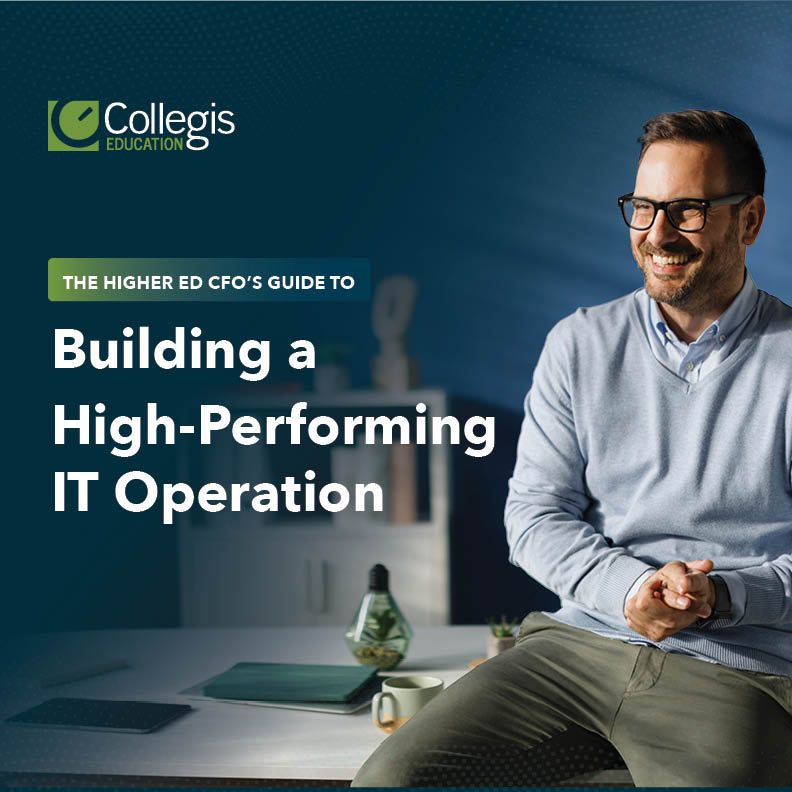
IT isn’t just a cost center. It’s a critical enabler of your institution’s strategic goals. But too often, campus technology operations are under-resourced, fragmented, and reactive. That leaves CFOs in the dark about what’s working, what’s wasted, and where to invest next.
We built this free guide specifically for higher ed finance leaders who are ready to shift from maintenance mode to a more strategic, future-ready approach.
What You’ll Learn:
- Why most institutions struggle to modernize their IT function — and how to break the cycle
- How to assess infrastructure health, team capabilities, and tech ROI using a practical evaluation framework
- Where to find hidden costs, duplication, and vendor inefficiencies
- What a high-performing IT operation looks like and how to build one at your institution
- Steps you can take today to align IT investments with institutional priorities
Who It’s For:
- CFOs and finance leaders
- COOs, CIOs, and enrollment executives involved in tech decision-making
- Presidents and provosts seeking better visibility into IT performance
Whether you’re facing outdated systems, overwhelmed teams, or rising IT costs with unclear returns, this guide will give you the insight and structure to lead with impact.
Submit the form on the top right to get your free copy.
Multi-year collaboration to strengthen cybersecurity, streamline systems, and drive operational innovation across campus.
DENVER, Colo. — [November 11, 2025] — Regis University today announced a new five-year partnership with Collegis Education, a nationally recognized provider of higher education technology and data solutions, to modernize and strengthen the university’s IT infrastructure. The collaboration marks a major step in Regis’ ongoing digital transformation strategy, designed to enhance cybersecurity, improve data integration, and deliver more efficient, 24/7 technology services across campus.
In the fall of 2023, Regis launched a comprehensive assessment of its IT infrastructure. The results made clear that gaps in existing systems limited the university’s ability to serve students, faculty, and staff efficiently. Addressing these challenges required reimagining how technology services are delivered to ensure systems are reliable, responsive, and aligned with the needs of a modern learning environment.
“Technology is foundational to how we teach, learn, and work, and this partnership represents a major investment in Regis University’s future,” said Stephanie Morris, Vice President and Chief Financial Officer of Regis University. “Partnering with Collegis allows us to modernize our IT operations, strengthen security, and provide a more unified and responsive experience for our community, all while maintaining our commitment to operational excellence and fiscal responsibility.”
Regis selected Collegis through a competitive RFP process, following staff recommendations based on prior positive experiences with the company at other institutions. Throughout the evaluation, Collegis distinguished itself by demonstrating a deep understanding of universities’ operational complexities and by recognizing the central role technology plays in supporting teaching, learning, and student success.
As part of the partnership, Collegis will help Regis integrate core systems, including Colleague, Salesforce, and Workday, to create a more seamless experience for students, faculty, and staff. This will allow Regis to improve efficiencies, access diverse levels of expertise, provide 24/7 service availability, and improve system integrations.
The collaboration will provide Regis with access to a broad range of higher education IT expertise and scalable resources. Collegis’ team will collaborate closely with Regis leadership to deliver high-performing systems, improved uptime and reliability, and integrated data systems that strengthen university operations and inform decision-making.
“We are proud to partner with Regis University, an institution with a deep commitment to innovation and service,” said Kim Fahey, CEO of Collegis Education. “Our role is to help Regis leverage technology to empower its mission to support a secure, connected, and efficient digital ecosystem that enhances the student experience and strengthens institutional resilience.”
Under the agreement, Collegis will assume management of day-to-day IT infrastructure operations, while Regis will continue to oversee technology strategy and governance. Faculty, staff, and students will continue to access support through familiar channels—including the online self-service portal and ITS help desk—with the added benefit of 24/7 availability and expanded system monitoring.
The transition will take place over the coming year, with listening sessions and open forums held throughout the process to ensure transparency, collaboration, and feedback from the Regis community.
“Partnership success is realized when operational excellence, trust, and shared purpose combine to deliver reliable technology services; improved faculty, staff, and student experiences; and measurable value to the university’s mission,” said Morris. “With Collegis as a strategic partner, we will be able to evolve to meet changing institutional needs and empower our faculty to teach, our students to learn, and our community to thrive.”
About Regis University
Established in 1877, Regis University is a premier, globally engaged institution of higher learning in the Jesuit tradition that prepares leaders to live productive lives of faith, meaning and service. Regis University, one of 27 Jesuit universities in the nation, has two campus locations in the Denver metro area and extensive online program offerings with more than 6,000 enrolled students. It is a federally designated Hispanic-Serving Institution. For more information, visit www.regis.edu.
About Collegis Education
As a mission-oriented, tech-enabled services provider, Collegis Education partners with higher education institutions to help align operations to drive transformative impact across the entire student lifecycle. With over 25 years as an industry pioneer, Collegis has proven how to leverage data, technology, and talent to optimize institutions’ business processes that enhance the student experience. With strategic expertise that rivals the leading consultancies, a full suite of proven service lines —including marketing, enrollment, retention, IT —and its world-class Connected Core® data platform, Collegis helps its partners drive impact and generate revenue, growth, and innovation. Learn more at CollegisEducation.com or via LinkedIn.
Media Contacts:
Collegis Education
Alyssa Miller
973-615-1292
Regis University
Sheryl Tirol
Technology can be one of the most powerful tools an institution has to advance its mission. But without clear, strategic guidance, that same technology can quickly become a source of frustration, inefficiency, and risk. That’s where IT governance comes in.
Today’s colleges and universities are navigating rising cybersecurity threats, tighter budgets, and an expanding ecosystem of platforms and tools. In this environment, IT governance isn’t just an operational necessity — it’s a strategic imperative.
In this article, I’ll define what higher ed IT governance is, why it matters more than ever, and how institutions can build a framework that aligns technology investments with institutional priorities.
What is IT governance in higher ed?
Put simply, IT governance is the structure that ensures every technology investment and decision supports the institution’s goals and strategies. While IT management focuses on maintaining day-to-day systems — like patching servers or updating networks — IT governance answers a different set of questions, such as:
- Which projects should we prioritize?
- How do we allocate limited resources for the greatest impact?
- Who needs to be involved in shaping these decisions?
A thoughtful approach to IT governance isn’t just a collection of policies. It’s an intentional structure that fosters transparency, collaboration, and accountability across the entire institution.
When done well, governance clarifies how decisions are made, who is responsible for making them, and what criteria determine success. This clarity reduces confusion, builds trust, and ensures that technology investments consistently support the institution’s mission and priorities.
An effective governance framework typically includes:
- Decision-making structures such as IT governance committees with representation across academic and administrative areas
- Policy development that guides how technology projects are evaluated and approved
- Risk management and compliance oversight to keep pace with evolving regulations and security requirements
When institutions embrace governance as a shared responsibility, technology becomes a strategic asset rather than a departmental concern.
Why higher ed IT governance matters more than ever
The complexity of higher ed technology ecosystems has grown exponentially. Many institutions now rely on cloud platforms, ERP and student information systems, learning management systems, and emerging tools like AI.
Without governance, it’s easy for tech investments to become siloed or redundant — especially when departments act independently. This fragmentation can lead to:
- Financial waste due to functional redundancy
- No clear system of record/unclear data access policies
- Missed opportunities for collaboration and efficiency
External pressures are also intensifying. Regulatory requirements such as FERPA and GLBA have expanded. Accrediting bodies increasingly expect transparent, documented technology processes. And stakeholders — from faculty to students — demand seamless, secure digital experiences.
In an era of constrained budgets, institutions can’t afford to treat IT governance as an afterthought.
Ready for a Smarter Way Forward?
Higher ed is hard — but you don’t have to figure it out alone. We can help you transform challenges into opportunities.
The risks of poor or nonexistent IT governance
When governance isn’t in place, institutions face serious consequences that extend far beyond the IT department. Gaps in oversight and alignment can ripple across every facet of the organization, undermining financial stability, operational efficiency, and stakeholder confidence. Over time, these issues can erode the very foundation of an institution’s mission and reputation.
Some of the most common (and costly) problems include:
- Financial inefficiency and wasted resources: With shrinking enrollments and limited funding, institutions can’t afford investments that fail to deliver measurable value or duplicate existing capabilities.
- Missed opportunities to maximize impact: When IT resources are spread thin across too many projects, even high-priority initiatives can stall or underperform.
- Increased security vulnerabilities: Technology risks are growing faster than most budgets. Without clear governance to prioritize spending on solutions that mitigate the most critical threats, institutions are more exposed to breaches and compliance failures.
- Resistance to change: If end users feel excluded from decisions, adoption suffers—and so does return on investment.
- Reputational damage: Failed implementations and security incidents can erode trust with students, staff, and stakeholders.
- Inability to scale or innovate effectively: Disconnected systems and uncoordinated efforts make it harder to keep pace with evolving needs.
We’ve seen this firsthand, where IT leadership at institutions make major platform decisions without involving departmental leaders. The result was widespread resistance and a perception that technology was imposed rather than collaborative. When people don’t have a seat at the table, they’re far less likely to champion change.
“When people don’t have a seat at the table, they’re far less likely to champion change.”
What effective higher ed IT governance looks like
Good governance is intentional, inclusive, and transparent. It doesn’t happen by accident — it requires clear structures and a shared commitment to align technology decisions with institutional goals. When these elements come together, colleges and universities create an environment where technology can thrive as a strategic asset rather than a siloed expense.
To build this kind of foundation, governance should include:
- Cross-functional committees: Cabinet members typically designate representatives from key areas (e.g., academic affairs, enrollment, finance) to ensure diverse perspectives.
- Clear processes: Policies that define how projects are proposed, prioritized, and evaluated.
- Defined success metrics: Criteria for measuring whether investments deliver the intended impact.
- Regular reviews: Governance frameworks should be revisited at least annually to keep pace with evolving needs and regulations.
Moving forward: IT governance as a strategic imperative
IT governance in higher ed isn’t just about compliance or risk avoidance. Done well, it empowers colleges and universities to:
- Use technology as a force multiplier
- Align financial and technology resource investments with strategic goals
- Build a culture of collaboration and shared accountability
As institutions navigate emerging priorities — from AI policies to hybrid learning environments — governance will only grow more critical. If you haven’t assessed your governance framework recently, now is the time.
Ready to strengthen your IT governance?
At Collegis, we help institutions develop and operationalize IT governance models that balance innovation with accountability. Our team brings decades of expertise with deep experience aligning technology strategy with institutional vision.
If you’re ready to move beyond reactive technology decisions and build a governance model that drives lasting success, let’s connect!
Innovation Starts Here
Higher ed is evolving — don’t get left behind. Explore how Collegis can help your institution thrive.
The strategic partnership will strengthen the University’s student-centered mission through agile technology, operational innovation, and a shared commitment to community.
St. Paul, Minn. – (May 5, 2025) — St. Catherine University (St. Kate’s) and Collegis Education announced today that they have entered into a strategic partnership to enhance the University’s delivery of IT services.
The decision to seek external IT support was driven by the University’s growing need to accelerate progress on strategic technology initiatives that had slowed within the existing tech infrastructure. The University recognized the need for a partner with the expertise, agility, and shared mission to help build a more responsive, future-ready infrastructure.
“We realized that the pace of change in technology—and the expectations of our students—were outpacing what our internal systems and structures could support,” said Latisha Dawson, Vice President of Human Resources and Project Lead. “Our institution is centered around student connection and academic excellence. But to uphold that mission, we needed a partner with the technical expertise and scalability to move faster, innovate more nimbly, and help us deliver a modern student experience. Collegis allows us to do just that, so we can spend less time managing systems and more time serving our students.”
In this partnership, Collegis will provide day-to-day IT operational support, a dedicated Chief Information Officer (CIO), and technological infrastructure that supports the university’s forward progress on strategic projects, while upholding strong data governance and enabling real-time responsiveness.
As part of the deal, St. Kate will gain access to Collegis Education’s Connected Core®, a secure, composable data platform powered by Google Cloud. As a tech-agnostic solution, Connected Core unifies siloed systems and data sets, enables real-time and actionable institutional intelligence, produces AI-powered data strategies, and delivers proven solutions that enhance recruitment, retention, operations, and student experiences — driving measurable impact across the entire student lifecycle.
St. Kate’s selected Collegis following a thorough evaluation of potential partners. “A lot of vendors can fill a gap, but that’s not what we were looking for,” said Dawson. “We were looking for someone to meet us where we are, grow with us, and truly enable us to excel. The real differentiator with Collegis was the spirit of partnership, and beyond that, community. From the beginning, they didn’t feel like an outsider. The team has become part of our community, and a part of helping us advance our mission.”
“Collegis is honored to join the St. Kate’s community in a shared commitment to the future of higher education,” said Kim Fahey, President and CEO of Collegis Education. “We see technology not as an end but as an enabler, an extension of the institution’s mission to educate women to lead and influence. This partnership is about building agile systems that empower faculty, enrich the student experience, and keep the University ahead of what’s next.”
The partnership also reflects St. Kate’s strategic priority to build a more nimble technology foundation that shortens the timeline between priority-setting and implementation. The transition enables the university to move away from legacy systems and toward a model that supports real-time innovation, strategic flexibility, and long-term sustainability.
“Our partnership with Collegis is rooted in our values,” said Marcheta Evans, PhD, President of St. Catherine University. “It allows us to remain focused on our mission while bringing in trusted expertise to support the evolving needs of our students, faculty, and staff.”
Dawson concludes, “We’ve always been guided by the principle of meeting the needs of the time. Embracing this next level of technology ensures we can continue nurturing the powerful, personal connection between our faculty and students, which is what makes us uniquely St. Kate’s.”
About Collegis Education
As a mission-oriented, tech-enabled services provider, Collegis Education partners with higher education institutions to help align operations to drive transformative impact across the entire student lifecycle. With over 25 years as an industry pioneer, Collegis has proven how to leverage data, technology, and talent to optimize institutions’ business processes that enhance the student experience. With the strategic expertise that rivals the leading consultancies, a full suite of proven service lines, including marketing, enrollment, retention, IT, and its world-class Connected Core® data platform, Collegis helps its partners enable impact and drive revenue, growth, and innovation. Learn more at CollegisEducation.com or via LinkedIn.
About St. Catherine University
Sustained by a legacy of visionary women, St. Catherine University educates women to lead and influence. We are a diverse community of learners dedicated to academic rigor, core Catholic values, and a heartfelt commitment to social justice. St. Kate’s offers degrees at all levels in the humanities, arts, sciences, healthcare, and business fields that engage women in uncovering positive ways of transforming the world. St. Kate’s students learn and discern wisely, and live and lead justly — all to power lives of meaning. Discover more at stkate.edu.
Media Contacts:
Collegis Education
Alyssa Miller
973-615-1292
St. Catherine University
Sarah Voigt
651-690-8756
In higher education, it’s easy to feel stuck.
You know something isn’t working — maybe enrollment processes are clunky, or student support services feel disconnected. You’ve tried new tools, updated systems, created initiatives to create change, and added staff, but the problem persists. It’s like there’s a giant boulder in your way, and no matter how hard you push, it doesn’t budge.
It turns out, you don’t need a bulldozer – just a napkin sketch to start building momentum to move the boulder standing in the way.
It’s a surprisingly simple concept, using visual design thinking exercises to help colleges and universities get unstuck. Not with more tech, or a fancy AI solution, but with more clarity to understand how things work today to create a framework for change tomorrow.
Because real innovation in higher education doesn’t come from software or a technology — it starts with understanding the systems and the processes you already have so you can visualize what they could be.
What is a napkin sketch?
The napkin sketch is exactly what it sounds like: a back-of-the-napkin-style drawing that quickly maps out how a particular process actually works in your institution so it can be reimagined.
It’s low-tech, but high-impact.
Think of it as building a gameboard for players to play. Like a Monopoly board, everyone knows the players, the rules, and the steps. It makes the choices that need to be made for each player’s turn clear. When these choices are laid out visually, it becomes much easier to pinpoint where the real opportunities (and challenges) are.
What does the napkin sketch exercise entail?
I usually start these sessions by asking one simple questions with a key follow-up
- What’s the opportunity for ‘impact’? (What are you trying to accomplish?)
- What’s preventing progress?
Then we get to work. Together, we sketch out the entire process: from first interaction to the final outcome. We account for every step, system, and stakeholder that’s involved. We highlight the costs, the tools and technology handoffs, potential delays, and where things might be falling through the cracks.
We typically conduct the sketch in a virtual drawing space, where we can collaborate in real time to map out the full process. It’s not about polished visuals — it’s about building a shared understanding of how things operate today.
And in about 60-90 minutes, we always have at least one person in the group say out loud “I didn’t realize that’s how it actually works.” And another will inevitably ask “You’re going to send us this napkin sketch, right? I want to print it out.”
Ready for a Smarter Way Forward?
Higher ed is hard — but you don’t have to figure it out alone. We can help you transform challenges into opportunities.
What can the napkin sketch reveal?
In our experience working with hundreds of institutions of all shapes and sizes, we’ve found that many face surprisingly similar challenges. This exercise consistently shines a light on hidden opportunities, creating a blueprint for change.
Common things we uncover include:
- Manual, repetitive tasks that could be automated or streamlined
- Workarounds that have become permanent fixtures without anyone questioning them
- Disconnects between departments, systems, or technologies
- Operational silos that prevent teams from seeing the full picture or collaborating effectively
- Missed opportunities to better track, analyze, or act on data
- Unclear ownership of key steps in the process
In short, the napkin sketch helps institutions see what’s really going on — and what needs to change to move forward.
Why does it work?
Higher ed innovation often stalls because teams are too close to the problem or too deep in their own silo to see the bigger picture. The napkin sketch breaks through that by creating a space for everyone involved to step back and collaborate.
Here’s why it’s effective:
- It’s fast — most sessions take an hour or two.
- It’s visual — helping teams align quickly and clearly.
- It’s collaborative — bringing together voices from across departments.
- It’s actionable — revealing next steps that are grounded in reality.
Most importantly, it shifts the focus away from jumping to solutions and toward understanding the system. Once you understand the system, smart solutions become much more obvious — and effective.
Real examples of the napkin sketch in action
Whether it’s enrollment workflows, transcript processing, student communications, or data handoffs between systems or teams, the napkin sketch exercise can help untangle a wide variety of operational challenges. No two institutions are exactly alike, but many face similar complexities — manual processes, siloed teams, and unclear ownership that stall progress.
Here are a few discoveries we uncovered in recent napkin sketch sessions I’ve led:
- One institution realized how many steps were involved in processing transcripts — with staff toggling between platforms, uploading the same file in multiple places, and doing manual comparisons. Once the process was mapped, we explored how AI could handle the course match evaluations — saving hours of staff time each week.
- Another team sketched out their enrollment outreach process and discovered they were sending multiple conflicting messages to students at the same time. The sketch helped them realign their communications and reduce student confusion.
- A third school wanted to integrate a new tool into their tech stack, but the sketch revealed that the underlying workflow was broken — and that no tool would help until the foundational process was improved.
In each case, the aha moment didn’t come from buying something new — it came from clearly seeing what was already happening so it could be improved upon.
What could your napkin sketch uncover?
If you’re wrestling with outdated processes, disconnected systems, or unclear handoffs — you’re not alone. Many institutions are trying to drive higher ed innovation with limited resources and overwhelming complexity.
But you don’t need to have all the answers right now. You just need a clearer view of the problem so you can develop a thoughtful solution.
That’s what the napkin sketch offers: a simple, collaborative way to map your reality, uncover opportunity, and take a smarter next step forward.
Let’s sketch it out — and see what we find!
Ready to uncover what’s holding you back?
Reach out to schedule your own session and take the first step toward smarter solutions.
College administrators wear many hats to ensure their institutions thrive. Stakeholders expect them to be visionaries, budget stewards, tech experts, and student champions. However, wearing too many hats can hinder the ability to meet more strategic and forward-thinking institutional demands, effectively diluting leadership capacity and outcomes.
How can administrators remove some of those hats without losing control or spending more?
How can they guide their institutions to achieve better outcomes with fewer resources?
At the 2024 Collegis Education Summit, keynote speaker Dr. John Smith-Coppes, president of Joyce University, shared his advice for achieving higher ed excellence amid market paradigms, shifting learner expectations, and capacity constraints.
“Embrace your institutional superpower and then partner for expertise. You have to know what you are really good at, but also where you might need help. Having the bravery to objectively look at the brutal facts can take you from good to great. Keep this in mind: Your institution is perfectly designed to get the outcomes it’s getting.”
-Dr. John Smith-Coppes, President of Joyce University
Dr. Smith-Coppes is right. If you’re not getting the results you want, you have to shine a light on the operation and consider what adjustments or changes will better position your institution for desired outcomes.
To echo Dr. Smith-Coppes and answer the earlier questions, working with a strategic partner who has deep expertise in higher education shared services and can manage certain responsibilities more efficiently can get your institution closer to turning aspiration into reality. A true partnership is not about simply outsourcing tasks. Rather, it’s a strategic way to gain access to specialized knowledge, proven methodologies, and scalable resources, all while enabling administrators to focus on their core areas of expertise.
Mounting challenges facing higher ed leaders
When I talk to administrators, the conversation inevitably turns to the challenge of doing more with less. They consistently grapple with four key issues:
- Budget Cuts: Funding is uncertain or shrinking, forcing them to rethink the allocation of resources.
- Advancing Technology: Technology is rapidly evolving, leaving administrators to scramble after the next advancement or emerging capability.
- Socioeconomic Pressures: With some questioning the value of postsecondary education, relevant programs with affordable tuition have never been more critical.
- Employee Turnover: Retaining top talent is difficult, leaving critical gaps.
But none of these issues surprise us. On the contrary, Collegis Education has partnered with numerous public and private institutions of varying sizes and levels of brand recognition to address these challenges, uncovering advantageous pathways toward more sustainable and fruitful operations.
The results speak for themselves. Administrators gain more time to leverage their core strengths to elevate their institution’s mission and educational outcomes while actualizing a variety of clear benefits. Here is what Collegis Education continues to deliver for our shared-service partners.
Seven ways shared services in higher education deliver results
Institutions that leverage shared services experience benefits in a variety of key areas. Explore some of the most significant advantages:
1. Improved financial stability
Predictability and optimization are the key words here. With our solutions for technology management, enrollment management, and student services, institutions know exactly what to budget every year. At the same time, we find cost savings by getting a better return on technology investments, strategically decommissioning redundancies, and renegotiating contracts.
2. Enhanced operational efficiency
Is there a better way to reach an institution’s goals more efficiently? More often than not, the answer is yes. We help bring these opportunities to the surface by fully assessing the school’s infrastructure, technology, processes, and other operating procedures. This assessment denotes areas of excellence and points of failure as well as identifies where lag or waste exists. With these insights, we can identify and prioritize emerging opportunities to drive improvement. All this informs a multiyear roadmap that guides higher ed leaders on how to thoughtfully implement changes that engage key stakeholders to accelerate the change management cycle.
3. Objective perspective & best practices
We bring a unique perspective to our recommendations based on our work with other schools while protecting each school’s anonymity and uniqueness. This helps give you a baseline of how your school performs when compared to similar ones. Are you leading or lagging? As an unbiased third party, we offer fresh ideas backed by the knowledge of the results they have produced. It’s a great way to eliminate the “but this is how we’ve always done it” objection and gain buy-in from internal staff.
4. Risk mitigation & accountability
There’s rarely a higher ed situation we haven’t already dealt with at another institution. Our partners benefit from this experience, allowing them to proactively avoid operational and technical risks. They also benefit tremendously from having a partner who holds themselves accountable to quantifiable outcomes measured by agreed-upon service level agreements (SLAs). Together, these provide a lot of peace of mind when it comes to issues like cybersecurity, compliance, disaster recovery, and business continuity.
5. Specialized expertise without the overhead
Hiring and retaining experienced staff is challenging enough. Finding people with skill sets to leverage evolving technology capabilities like artificial intelligence (AI) is a whole other story. That’s why our partners rely on Collegis to provide the expertise that’s hard to find. We’re software-agnostic and implement solutions that are in the school’s best interest from a financial, operational, and strategic perspective without the need for full-time employees to manage them.
6. Data-enabled decision making with full transparency
Data at most institutions is stored in siloes, with limited stewardship and governance over its quality and consistency. However, many of the “data” solutions in the market today are complicated and difficult to implement and support.
This is why we built Connected Core, a scalable higher education industry cloud solution that integrates siloed data sets, systems, and applications to enable institutional intelligence. This proven approach and methodology for collecting, connecting, and activating institutional data eliminates data doubt and gives leaders the confidence to make quickly make strategic decisions with confidence.
7. Focus on core mission & educational outcomes
By outsourcing some functions, administrators can redirect resources and energy to what truly matters: student success. By reducing the number of hats they wear, leaders can instead focus on using the tools they have on hand to manage strategic initiatives that drive institutional growth.
Strategic delegation to yield better outcomes
Some leaders fear losing control through outsourcing, and rightfully so. Too many vendors tout “partnership” when, in fact, they are trying to build an unhealthy dependency that is not mutually beneficial.
That’s just not us. It fundamentally goes against our values and who we are as a company.
Our partnerships are built on collaboration and shared governance. Institutions set priorities, and all actions follow clear assessments, implementation plans, and progress reviews. Our partners gain greater control over technology, enrollment, and budgets. Control isn’t lost, but visibility and accountability are gained.
Shared-services models allow administrators to confidently offload specific responsibilities. Leveraging external expertise amplifies your internal strengths and empowers your leaders to focus on building and maintaining a thriving campus community.
But the first step is starting the conversation with the right partner.
Innovation Starts Here
Higher ed is evolving — don’t get left behind. Explore how Collegis can help your institution thrive.
AI is the latest buzzword in higher ed, but without a clear strategy and solid data, institutions risk overinvesting in additional products, platforms, and applications they can’t fully support or operationalize. Instead, take a step back and ask, “What’s the impact I want to achieve, and how can AI fit or support my broader goals?”
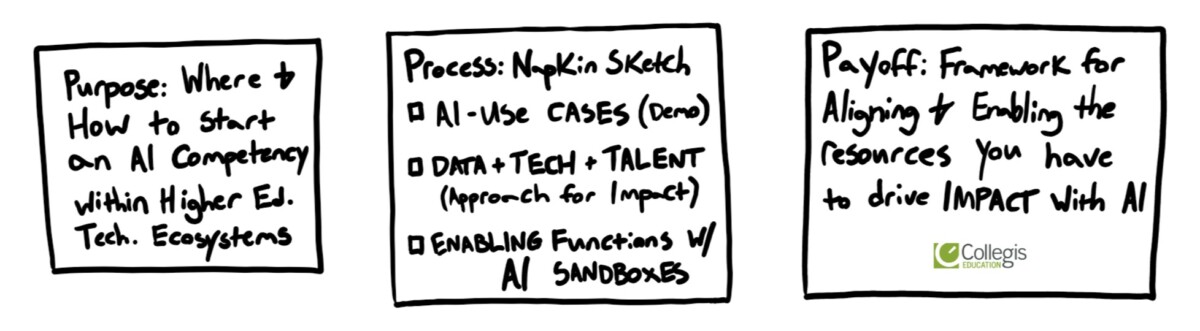
In this webinar, AI Jumpstart Kit: How to Build Toward IMPACT with AI in Higher Ed, Collegis Education’s AVP of Analytics & Technology Solutions, Dan Antonson, and Senior Director of Strategy and Innovation, Wes Catlett-Miller, will guide attendees through an interactive discussion about how to approach key use cases with AI in higher education. We’ll whiteboard out what an AI-enabled institution can look like, how it all works, and live demo actual AI initiatives Collegis has deployed for its partners.
No clunky PowerPoint slides. Just a clear path for approaching AI enablement.
What you’ll walk away with:
- A thorough understanding of how AI fits into the broader ecosystem (add-ons vs. platform)
- A model for making decisions on when to build and when to buy
- A clear understanding of the role tech and data play in AI enablement
Who should attend:
- Presidents + Provosts
- CFOs + COOs + CMOs
- Enrollment + Marketing leaders
College administrators know that technology can be a powerful tool for improving operations and boosting student success. However, given the rapid pace of technological change and the shrinking pool of qualified IT professionals, getting a real return on IT investments can be a major challenge.
One way to deal with these challenges is to outsource IT management and operations, and explore managed IT services for higher education.
While change can seem daunting, IT outsourcing can significantly improve overall IT management and strategic focus while mitigating risk and reducing cost. It’s about more than just maintaining IT infrastructure and operations –– it’s about using technology strategically to create better student experiences and drive institutional success.
Complexity: Streamlining the Transition
One of the primary concerns I hear from administrators is the perceived complexity of moving to an outsourced IT model. Such a move impacts people, processes, and technology – so if not managed thoughtfully, unintended consequences could occur.
However, a well-structured transition plan significantly simplifies the process and minimizes risk to business operations during the transition. At Collegis, we employ a phased approach, starting with a thorough assessment of an institution’s current IT ecosystem, including resources, processes, financials, systems, infrastructure, projects, operations, etc. This assessment forms the foundation of a customized transition plan designed around the institution’s unique needs, outlining each step – from stabilization and standardization to technology optimization and, finally, transformation.
A key element of our approach is the stabilization phase, where we address immediate pain points and ensure that systems are secure and able to support day-to-day operations with no disruptions. This initial phase creates the foundation from which to build on and, ultimately, a level of confidence that sets the stage for longer-term improvements.
By breaking the transition into manageable phases and providing clear communication throughout the process, we alleviate much of the anxiety associated with change. Instead of a big “lift and shift,” the multi-year transition plan means current systems and processes continue to be supported. Administrators often express relief once they understand our structured approach and how it addresses their specific needs.
For example, our managed IT services solution for Saint Francis University involved stabilizing the core technology and infrastructure, standardizing expectations through strong IT governance (including installing a virtual CIO), and optimizing business processes and infrastructure for increased efficiency. This identified $200,000 in budgetary waste that was able to be reallocated toward technology upgrades.
Cost: ROI Beyond the Bottom Line
Cost is, of course, a major factor in any IT outsourcing decision. Administrators are understandably concerned about the financial implications of outsourcing.
Studies show that many higher education institutions spend more than 75% of their IT budgets on basic support and technology maintenance. This is partially due to the technology debt that accrues after years of neglect and a lack of the precise skill sets needed to address deficiencies and create more efficient and effective operations. Just think of the impact technology could make if schools could reduce this amount by 25%+ and reallocate these dollars to improving student experiences or driving institutional cost savings.
Outsourcing can free up these valuable financial resources, enabling institutions to focus on projects that drive growth and enhance the student experience. Collegis partners typically experience:
- Predictable budgeting: We offer all standard IT management services through a clear and transparent fixed fee mutually determined for the life of the partnership so institutions know exactly what they spend for IT management every year. There are no surprises.
- Access to top IT talent: While Collegis goes out of its way to assess existing staff and rebadge those who have the needed skill sets and cultural fit, we also bring a team of more than 185 IT professionals to our partnerships, ensuring schools have access to the right skillsets at the right time.
- Better contract negotiations: Schools benefit from Collegis’s expertise in IT contract negotiations and cross-institutional expertise during all technology contract negotiations. We have long-term relationships with third-party vendors and can negotiate from a position of strength because we support dozens of similar institutions.
- Lower cybersecurity costs: We handle network, application, and data security, reducing a school’s need for additional resources or security solutions. Our partnerships have also helped many schools successfully stabilize or even reduce their cybersecurity insurance premiums.
- Elimination of consulting fees: Our model also eliminates the need for expensive consultants to fill staffing gaps or deliver strategic projects.
Most schools find that an IT managed services partnership with Collegis either saves them money or is cost-neutral. Our economies of scale enable us to provide expert services at a lower cost than most institutions could achieve in-house. Plus, we provide clear service level agreements (SLAs) to ensure accountability.
Beyond cost savings, outsourcing can also improve ROI by ensuring technology investments deliver their intended value. By leveraging the expertise of a dedicated IT partner, institutions can optimize their systems and ensure they are getting the most out of their technology investments.
Control: Maintaining Oversight and Ensuring Security
Some administrators worry about losing control when they outsource IT. They’re concerned about relinquishing oversight of critical systems and data. However, a well-designed outsourcing agreement includes clear governance structures and communication channels, ensuring they retain control.
One way we’ve addressed this concern is by establishing a steering committee for IT governance that includes representatives from the institution’s leadership and fosters collaboration and shared decision-making.
Data security is paramount, and we understand the sensitivity of institutional data. We are a SOC 2-compliant organization that undergoes regular external audits to ensure the security and integrity of the data we manage.
Our dedicated information security officers (CISOs) work closely with each institution to implement best practices and address any security concerns. We also proactively monitor systems for potential threats, leveraging our experience working with multiple institutions to identify and mitigate risks before they escalate.
Getting More Out of IT investments
Outsourcing IT management in higher education can be a game-changer for institutions looking to navigate the complexities of the evolving IT landscape. Working with a partner that focuses on open communication, a phased approach to transitioning, a stronger cybersecurity posture, and leveraging your technology’s true potential can eliminate concerns about complexity, cost, and control while enabling schools to achieve strategic goals.
Finally, when considering IT outsourcing, institutions cannot underestimate the importance and value of cultural fit. Finding a partner who shares your values and can be trusted to run a critical function for your institution is just as important as any of the other considerations I’ve highlighted above.
— Kim Fahey, CEO Collegis Education
Innovation Starts Here
Higher ed is evolving — don’t get left behind. Explore how Collegis can help your institution thrive.
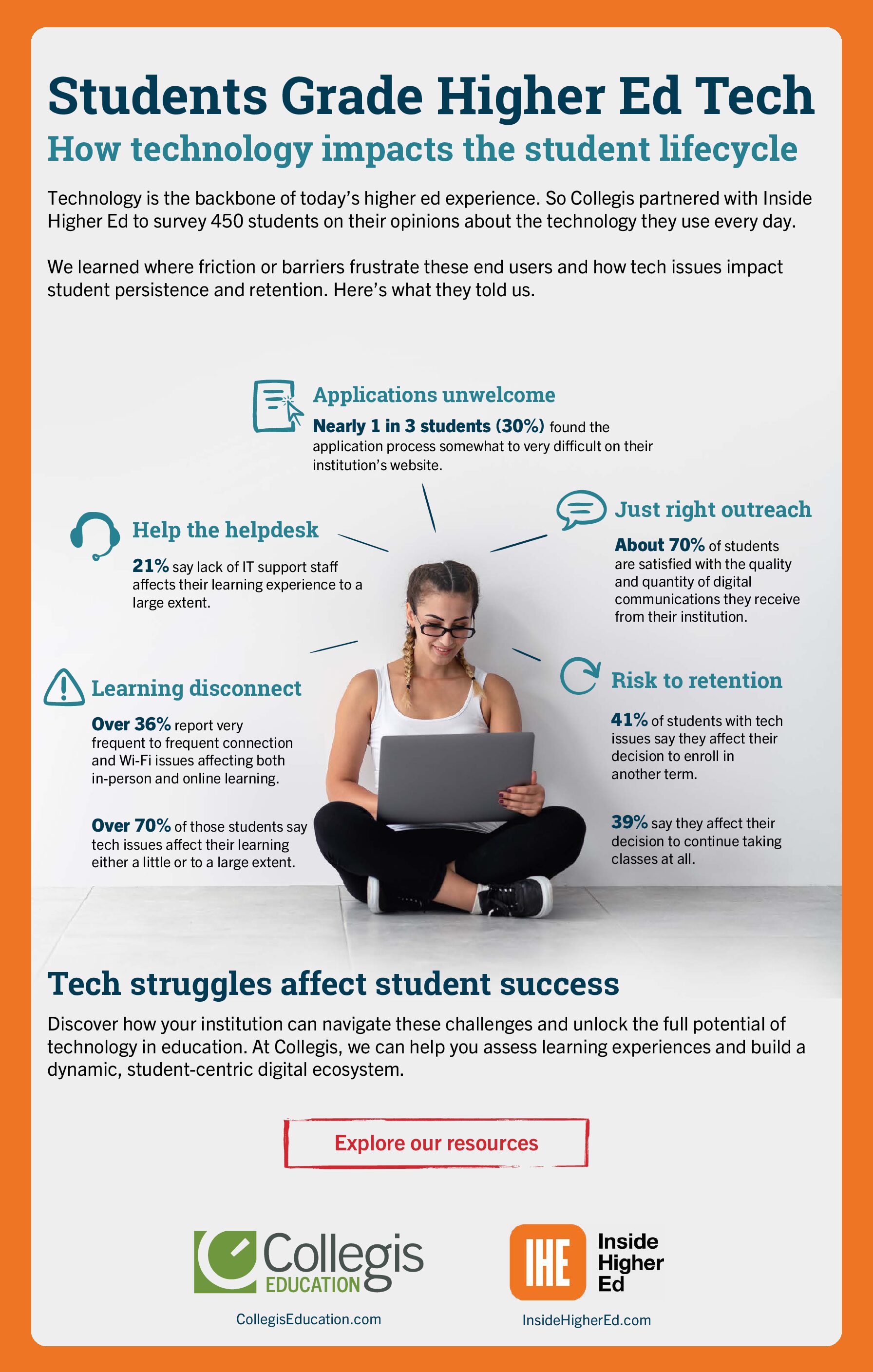
Technology is the backbone of today’s higher education experience, yet many students face significant challenges that impact their learning, engagement, and persistence. To better understand these barriers, Collegis Education partnered with Inside Higher Ed to survey 450 students on their experiences with higher ed technology.
Our latest infographic highlights the key findings and their implications for student success.
Innovation Starts Here
Higher ed is evolving — don’t get left behind. Explore how Collegis can help your institution thrive.