500+ employers share their views
As higher ed looks to create and retain partnerships with employers, they need to understand how employers perceive them and meet their urgent needs.
As part of an ongoing research series, Collegis and UPCEA, the leading association for professional, continuing and online education, partnered to survey over 500 employers to better understand their perceptions of partnering with a four-year higher ed institution on professional development programs and alternative credentials.

Insights from the report include:
- The changing landscape of alternative credential programs
- Obstacles and opportunities of working with higher ed, according to employers
- The most important program features to help secure a partnership
Download Now




Transform Challenges Into Opportunities
Facing challenges in enrollment, retention, or tech integration? Seeking growth in new markets? Our strategic insights pave a clear path for overcoming obstacles and driving success in higher education.
Unlock the transformative potential within your institution – partner with us to turn today’s roadblocks into tomorrow’s achievements. Let’s chat.
Adult learners are higher ed’s future
Reskilling, upskilling and lifelong learning are creating a big opportunity for higher education to become the go-to resource for career-minded adults. But not all adult learners are alike. In this report, we break them down into four types of adult learners (Career Advancer, Career Builder, Discerning Academic and Hesitant Learner).
Download the white paper with the following insights for each persona:
- Top motivations
- Recruitment strategies
- Program optimization recommendations
Collegis Education surveyed 1,000 adult learners interested in pursuing degrees for this white paper, Rethink Your Student Population. Discover who makes up the majority of the adult learner market and how to target your outreach to grow your enrollment in this untapped population.
Also, get key takeaways in our infographic The Adult Learners You’re Ignoring.
Download Now
Transform Challenges Into Opportunities
Facing challenges in enrollment, retention, or tech integration? Seeking growth in new markets? Our strategic insights pave a clear path for overcoming obstacles and driving success in higher education.
Unlock the transformative potential within your institution – partner with us to turn today’s roadblocks into tomorrow’s achievements. Let’s chat.
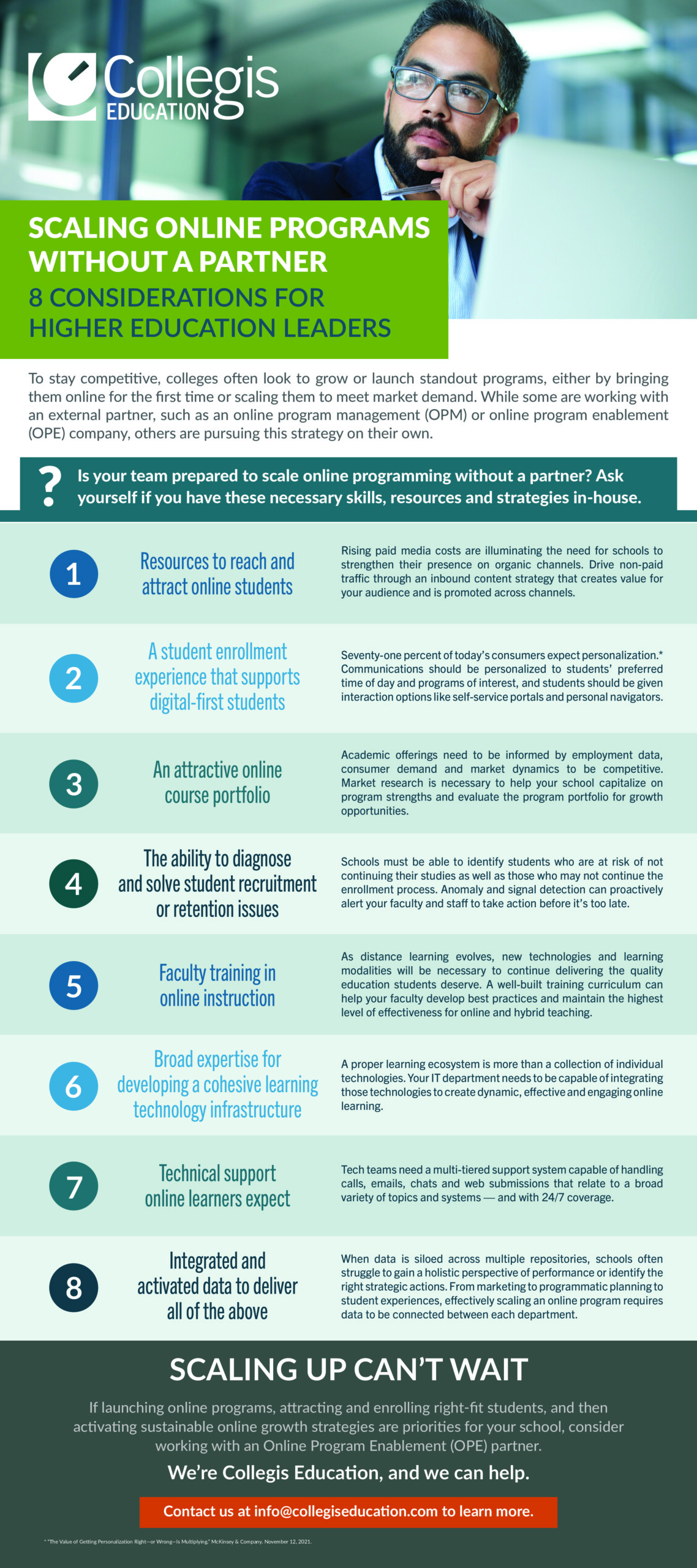
As demand for online education continues to grow, many institutions are looking to expand their online programs to reach more students, drive enrollment, and stay competitive. While some schools work with online program management (OPM) providers, others are choosing to scale online learning in-house.
If your institution is considering launching or growing online programs independently, our latest infographic outlines the critical skills, resources, and strategies you’ll need for success.
Innovation Starts Here
Higher ed is evolving — don’t get left behind. Explore how Collegis can help your institution thrive.
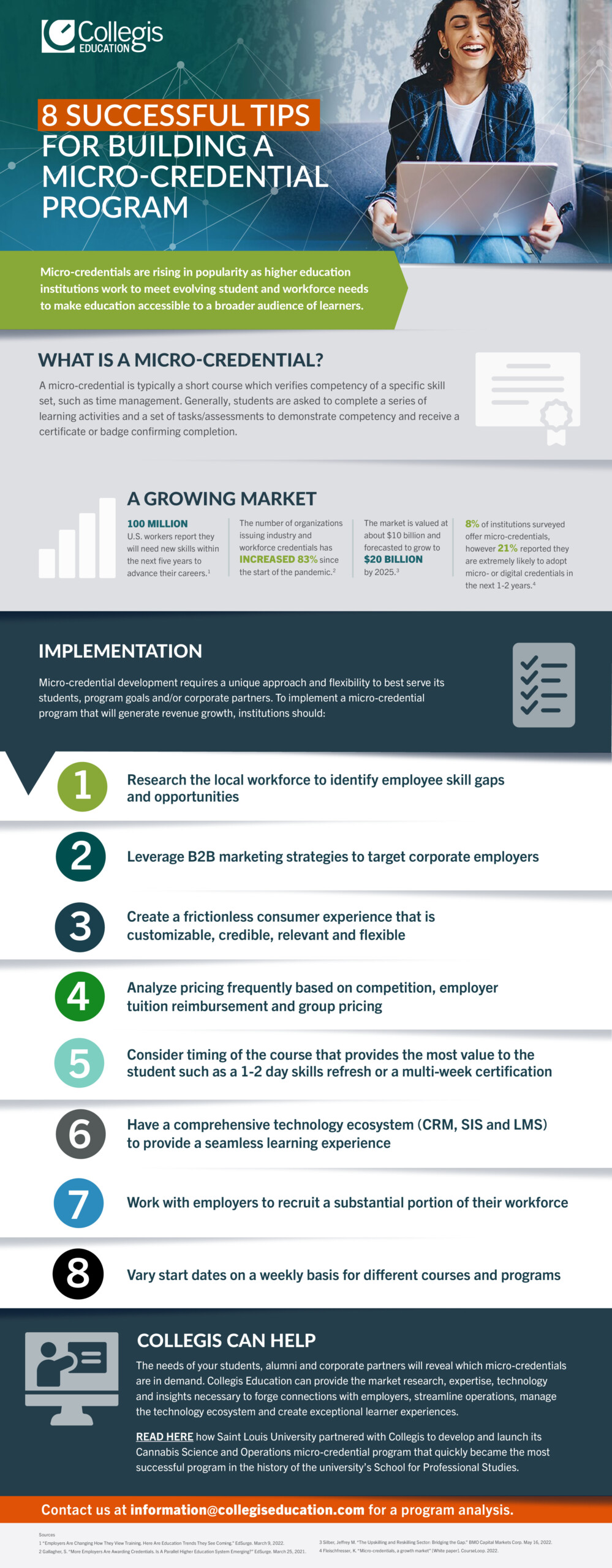
As workforce demands evolve, microcredentials are becoming a key strategy for higher education institutions looking to expand their offerings and serve lifelong learners. These short, skills-focused programs provide flexible, career-aligned learning opportunities that appeal to students, alumni, and corporate partners alike.
Our infographic outlines essential steps for institutions looking to develop, market, and scale high-impact microcredentials.
Innovation Starts Here
Higher ed is evolving — don’t get left behind. Explore how Collegis can help your institution thrive.
More than 500 employers share their perceptions
As the workforce evolves, many employers are considering the relevance and use of alternative credentials for upskilling or reskilling employees. This reimagining of workforce education provides an opportunity for higher ed leaders to partner with employers on microcredential programs that drive a funnel of enrollments.
Collegis teamed up with UPCEA to survey more than 500 employers about their perceptions of microcredentials and interest in partnering with colleges and universities on these non-degree programs.
Download the report to receive insights on:
- What incentivizes employers to work with higher ed institutions
- Employer valuation of alternative credentials
- Employer use of alternative credentials in lieu of degrees in the hiring process
Download Now
Transform Challenges Into Opportunities
Facing challenges in enrollment, retention, or tech integration? Seeking growth in new markets? Our strategic insights pave a clear path for overcoming obstacles and driving success in higher education.
Unlock the transformative potential within your institution – partner with us to turn today’s roadblocks into tomorrow’s achievements. Let’s chat.
How SLU Reached Record Enrollment Results
Many institutions are turning to alternative credentials to attract diverse student audiences, grow enrollment, find new ways to generate income and advance their reputations as providers of high-quality academic programs designed to meet learner and workforce needs.
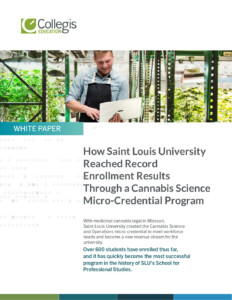
In this white paper, you’ll learn how Saint Louis University (SLU), partnered with Collegis Education to develop and launch its Cannabis Science and Operations micro-credential program that allowed SLU to:
- Respond to local and national workforce demands
- Increase overall enrollment
- Engage and enroll more diverse online learners
The program quickly became the most successful program in the history of the university’s School for Professional Studies, providing record results for the institution.
Download Now
Transform Challenges Into Opportunities
Facing challenges in enrollment, retention, or tech integration? Seeking growth in new markets? Our strategic insights pave a clear path for overcoming obstacles and driving success in higher education.
Unlock the transformative potential within your institution – partner with us to turn today’s roadblocks into tomorrow’s achievements. Let’s chat.
From shifting student demographics to distance learning and competency-based courses, higher continues to evolve to meet the needs of today’s students and tomorrow’s workforce.
The emergence of microcredentials as a new form of certification is driven by the skills gap in today’s 21st century workforce. Let’s talk about the purpose of micro-credentials and what they mean for students and higher education institutions alike.
What are micro-credentials?
The National Education Association describes micro-credentials as a “competency-based digital form of certification.”
Sometimes referred to as “badges,” microcredentials are hyper-focused and typically comprised of sub-competencies. These skills are outlined within a rubric, along with the specific criteria required of each. It is earned once a student successfully demonstrates each competency.
Micro-credentials typically align with soft skills that are valued by employers. They recognize an individual’s proficiency in areas like oral communication, initiative or even empathy. Once earned, the recipient can add it to their LinkedIn profile and resume as a way to formally recognize their aptitude in that area.
What’s driving the need for micro-credentials?
Microcredentials are gain traction because there’s a growing disconnect between what employers want and what candidates have to offer — especially when it comes down to their soft skills.
In Monster’s The Future of Work 2021: Global Hiring Outlook report, employers asked to name the top skills they want in employees cited soft skills such as dependability, teamwork/collaboration, flexibility and problem-solving.
This is where microcredentials can help fill the skills gap.
How are micro-credentials helping meet demand?
Most college degree programs are built to train students on the technical skills needed to perform the duties related to their desired profession. Training on the transferable skills that help individuals succeed beyond the most basic job duties is less prevalent.
For example, aspiring data analysts will master technical skills like SQL, Tableau and data mining in a degree program. But employers are also seeking candidates with a demonstrated proficiency in problem-solving, communication and project management. These skills make them more collaborative, productive employees, and are areas in which microcredentials can make an impact.
Because these certifications are built upon competencies, they carry more weight with employers. Anyone can list “communication, critical thinking and empathy” in a paragraph on a resume. But displaying a microcredential serves as concrete evidence that you’ve demonstrated proficiency in that area.
Micro-credentials are a promising solution for students and employers alike, but credentials may eventually need to undergo some sort of standardization process — both to increase its validity, and also to set expectations of students and employers.
With many institutions already adopting the microcredential method in various ways, it seems to be a trend that won’t be fading anytime soon.
Who are the early adopters of microcredentials in higher education?
It hasn’t been long since micro-credentials first made their entrance in the higher ed world. Though they are still in their infancy, a handful of institutions have already acknowledged their value and incorporated them into their suite of offerings.
For example:
- Colorado State University offers an array of soft-skill badges which include subjects such as teamwork, conflict resolution and stress management.
- George Mason University established a resilience badge, which demonstrates a student’s ability to positively deal with stress, change, uncertainty and adversity.
- California Community Colleges (CCC) now offer “21st Century Skills badges” throughout their campuses, covering skills such as collaboration, digital fluency, entrepreneurial mindset and social/diversity awareness.
These are just a few examples of how forward-thinking institutions have adopted the microcredential method to help provide additional development opportunities for the modern student.
Filling the soft skills gap
Higher ed continues to evolve to meet the needs of students and the workforce. With the increasing desire for job candidates with stronger soft skills, microcredentials and digital badges stand to benefit graduates and employers alike. We anticipate more schools will join the soft skills movement by incorporating micro-credentials into their program portfolios.
The increasing implementation of microcredentials is just one of many trends emerging in higher education. Learn more about what else is on the horizon in our article, “Reimagining Higher Ed for the 21st Century.”
Curious about how your institution might incorporate microcredentials into your program mix? We’d love to chat about the opportunities! Contact us at info@collegiseducation.com.
Innovation Starts Here
Higher ed is evolving — don’t get left behind. Explore how Collegis can help your institution thrive.
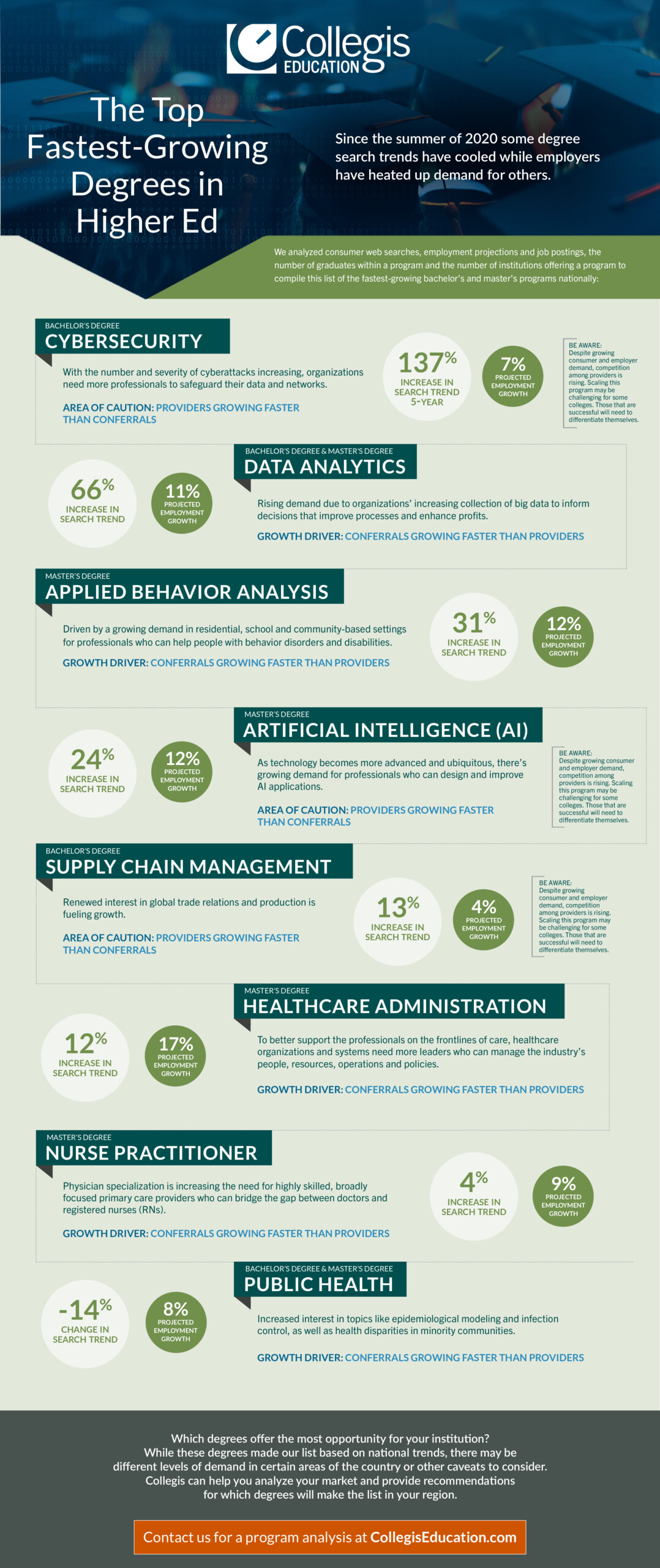
As student demand and workforce needs evolve, institutions must stay ahead of shifting degree trends to attract enrollments and align programs with job market demand. While some academic fields are experiencing rapid growth, others are becoming more competitive as more providers enter the space.
This infographic highlights the top bachelor’s and master’s programs gaining traction based on consumer searches, employment projections, job postings, and degree conferrals.
Innovation Starts Here
Higher ed is evolving — don’t get left behind. Explore how Collegis can help your institution thrive.
The workforce has changed. And with its transformation, workers have evolved their qualifications to meet new demands.
These changes are driven by technology — and the workforce must respond. Higher education institutions must also adapt to provide relevant, capable graduates who are properly equipped for today’s corporate landscape.
We’re in the information age, in which the economy is shaped by technology — a significant departure from manufacturing-focused industrialism. With new innovation comes exciting promise, but also a unique set of challenges for today’s graduates.
There’s a new skillset today’s students need in order to succeed, and these have been dubbed “21st century skills.” Keep reading to learn more about why 21st century skills are so critical and what it means for higher education.
What are 21st century skills?
What specialized skills does one need to succeed in today’s information age? That’s the ideology behind the concept of 21st century skills. 21st century learning can be broken out into three main groups, each comprising different sets of competencies:
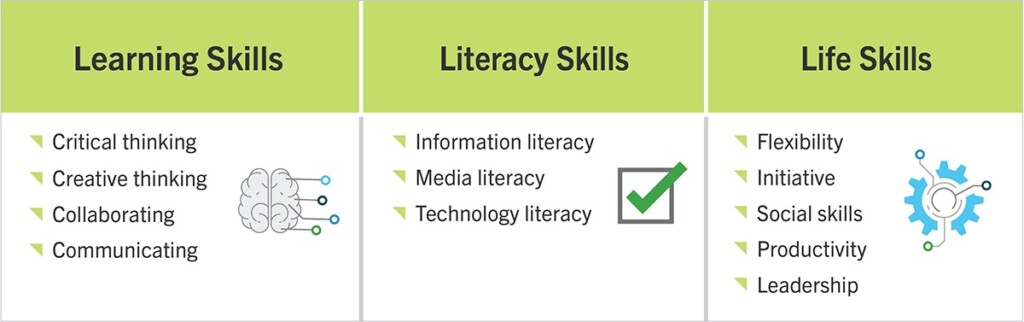
The 21st century skills movement caught on around the beginning of the millennium, when the National Education Association established the Partnership for 21st Century Skills (P21) and developed a “Framework for 21st Century Learning.”
This framework outlined different skills deemed especially valuable and necessary to prepare today’s students for tomorrow’s workforce. Numerous states have since joined P21 through the years and have built these 21st century skills into their school districts’ curriculums.
21st century skills were specifically selected and deemed critical to modern workplaces. Advancements in technology have changed not only the type of work that’s done, but how it’s done. Because of this, the human element is growing more important than ever before.
This is especially true with emerging technologies, such as machine learning and artificial intelligence. With technology taking on more and more of the repetitive, task-based work, it means that humans are left to tackle more dynamic issues that require creativity, critical thinking and collaboration.
What do employers think of 21st century skills?
The term “soft skills” is slowly being replaced by “21st century skills.” Competencies like communication and collaboration have long been characterized as soft skills, and remain important through the evolution into 21st century skills. These are skills that employers are seeking in job candidates.
In fact, a majority of employers find these skills to be just as important as technical skills. In LinkedIn’s 2019 Global Talent Trends Report, over 90 percent of surveyed employers reported that soft skills are just as or even more important to hire for than hard skills.
And in a recent survey of 400 employers, 85 percent reported wanting to hire individuals with a broad range of knowledge and skills, as compared to field-specific skills. These employers listed leadership, written communication, verbal communication, flexibility and teamwork as some of the most-desirable attributes in candidates.
Unfortunately, only 11 percent of business leaders agree that today’s college graduates have the skills needed for today’s dynamic workforce. On the other hand, 96 percent of college academic officers believe in their school’s ability to prepare students for the workforce.
As you can see, there’s a disconnect between academia and corporate America. So what can be done to connect the needs of employers with the qualifications of college graduates?
What role does higher education play in developing 21st century skills?
Some universities or particular programs naturally incorporate these kinds of transferable skills into their curriculum. Liberal arts programs, for example, are notorious for emphasizing soft skills like leadership, communication and teamwork. But 21st century skills aren’t only valuable for communications or philosophy majors.
Even the most technical fields – like computer science or accounting – are in need of professionals who can collaborate, adapt, think critically and take initiative. So how can schools equip students with these types of 21st century skills without overhauling their entire curriculum?
Several higher education institutions have acknowledged the need to better prepare students for the modern workforce using a more innovative approach. This includes new offerings, such as digital badges and micro-credentials, which help arm their graduates with the 21st century skills employers are seeking.
Digital badges can cover anything from blogging to time management or even initiative – competencies that until now have not been formally recognized on resumes or LinkedIn profiles.
Students earn digital badges in a similar manner to competency-based courses. A digital badge typically contains sub-competencies that are outlined within a rubric, and students must prove their proficiency in the specified skill in order to earn the badge. From there, they can add it to their LinkedIn account, website, portfolio or resume.
As many as one in five schools now offer some form of digital badges. And many of these offerings address the interpersonal, transferable-skill emphasis that aligns with the 21st century skillset.
Consider the following examples:
- Colorado State University offers soft skill badges in teamwork, conflict resolution and stress management.
- Johnston Community College in North Carolina offers an intercultural fluency badge.
- George Mason University offers a resilience badge.
- California Community Colleges (CCC) now offer “21st Century Skills Badges” in subjects such as collaboration, digital fluency, entrepreneurial mindset and social/diversity awareness.
Prepare your graduates for the professional world
The workforce has evolved, and higher education must follow suit. Today’s graduates are entering a different type of workforce, so make sure you’re setting yours up for success.
Learn more about how some colleges are adapting to meet this need in our article, “What Are Micro-Credentials? How Colleges Are Adapting to the Modern Workforce.”
Innovation Starts Here
Higher ed is evolving — don’t get left behind. Explore how Collegis can help your institution thrive.