The Top 5 Takeaways from #DisruptED26, Phoenix
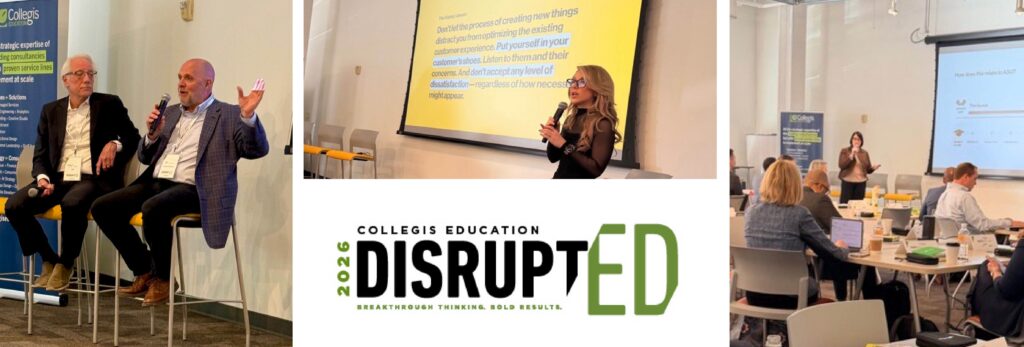
Last month, presidents, chancellors, and cabinet-level leaders, along with some of the most influential voices in higher education, joined Collegis Education at Arizona State University for #DisruptED26 — an executive-level summit where leaders came together to confront higher ed’s toughest challenges, from enrollment pressure and regulatory disruption to AI readiness and student experience.
It was a day of courageous conversations on how to shift the balance of power in our space from being disrupted to being the disrupters of higher ed. We discussed what it takes to operationalize innovation and how to redesign the student experience around the realities of modern higher education.
One message came through consistently: Institutions cannot afford to respond to today’s challenges with yesterday’s models. Here are some of the key insights and takeaways from #DisruptED26.
5 Key insights shaping higher ed’s next chapter
The conversations at #DisruptED26 surfaced several themes that will shape how institutions respond to enrollment pressure, technological disruption, and evolving student expectations.
1. Student behavior has changed faster than institutional design has kept pace.
The traditional student of today is non-traditional. Their expectations, behaviors, and preparation levels have evolved just as quickly. Students now search and browse differently — 60% of searches end in zero clicks — learn with AI, and arrive differently prepared, with reading levels the lowest in 30 years.
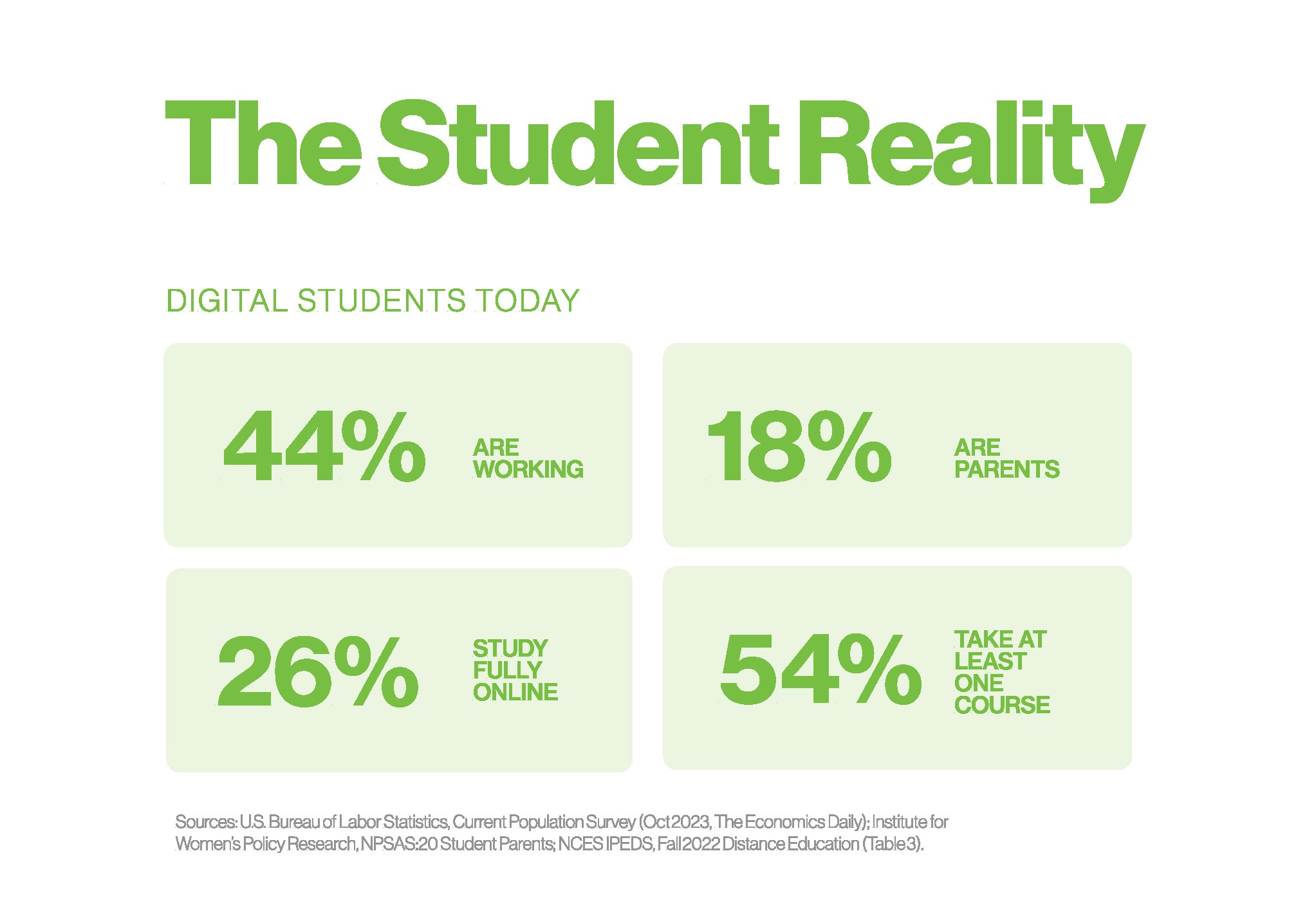
But here’s the problem: Institutions are still designing experiences for learners from 10 to 20 years ago. AI, technology, and a global pandemic rewired our behaviors, yet higher ed models remain relics of another era. We’ve reached a watershed moment, and as Michael Crow, President of Arizona State University, boldly states. Higher ed must evolve — or risk dying.
Institutions need to start thinking and operating more like businesses, treating their students as customers, and delivering products, experiences, and services that meet student expectations while staying mission-aligned. We’ve reached our Netflix moment.
2. The 60-year ‘Golden Age’ of enrollment growth is gone
The challenge is bigger than the demographic cliff alone. Wage compression, declining consumer confidence in higher ed, and graduates not being immune to lengthy periods of unemployment are all contributing to a decline in matriculation.
As Nathan Grawe, author and professor of economics at Carleton College, warned, “Institutions cannot simply recruit their way out of this problem.” The traditional-age higher ed market will continue to tighten. Recent projections show a 10% decline nationally from 2025 to 2041, requiring institutions to chase the same shrinking pool, potentially intensifying discounting and competition.
3. Experience is the new differentiator and it requires systems thinking and design thinking
To win the long game, schools must look at the end-to-end student experience, not just course design and curriculum. Fixing one piece of the student journey will do you no good if the surrounding student experience remains broken.
How do you accomplish this? To start, higher ed needs to adopt a systems-thinking and design-thinking mindset. It enables leaders to evaluate their tech, data, and institutional infrastructure while keeping solutioning and innovation student-centered. When system health is balanced with end-user delight, friction is reduced, outcomes improve, and exceptional experiences emerge.
4. The OPM era is giving way to a more accountable partnership model
Institutions are facing new program-level accountability requirements and need to shift from dependency to empowerment in their online and hybrid strategies. This is less about abandoning partnerships and more about pursuing balanced, transparent partnerships that build institutional capability over time.
As Marc Austin, Vice Provost and Managing Director of Montclair Unbound, stated at a previous Collegis summit, “Invest internally in your current centers of excellence, and look to partner where capacity and expertise may be limited.”
5. The higher ed regulatory environment is not episodic; it is cumulative
From January 2025 through early 2026, there’s been a regulatory tsunami — a rolling sequence of federal actions spanning DEI, funding freezes, IES cuts, Department of Education restructuring, accreditation, workforce development, AI, admissions transparency, and negotiated rulemaking.
The key insight is operating volatility: Leaders are not responding to one rule change but to continuous policy churn. Accountability is moving closer to program economics and outcomes, with earnings thresholds, disclosure requirements, and potential loss of direct loan eligibility, thereby shifting risk from the institutional level to the program level.
Rewriting the rules of higher education
From the first session to the final conversation, #DisruptED26 proved that a packed agenda need not come at the expense of engagement. The day prioritized session quality over quantity, bringing together senior leaders for honest, candid, and deeply interactive discussions.
Rather than delivering presentations from a distance, speakers and SMEs engaged participants in a true dialogue — one that challenged assumptions, invited debate, and sparked the kind of collaboration that rarely happens in larger conference settings. As Amanda Gulley, Chief Product and Experience Officer at ASU EdPlus, said, “This is some of the best content I have seen at a higher ed conference.”
If #DisruptED26 made one thing clear, it is that higher ed leaders are hungry for spaces where real challenges can be met with real conversation. We’re already looking ahead to the next DisruptED on September 23 in Denver, Colorado, with more details to be announced soon. We hope to see you there!
Innovation Starts Here
Higher ed is evolving — don’t get left behind. Explore how Collegis can help your institution thrive.