
Tech Troubles: How Technology-Student Interactions Impact Retention [Report]
A report from your end users
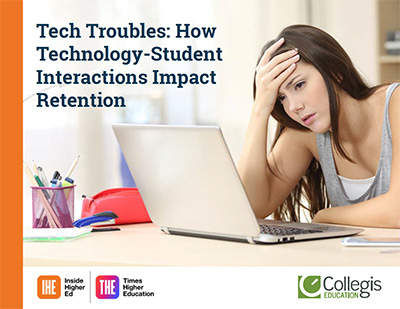
In partnership with Inside Higher Ed, Collegis surveyed 450 students to gauge the impact of higher education technology on both their learning experiences and opinions of the school. Higher ed leaders will want to read our report, “Tech Troubles: How Technology-Student Interactions Impact Retention,” to dive deeper into how technology environments can help (or hinder) the student journey.
Students raise high-stakes concerns
While our study indicates colleges and universities are succeeding in some aspects of technology usage (digital communications, for one), the results also exposed several areas where technology hurdles are damaging, or even disastrous, to the student experience:
- Website application hurdles: A quarter of students report some level of difficulty.
- No internet, no class? Technical issues cause distractions and lost class time, both on and off campus.
- Retention at risk: Over 40% of students who experienced tech issues question whether to continue their education at the institution.
Plus! Included in the report are reactions to the findings from higher ed leaders. They share the top challenges their schools face in addressing the issues raised by students.
Download the report for summaries by topic, stand-out results from audience segments, charts that show the intensity of student sentiment, and recommendations for technology investments to improve student success.
Download Now
Additional Resources



Transform Challenges Into Opportunities
Facing challenges in enrollment, retention, or tech integration? Seeking growth in new markets? Our strategic insights pave a clear path for overcoming obstacles and driving success in higher education.
Unlock the transformative potential within your institution – partner with us to turn today’s roadblocks into tomorrow’s achievements. Let’s chat.
In an era where higher education is experiencing increased cyberattacks and smarter cyberthreats, colleges and universities must do all that they can to safeguard sensitive data and ensure the privacy of their constituents. While the evolving cybersecurity landscape may seem daunting, adopting fundamental strategies can significantly bolster your school’s resilience against cyberattacks. As a bonus, schools may experience lower insurance premiums by showing commitment to cybersecurity, implementing comprehensive measures, and complying with relevant regulations.
Here are three basic higher education cybersecurity strategies every institution should prioritize:
1. Stop cybersecurity attacks before they happen: Invest in early threat detection and monitoring
Stopping threats before they occur is the best-case scenario. Threat-detection tools, such as data loss–prevention software, can analyze the security ecosystem and quickly identify malicious activity and enact mitigation efforts. These tools allow institutions to detect threats in real-time and stop breaches before they occur.
2. Empower your staff and students: Provide cybersecurity education and training
Education is a powerful and essential to counteract cyberthreats. Enable students and staff to recognize, avoid and report an attack by offering regular awareness training that promotes cybersecurity best practices for schools. They should be made aware of common cyberattacks, such as:
- Ransomware Attack: Paralyzing a victim’s systems or threatening to steal, block or publish a victim’s data unless a ransom is paid.
- Business Email Compromise (BEC): Emails that impersonate senior leadership and ask for tasks to be carried out that would reveal sensitive information or transfer funds.
- Phishing: Using electronic communications to deceive and take advantage of users, often beginning with an email attempting to obtain sensitive information by persuading a user to click on a malicious link or download an infected attachment.
- Spear Phishing: Infiltrating an organization to steal sensitive information through a targeted type of phishing. Attackers will often gather personal information about their victims via social media profiles to write emails with more authentic context.
- Spoofing: Committing malicious acts by disguising oneself as a person, business or entity the victim is familiar with to get them to freely provide information.
Students and staff should also be educated in proper data-handling practices and physical security measures for various technologies. By creating a culture that values cybersecurity, schools can empower active contributions to defend against cyberthreats.
“The most significant new risk in higher ed is the bad guys’ use of AI to develop and launch more targeted and believable phishing campaigns. Phishing is still a top method of compromising users, but with the added power of AI, it can be easier, quicker, and more effective than ever. User training has to shift to meet the challenge,” said Nairn.
3. Safeguard your data: Establish a comprehensive security policy
The recent changes to the Gramm-Leach-Bliley Act’s safeguard rules require universities and colleges to take a proactive approach to student financial record-keeping and cybersecurity. Remaining compliant with these regulations and reporting requirements is essential to securing funding. That begins with a well-documented IT security policy that sets standards of behavior for the digital activities of faculty, staff, and students.
Your policy should define common cyberattacks, outline systems to guard data, assign roles and responsibilities, and be regularly updated as new regulations and threats emerge. Artificial intelligence (AI), though somewhat underdeveloped, should have a place in your IT security policy that outlines how to reduce the cybersecurity risks of AI, such as avoiding sharing sensitive data with AI and building a strong AI incident-response procedure.
Collegis can also help with a cybersecurity risk assessment. Contact us to learn more.
Innovation Starts Here
Higher ed is evolving — don’t get left behind. Explore how Collegis can help your institution thrive.
Cyber attacks are on the rise
Cyber attacks on colleges and universities are unfortunately commonplace, with a staggering 79% of schools falling victim to ransomware in 2023 and 56% paying a ransom to get their data back. With sensitive data at risk, protecting student privacy – in addition to protecting the privacy of employees, alumni, and donors, as well as securing your school’s intellectual property – needs to be a top priority for your school.
Not sure where to start?
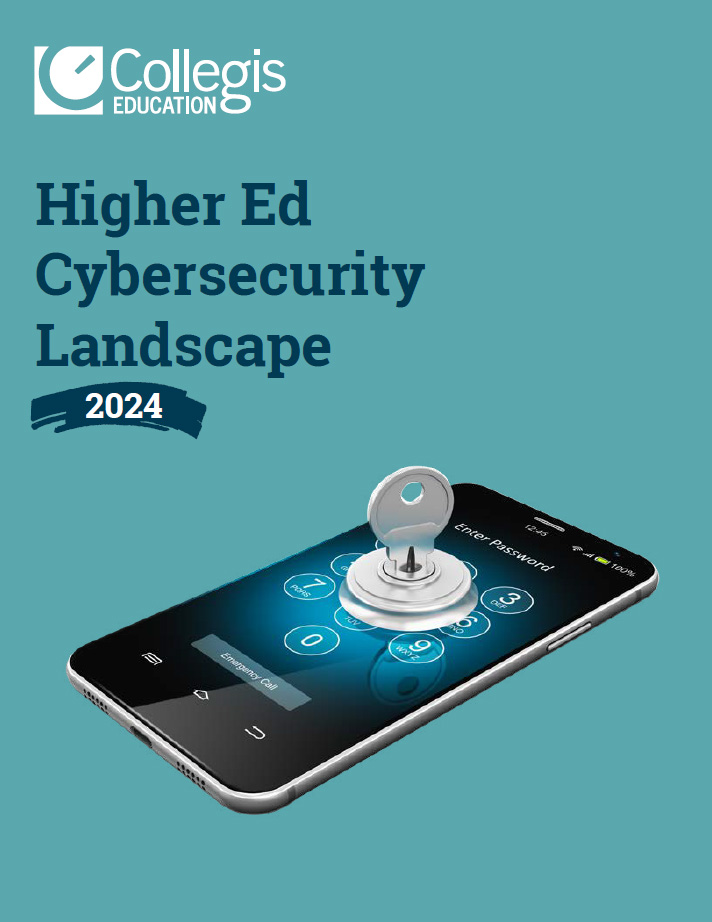
Download our “2024 Higher Ed Cybersecurity Landscape” ebook (an update to our 2022 edition) to learn:
- Why colleges and universities are attractive targets for cyberattacks
- Potential impact of cyberattacks
- How your school can defend itself
- Notable GLBA updates and impacts on security measures
- Security impacts of AI in higher education and how to reduce its risks
Take the first step in better defending your college or university today!
Download Now
Additional Resources

Transform Challenges Into Opportunities
Facing challenges in enrollment, retention, or tech integration? Seeking growth in new markets? Our strategic insights pave a clear path for overcoming obstacles and driving success in higher education.
Unlock the transformative potential within your institution – partner with us to turn today’s roadblocks into tomorrow’s achievements. Let’s chat.
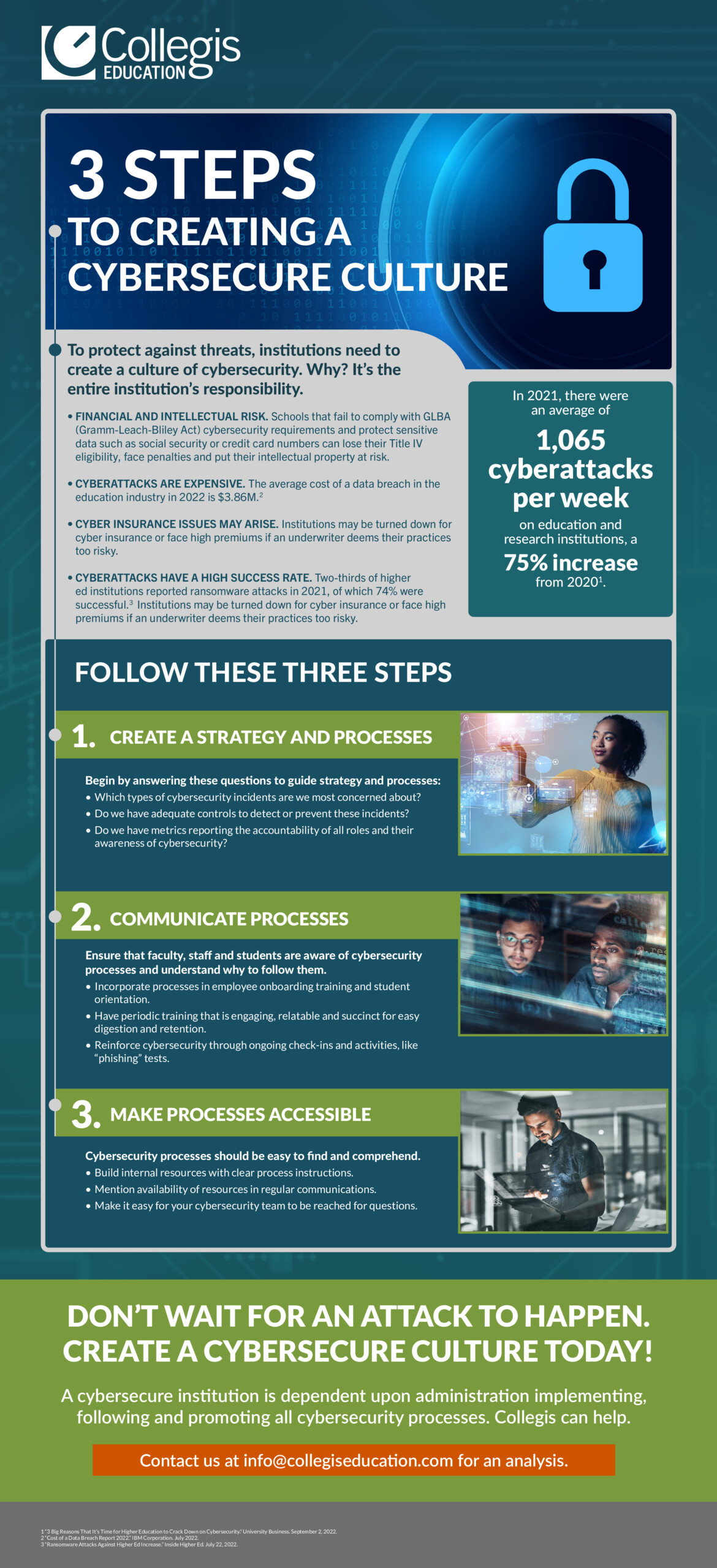
With cyberattacks on the rise, higher education institutions must move beyond reactive security measures and foster a cybersecure culture that protects students, faculty, and institutional data. A strong cybersecurity strategy isn’t just about technology — it’s about people, processes, and awareness.
Our latest infographic outlines key actions colleges and universities can take to build a proactive security mindset across their campuses.
Innovation Starts Here
Higher ed is evolving — don’t get left behind. Explore how Collegis can help your institution thrive.
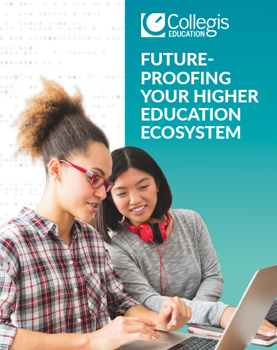
Future-Proofing Your Higher Education Ecosystem [eBook]
An institution’s long-term sustainability, including enrollment growth, anytime/anywhere learning, student retention, exceptional student experiences, and operational efficiencies is only possible with a data-enabled, technology ecosystem.
Higher ed leaders who prioritize data and technology and elevate their IT department’s role as a strategic partner within their institution will be best positioned for long-term sustainability.
To help college and university leaders create an integrated technology ecosystem, this ebook offers key considerations for the tech initiatives that drive effective transformation in higher ed.
Key points addressed
In this ebook, you’ll learn more about the following:
- Four barriers preventing schools from achieving value from their technology
- Six areas to focus on when assessing your technology environment
- Four Stages to transform your technology ecosystem
- Three Steps to realizing value from your data
Download Now
Transform Challenges Into Opportunities
Facing challenges in enrollment, retention, or tech integration? Seeking growth in new markets? Our strategic insights pave a clear path for overcoming obstacles and driving success in higher education.
Unlock the transformative potential within your institution – partner with us to turn today’s roadblocks into tomorrow’s achievements. Let’s chat.
IT Readiness Assessment
The higher education landscape is rapidly changing. Colleges and universities need to make the most of their data and technology to achieve strategic initiatives like enrollment growth, anywhere/anytime learning, student retention, academic value, operational efficiency and seamless digital experiences.
Our IT Readiness Assessment can help you prioritize where to focus your institution’s future efforts and investments. You don’t need to be a tech expert to take this assessment – it is meant for leaders responsible for their institution’s organizational strategy and growth.
Assess Your Institution’s Technological Capabilities
You will be guided through six vital areas of technological capabilities to help you assess where your institution stands today and which capabilities need attention. They are:
- Institutional Alignment
- IT Organization and Skill
- Stability
- Scalability and Innovation
- Student Experience
- Security
Additional Quizzes
No posts found.
Transform Challenges Into Opportunities
Facing challenges in enrollment, retention, or tech integration? Seeking growth in new markets? Our strategic insights pave a clear path for overcoming obstacles and driving success in higher education.
Unlock the transformative potential within your institution – partner with us to turn today’s roadblocks into tomorrow’s achievements. Let’s chat.
The Gramm-Leach-Bliley Act (GLBA), established in 1999 under the purview of the Federal Trade Commission (FTC), has long governed the safeguarding of sensitive information within financial institutions. Although not initially focused on educational contexts, the GLBA has more recently shifted into the spotlight of higher education governance.
Here we’ll dissect and analyze the critical elements of the GLBA and its Safeguards Rule, focusing on how they impact the collection, storage and use of student financial records in colleges and universities.
GLBA’s Rising Relevance in Higher Education
Within the last four years, the impact of the GLBA has been increasingly felt in higher education institutions. The Office of Management and Budget (OMB) ratcheted up this focus when it released its Compliance Supplement in July 2019, incorporating a new audit objective to assess institutional compliance with the Safeguards Rule.
The average cost of a single cybersecurity breach in higher education now $3.65 million.
Given recent high-profile examples, like the potentially disastrous MOVEit attacks in which Colorado State was among 600 organizations affected by a widespread and well-coordinated ransomware campaign, this added focus on safeguarding student financial records isn’t surprising. With the average cost of a single cybersecurity breach in higher education now at $3.65 million (as of March 2023), your responsibilities to protect student data and your institution’s financial future are greater than ever.
Fresh Changes to GLBA Safeguards Rule: What You Need to Know
In December 2021, the FTC enacted a revision of its Safeguards Rule, with some provisions effective on June 9, 2023. The education sector should note that the Department of Education’s Office of Inspector General has indicated that these revisions may be included in future OMB Compliance Supplements and would be subject to the single audit/federal awards program audit. With federal funding on the line, remaining compliant with these regulations and reporting requirements is essential.
3 Notable Updates to GLBA Requirements
The revisions in the Safeguards Rule cover a myriad of points ranging from risk assessments to personnel responsibilities. Here is a breakdown:
1. Personnel Coordination
Old Rule: Designate employee(s) for information security coordination.
New Rule: A qualified individual must be designated to manage and enforce the information security program. Even if a service provider or affiliate meets this requirement, the institution itself retains responsibility for compliance and oversight.
2. Risk Assessment
Old Rule: A risk assessment addressing three required areas was mandatory.
New Rule: Institutions must now conduct a written, periodically updated risk assessment that considers both internal and external threats, incorporating a more robust set of evaluation criteria.
3. Safeguarding Measures
Old Rule: Identify safeguards for each risk.
New Rule: Besides identifying safeguards, institutions now have to embrace a more complex set of data protection measures, such as multifactor authentication, secure disposal, and annual penetration testing.
Institutional Compliance Is Key
Understanding and implementing these changes is crucial for educational institutions to not only ensure compliance but also safeguard student data. These new changes necessitate a reevaluation of existing information security programs and may require the allocation of additional resources, including expert personnel and advanced cybersecurity tools.
The Gramm-Leach-Bliley Act’s evolving role in higher education, particularly with the recent changes to the Safeguards Rule, calls for universities and colleges to be proactive rather than reactive in the domain of student financial record-keeping and cybersecurity.
Collegis Education can help your institution achieve and maintain GLBA compliance with comprehensive solutions tailored to your unique needs. Our team of experts is well-versed in the latest best practices and can guide you through the intricacies of the Safeguards Rule and other compliance requirements. Reach out to us today to discuss your needs and take the first step toward safeguarding your institution’s future.
Innovation Starts Here
Higher ed is evolving — don’t get left behind. Explore how Collegis can help your institution thrive.
Do You Know How Technology Affects Your Higher Ed Institution?
Technology touches every aspect of every higher ed institution. As a leader who may not work in IT, it’s important to understand how technology affects your everyday functions so you can ensure it is aligned to your strategic goals – and investments are made in the right areas.
Get helpful content to take the next step in understanding just how essential it is for the future of your college or university – and the challenges IT is facing.
Collegis Education can partner with you to create a technology management strategy that aligns with your strategic goals. To learn more, reach out to us.
Take the quiz
Take our quick, 7-question quiz to see how much you know about higher ed technology.
Additional Quizzes
No posts found.
Transform Challenges Into Opportunities
Facing challenges in enrollment, retention, or tech integration? Seeking growth in new markets? Our strategic insights pave a clear path for overcoming obstacles and driving success in higher education.
Unlock the transformative potential within your institution – partner with us to turn today’s roadblocks into tomorrow’s achievements. Let’s chat.
Optimizing IT Spend Without Sacrificing Performance
How Saint Francis University partnered with Collegis to reduce its IT budget and reinvest savings into strategic technology modernization.
As Saint Francis University (SFU) expanded online and hybrid learning, leadership recognized a critical need: its technology infrastructure had to evolve just as quickly. The university lacked a cohesive IT strategy, governed systems, and scalable infrastructure to support growth. Through a strategic IT Managed Services partnership with Collegis, SFU implemented a long-term technology roadmap that stabilized operations, standardized systems, and positioned the institution for sustainable transformation.
An Aging, Fragmented IT Environment Limited Scalability and Growth
To support expanded digital learning and institutional modernization, SFU needed a stronger technology foundation.
Key challenges included:
- No cohesive long-term IT strategy aligned to institutional growth goals
- Limited governance and inconsistent system standards
- Infrastructure gaps impacting security, connectivity, and reliability
- Technology constraints hindering online and hybrid program expansion
Without stabilization and structure, IT operations remained reactive — limiting the university’s ability to scale confidently.
A Strategic Roadmap for IT Stability and Growth
Collegis partnered with SFU to assess the environment, reduce risk, and design a phased roadmap for long-term success.
Key actions included:
- Conducted a full IT assessment and built a multi-year strategic roadmap
- Established formal IT governance to standardize systems and decision-making
- Modernized core infrastructure, including Active Directory, Wi-Fi, security, and help desk support
- Delivered virtual CIO leadership to align IT strategy with institutional goals
This coordinated approach transformed IT from a support function into a strategic enabler of institutional progress.
The Collegis Impact
Measurable Savings, Stronger Infrastructure, and Exceptional User Satisfaction
SFU’s roadmap execution delivered clear, quantifiable outcomes:
- 14% reduction in the university’s IT budget, enabling reinvestment in strategic upgrades
- 96.3 average Net Promoter Score for help desk satisfaction (six-month average)
- Major infrastructure upgrades completed, improving security, connectivity, and system reliability
- Seamless transition to remote and hybrid operations supported by a stabilized, scalable IT environment
The partnership didn’t just modernize systems. It strengthened institutional confidence in technology as a strategic enabler.
The Takeaway
Stabilize First. Standardize Second. Transform with Intention.
Digital transformation requires more than isolated upgrades. It demands governance, leadership, and a clear roadmap aligned to institutional goals. Saint Francis University’s partnership with Collegis demonstrates how structured planning and strategic IT management reduce risk, improve efficiency, and create a foundation for long-term growth.
Build a Technology Foundation Designed for What’s Next
If your institution is navigating aging infrastructure, inconsistent systems, or stalled modernization efforts, it’s time for a strategic roadmap. Collegis partners with colleges and universities to stabilize operations, standardize environments, and transform IT into a catalyst for institutional growth. Learn more about our Managed IT Services.
Let’s Start Writing Your Success Story
See what’s possible when strategy, creativity, and execution come together. Partner with Collegis to turn your challenges into outcomes worth sharing.
Transform Challenges Into Opportunities
Facing challenges in enrollment, retention, or tech integration? Seeking growth in new markets? Our strategic insights pave a clear path for overcoming obstacles and driving success in higher education.
Unlock the transformative potential within your institution – partner with us to turn today’s roadblocks into tomorrow’s achievements. Let’s chat.
Finding efficiencies and reinvesting in upgrades
Looking to broaden their reach and serve students outside of their region, Saint Francis University decided to expand their online program offerings. To reach this goal, they needed to scale their operations to deliver a quality, technology-enabled student experience.
Situation: Tech infrastructure assessment
Saint Francis recognized the need to modernize their technology infrastructure and strengthen their capabilities in order to achieve their goals and improve long-term stability. The institution was searching for a partner that could support their entire IT department’s daily operations, while also building a strategic roadmap to enable and transform their digital infrastructure. Collaborating with Collegis Education, Saint Francis found a partner that could implement a comprehensive IT managed services solution and make progress toward their longer-term goals. Through the partnership, the university gained access to a wealth of technology expertise and new capabilities.
The Collegis managed services solution for Saint Francis included stabilizing their technology and infrastructure, standardizing expectations through strong IT governance, and optimizing business processes and infrastructure for increased efficiencies.
Collegis conducted an assessment of key digital infrastructure to find efficiencies and cost savings. The result was a strategic roadmap that included recommendations for technology transition projects, augmentation of staff, and an expansion of student and staff help desk services.
In addition, Saint Francis leadership worked with Collegis to install a virtual CIO to oversee strategy and operations for the department and to transition Saint Francis staff to the Collegis technology team.
Results: Reduced technology debt and improved help desk satisfaction
Collegis created a transition plan to retire technology debt by upgrading major platforms. Significant transition projects to stabilize the university’s infrastructure were completed, including:
- A new card access system
- A more secure, robust Active Directory to replace outdated authentication
- Upgraded campus-wide Wi-Fi network
Collegis helped the entire university adapt to remote work and transition to hybrid classrooms and virtual technology. Additionally, the Saint Francis IT help desk transitioned to the Collegis Personal Support Center (PSC) technology support program. Since the transition, the 6-month average Net Promoter Score is 96.3, as rated by faculty, students and staff.
Just one year into the partnership, Collegis began to optimize and transform Saint Francis’s technology landscape, conducting business process assessments, streamlining student laptop programs, and implementing the Microsoft Office 365 suite to increase security and improve user experience.
Overall, the strategic planning and implementation of a long-term technology roadmap identified efficiencies and a 14-percent cost savings in the university’s IT budget, allowing the funds to be reinvested into digital transformation initiatives.
During the global COVID-19 pandemic, Collegis also provided strategic technology leadership and recommendations to deploy CARES Act funds for a smooth transition to remote and hybrid learning delivery and paved the way for capital projects that continue to help Saint Francis University transform.
About Saint Francis University
Institution Type:
Private Catholic liberal arts university
Location:
Loretto, Pennsylvania
Total Enrollment:
2,232
Services:
- Comprehensive IT Managed Services
- Enterprise Applications
- IT Leadership & Governance
- Infrastructure & Operations
- Virtual CIO
- 24/7 Tech Support & Help Desk
Key Takeaways:
- 3 year-one transition projects
- 14% IT budget cost savings
- 96.3 Net Promoter Score
Other Case Studies


Transform Challenges Into Opportunities
Facing challenges in enrollment, retention, or tech integration? Seeking growth in new markets? Our strategic insights pave a clear path for overcoming obstacles and driving success in higher education.
Unlock the transformative potential within your institution – partner with us to turn today’s roadblocks into tomorrow’s achievements. Let’s chat.