Institutions are under pressure to bring new programs to market faster than ever, but course development can be one of the most resource-intensive tasks. Tight timelines, faculty bandwidth, and competing priorities can make even a modest program launch feel like an uphill battle, but it doesn’t have to be.
Course Development at Scale: How Institutions Launch
High-Quality Programs Faster
Wednesday, May 20
2:00 pm ET / 1:00 pm CT
In this webinar, Jennifer Young, Associate Director of Course Development at Collegis Education, and Meg Shay, VP of Academic and Faculty Affairs at Project Kitty Hawk, break down how institutions can move with speed and precision, without compromising the integrity of the learning experience. You’ll hear firsthand what it looks like when the right model is in place, one that has powered the development of more than 400 courses across five institutions since 2024.
What you’ll learn
In this webinar, we’ll showcase a proven framework that enables institutions to scale course development efficiently without compromising academic integrity.
You’ll learn how to:
- Build an operational infrastructure to support scalable course development
- Increase course development velocity and consistency without sacrificing quality
- Align instructional design, faculty, and production workflows
- Gain faculty buy-in and increase engagement
- Accelerate time to market for new programs
- Leverage the right mix of internal resources and external expertise
- Turn course development from a bottleneck into a competitive advantage
Who should attend
This webinar is designed for decision-makers and leaders responsible for academic innovation, online learning, program development, and operational execution, including:
- Provosts and academic leadership
- Instructional design and curriculum teams
- Online learning and digital strategy leaders
- Enrollment and program development stakeholders
Expert speakers

Jennifer Young
Associate Director of Course Development
Collegis Education

Meg Shay, PhD
VP of Academic & Faculty Affairs
Project Kitty Hawk
Complete the form on the top right to reserve your spot. We look forward to seeing you on Wednesday, May 20.
For today’s adult learners, persistence is about more than just academic support. It’s about navigating real-world responsibilities — jobs, caregiving, financial stress — and still finding the flexibility and value they need from their educational experience.
To better understand what drives retention in this evolving landscape, Collegis Education partnered with UPCEA to conduct a national survey of both institutional leaders and online adult learners. The results revealed a powerful insight: While most institutions are actively investing in retention, many are missing the mark on what students actually need to stay enrolled and succeed.
5 Key takeaways from our latest retention research
Here are five notable insights from the research, and what they mean for colleges and universities committed to improving student outcomes.
1. Students want flexibility and autonomy, not more oversight
Many institutions prioritize structured check-ins and process-driven interventions, believing these strategies keep students on track. But our research shows adult learners value autonomy. They want tools that help them manage their own progress on their own time.
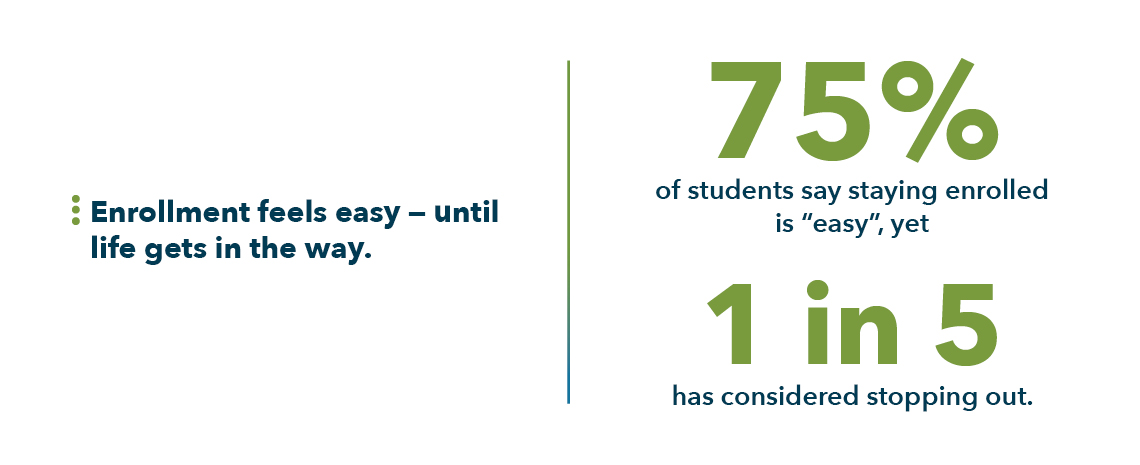
This disconnect highlights a critical point: ease of enrollment doesn’t guarantee persistence. Students need systems that accommodate their lives, not ones that require compliance with rigid structures.
2. Life stage matters more than demographics
A 25-year-old balancing their first full-time job faces different challenges than a 45-year-old returning to school after a career break. Yet many institutions still apply a one-size-fits-all support model across adult learner populations.
Our research shows that segmenting support by life stage (early career, mid-career, late career) helps institutions design smarter, more personalized services. That kind of alignment strengthens trust and improves outcomes.
3. Visibility drives persistence, but institutions underdeliver
What do students say actually helps them stay enrolled? Tools that let them track progress, set goals, and manage deadlines. A self-service progress dashboard was ranked as the most helpful support resource by students, yet institutions ranked it near the bottom.
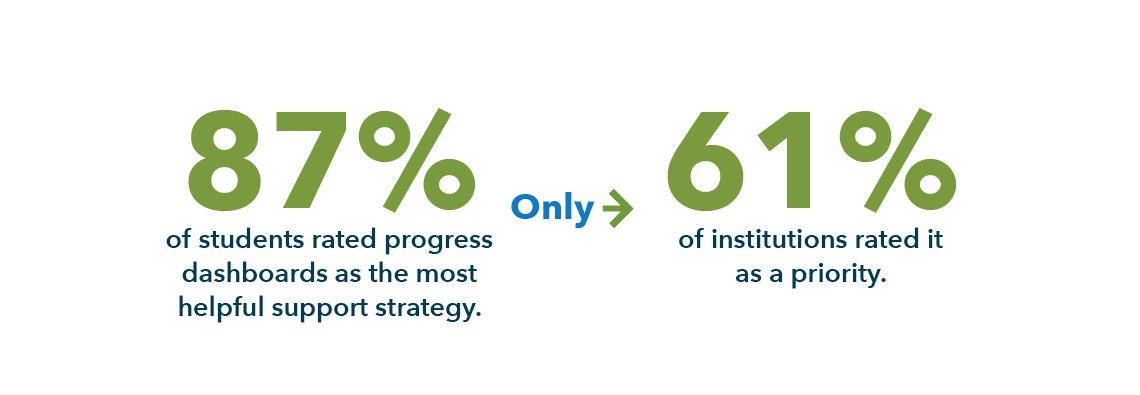
This doesn’t mean eliminating human touchpoints. It means empowering students with the information they need upfront, so that staff interventions can be more timely, relevant, and effective.
4. Career goals are the anchor across segments
Despite their differences, adult learners are united by one common motivator: career advancement. Whether they’re seeking a promotion, changing industries, or gaining credentials for long-term growth, students want programs that deliver clear ROI.
Institutions that embed career relevance into coursework, advising, and communication are more likely to keep students engaged and enrolled.
5. Nearly half of institutions don’t track online retention
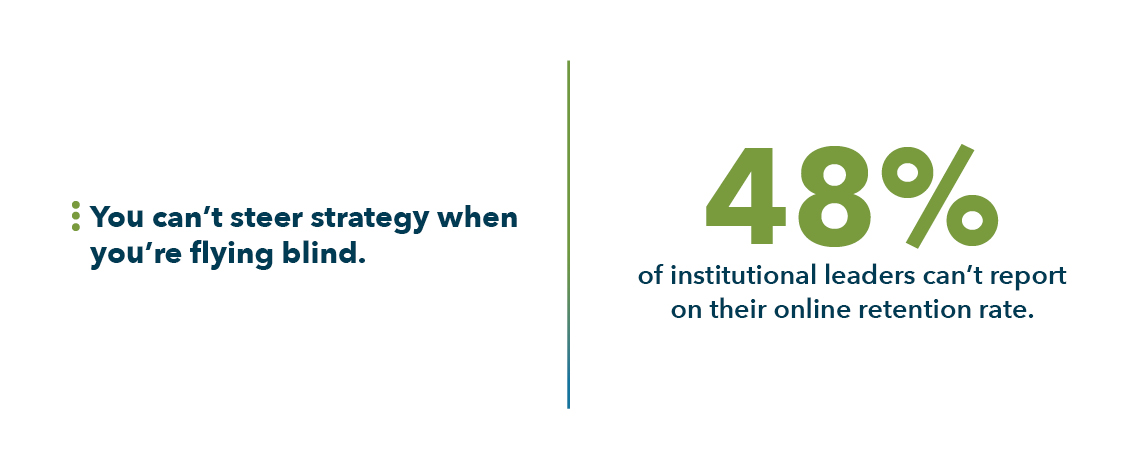
This was one of the most surprising data points: 48% of institutional leaders said they couldn’t report their online retention rate. Without clear tracking, it’s nearly impossible to assess what’s working or where improvement is needed.
Better visibility into retention metrics — paired with predictive analytics and student feedback — can help institutions act earlier and more effectively.
How institutions can start closing the retention gap
Improving retention for online adult learners isn’t about doing more. It’s about doing the right things with the right focus. The full UPCEA-Collegis report goes into detail about three institutional shifts that can help close the gap between intention and impact:
- Smarter automation that personalizes student support at scale
- Segmented strategies that align with learners’ life stages and goals
- Proactive intervention driven by real-time data and predictive tools
Get the full story
These insights are just scratching the surface. To explore the full findings and get actionable advice on how to build a more student-centered, data-powered retention strategy, download the full report below.
Download the Complete Report
“The Retention Disconnect: What Adult Learners Need and What Institutions Miss”
Higher education is seeing a surge of interest in non-degree credentials. Learners are seeking faster, more affordable pathways to workforce advancement. Employers are increasingly open to (and in some cases requesting) alternatives to traditional degrees. And with new federal policy expanding Pell Grant eligibility to non-degree programs, institutions are feeling the urgency to act.
But not all certificate programs are created equal. And while the trend line is clear, the strategy behind how institutions respond is anything but. This moment presents an opportunity, but only for those willing to plan with purpose and set realistic expectations.
What’s driving demand for short-term credentials?
Recent data underscores a clear increase in interest:
- Undergraduate certificate enrollment grew 33% and graduate certificate enrollment grew 21% from Fall 2020 to Fall 2024, according to National Student Clearinghouse data.
- Google search volume for certificates has increased 19% from 2020 to 2025, according to Google Trends data.
Today’s learners are drawn to programs that offer accelerated timelines, reduced costs, and clear pathways to meaningful career outcomes. Many working adults are looking to upskill or pivot careers, and a certificate can be a more practical option than a full degree — especially in disciplines where market demand is accelerating and new opportunities are emerging.
On the employer side, organizations want proof of skills and are increasingly willing to collaborate with institutions on curriculum design. In fact, according to a 2022 employer survey from Collegis and UPCEA, 68% of respondents said they would be interested in teaming up with an institution to develop non-degree credentials to benefit their workforce.
Certificates are a piece of the puzzle — not the whole strategy
Despite the interest, many institutions struggle to meet enrollment goals for certificate programs. Strong market trends do not automatically translate into high enrollment volume. The reality is that most certificates serve niche audiences and deliver modest numbers. When treated as stand-alone growth drivers, they often fall short.
The institutions that see the most strategic value from certificates do so by positioning them within a larger enrollment and academic ecosystem. For example, we’ve helped our partner institutions find success in using certificate interest as a marketing funnel to drive engagement in related master’s programs. Once a prospective student engages, enrollment teams can advise them on the best fit for their career goals, which, for some students, is enrolling in the full degree program.
Ready for a Smarter Way Forward?
Higher ed is hard — but you don’t have to figure it out alone. We can help you transform challenges into opportunities.
What a strategic certificate model looks like
A certificate program with purpose isn’t just a set of courses — it’s a product with clear value to both learners and the institution. Key elements of a strategic approach include:
- Workforce alignment: Programs must be rooted in real-time labor market data. What skills are employers seeking? Which certifications are valued? Aligning with reputable industry certifications is a proven way to ensure relevance and employer recognition.
- Accessibility: Pricing should reflect the certificate’s value relative to degree programs, and eligibility for financial aid must be prioritized. Lack of aid is a significant barrier to enrollment for many prospective learners.
- Laddering and stackability: Certificates should not be terminal unless intentionally designed that way. They should stack into larger degree pathways or offer alumni incentives for continuing their education.
- Delivery speed and flexibility: Busy adult learners expect quick starts, clear outcomes, and minimal red tape. Institutions need streamlined onboarding and agile curriculum design.
- Internal collaboration: Designing certificates in isolation often leads to friction. Academic, enrollment, and marketing teams must be aligned on purpose, target audience, and outcomes.
- Employer engagement: Employers want to be part of the development process and seek assurance that certificate programs teach the skills they need. Their involvement enhances the recognition and credibility of the credential.
The role of institutions: Balance mission with market
Certificate programs are not a shortcut to growth. But they can be a smart strategic lever when grounded in data and designed to complement an institution’s broader mission. They offer colleges and universities an opportunity to:
- Expand access to underserved learners
- Respond more nimbly to labor market shifts
- Strengthen ties with regional employers
- Drive awareness and enrollment for degree programs
The key is alignment. When certificate offerings reflect both market demand and institutional mission, they can play a powerful role in expanding reach and impact.
Plan with purpose, execute with intent
Certificates are more than just a trending credential. They’re a tool to serve learners in new ways. But institutions must resist the urge to chase quick wins. Success requires thoughtful design, realistic expectations, and cross-functional collaboration.
With the right foundation, certificate programs can do more than fill a gap. They can open doors for learners, employers, and institutions alike. Collegis supports this effort with integrated services in market research, instructional design, and portfolio development — empowering institutions to make informed, mission-aligned decisions that deliver impact.
Innovation Starts Here
Higher ed is evolving — don’t get left behind. Explore how Collegis can help your institution thrive.
As the demand for workforce upskilling grows, higher education institutions have a unique opportunity to partner with employers on microcredentials and professional development programs. But with increasing competition from private providers like LinkedIn Learning, Coursera, and Khan Academy, how can colleges and universities stand out?
To answer this question, Collegis Education and UPCEA surveyed more than 500 employers to understand their perceptions of working with higher ed institutions on professional development and alternative credentials.
Here’s a snapshot of what we found:
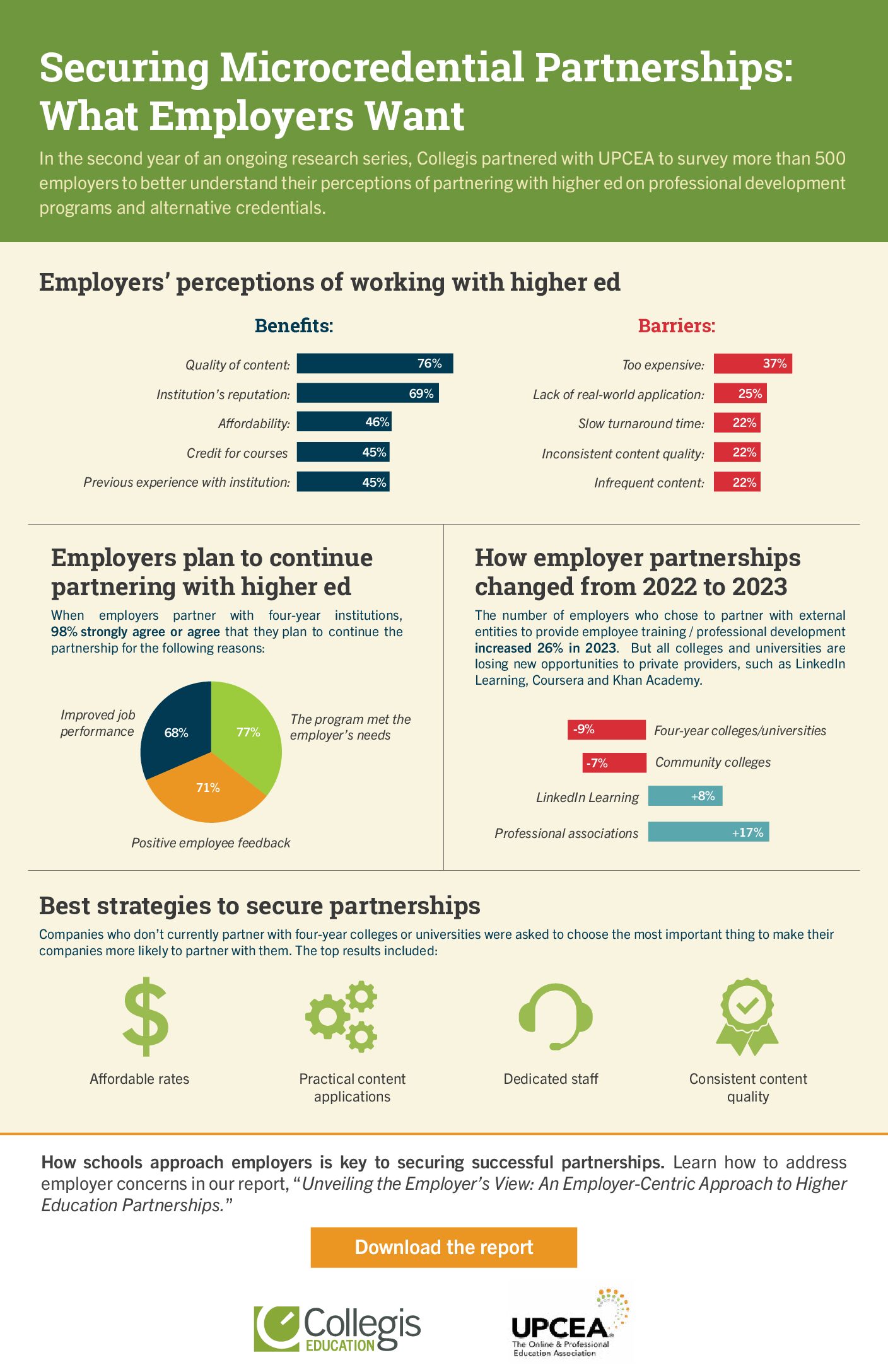
To stand out, institutions must focus on affordable, practical, and well-structured programs that align with employer needs. Successful partnerships require responsive engagement, clear outcomes, and content that directly applies to the workplace.
The insights found in the infographic only scratch the surface of what the research uncovered. Download the full report to learn what incentivizes employers to work with four-year higher ed schools.
Unlock Employer Insights
Learn what businesses seek in higher ed partnerships. Download the report today.
Employers want to partner with external providers to upskill and reskill their employees — presenting an opportunity for higher ed institutions to grow revenue by creating programs for employers. Our recent research with UPCEA found that from 2022 to 2023, companies partnering with external organizations to provide employee training/professional development increased 26%.
Challenges for higher education institutions
Higher ed is quickly losing these opportunities to private providers like Coursera and LinkedIn Learning. While partnerships with professional organizations and private providers rose year over year, partnerships with higher ed institutions fell. Schools need to aggressively align programs and processes with market demand and employer partnerships, or the market will go elsewhere.
The best way to take advantage of these opportunities is to play to your school’s strengths, prioritize program growth, and avoid overextending your resources. Consider using existing courses in high-demand areas to create online certificates and pathways to stack certificates into degree programs.
Top graduate certificate programs for 2024
Here’s a list of graduate certificate programs with the best growth potential (according to national conferral volume and growth). Are there any programs your school could develop to take advantage of this growing need?
Business
- Business Administration and Management
- Organizational Leadership
- Entrepreneurship
Education
- Teacher Education and Professional Development, Specific Levels and Methods, Other
- Special Education and Teaching, General
- Teaching English as a Second or Foreign Language/ESL Language Instructor
Healthcare/Nursing
- Psychiatric/Mental Health Nurse
- Family Practice Nurse
- Registered Nursing
Multidisciplinary
- Sustainability Studies
- Data Analytics, General
- Business Analytics
Science
- Epidemiology
- Natural Resources Management and Policy
- Biology/Biological Sciences, General
Social and Psychological Sciences
- Applied Behavior Analysis
- Geographic Information Science and Cartography
- Criminal Justice/Safety Studies
Technology
- Computer Systems Networking and Telecommunications
- Computer Programming/Programmer, General
- Computer and Information Sciences, General
Partnering with employers for program growth
After determining the most in-demand certificates for your school, partnering with employers to design the curriculum and develop enrollment pathways can help scale enrollments. Collegis can help you analyze your regional competition and the skills demanded most by local employers to develop the right programs for your market, support employer partnerships, and develop custom strategies for growth and differentiation.
Understanding Employer Perceptions: The Collegis-UPCEA 2024 report
Our new report “Unveiling the Employer’s View: An Employer-Centric Approach to Higher Education Partnerships” reveals what employers want and how to approach them. We’ll be here to help you get started.
Innovation Starts Here
Higher ed is evolving — don’t get left behind. Explore how Collegis can help your institution thrive.
How Spelman Expanded Reach to Working Adults
Like many colleges and universities today, Spelman was faced with the challenge of generating more revenue, particularly to help decrease the amount of debt its students graduate with. To begin combatting this challenge, the college ventured into online learning with summer courses that students could use to get ahead or catch up.
Keen interest in these courses prompted the college to leverage this model for a wider adult learner audience than their core population of women of color, and they scaled quickly:
In January 2022, eSpelman launched three courses and 49 learners. In 2023, enrollments rose to 1,300 learners. Today, eSpelman works with 19 corporate partners.
Collegis plays an integral role in faculty training and program planning for continued growth. Download “Expanding Vision to Reach Adult Learner Market” to learn how their marketing strategy, a partnership with Guild and alumni support contribute to eSpelman’s success.
Download Now
Additional Resources




Transform Challenges Into Opportunities
Facing challenges in enrollment, retention, or tech integration? Seeking growth in new markets? Our strategic insights pave a clear path for overcoming obstacles and driving success in higher education.
Unlock the transformative potential within your institution – partner with us to turn today’s roadblocks into tomorrow’s achievements. Let’s chat.
Online learning offers students flexibility to access classes where – and often when – they choose. This style of education has become the world’s most prevalent model for postsecondary learning, according to an Inside Higher Ed article. To stay relevant and best serve students, institutions must develop quality and effective online (or “distance learning”) courses.
There are five key elements that make up a quality distance education program. Let’s break them down…
1. Courses are designed to be conducted online.
One of the most important characteristics of a quality online education program is the fact that the courses were designed specifically for online delivery. Their learning modules are built to be effective and engaging online experiences.
When designing an online program, Dave Lungren, vice president of content solution at Collegis, says consistency is key. He believes it’s critical to have a single, fundamental design implemented across all courses in the program.
“Nothing is more difficult for students than needing to figure out what to do or where to go in a particular course,” Lungren explains. He adds that effective online courses are often structured in a weekly cadence, with regular activities and due dates that allow students to establish a weekly rhythm of effort, assignment completion and interaction.
2. Opportunities for student engagement are embedded within the courses.
An obvious drawback of distance learning is the lack of direct interaction between students and their instructors (as well as their peers). While it’s difficult to replicate the face-to-face collaboration that exists in a residential learning environment, a quality online program will have practical alternatives intentionally designed into the courses.
Lungren describes the three levels of interaction that are important in distance learning programs:
- Student-to-faculty interaction: Creating opportunities for students to have contact with the course instructor. This can be done through discussion boards, email, virtual office hours, phone calls and thoughtful assignment feedback.
- Student-to-student interaction: Providing ways for students to connect and collaborate with their peers. This can take place via group assignments, synchronous learning sessions, discussions boards and email, and can help build a sense of comradery within the program.
- Student-to-content interaction: Leveraging dynamic learning materials that require active involvement from the student. This could come in the form of animated or clickable images or through more complex interactive simulations.
3. Instructors are trained to teach in an online environment.
Not all instructors have experience teaching courses online. In fact, according to data from Bay View Analytics, when COVID prompted schools to shift courses online, 97 percent of the institutions surveyed tasked instructors who had no prior online teaching experience with transitioning to distance education courses. And 56 percent of faculty reported using teaching methods they had never used before.
Yet, instructors play a critical role in the success of any distance education program. That’s why the best programs revolve around instructors who receive the specific training, coaching and ongoing support it takes to be effective educators in an online modality.
4. Assessments are structured to be delivered virtually.
One of the most challenging parts of remote learning has been figuring out how to deliver effective, valid – and secure – assessments. This critical component is typically an area of intense focus when designing a quality distance education program.
Lungren describes three important elements that should be incorporated into every online course:
- Formative assessment: Building in opportunities for monitoring student learning throughout the term, providing ongoing feedback so students can measure their own personal learning progress.
- Summative assessment: Evaluating student achievement of course-level learning objectives. Authentic, project-based assessment methods tend to be most effective for online delivery.
- Exam security for objective tests: Ensuring exams are protected in an online environment using lockdown browsers, online proctoring and randomized test question pools in the learning management system (LMS).
5. Support is easily accessible.
Just because students aren’t on campus doesn’t mean they should be on their own. A successful distance education program is backed by 24×7 support for students and faculty alike. This helps ensure technology or accessibility issues won’t disrupt the learning process.
In the asynchronous world of online education, problems can pop up day or night on any given day. Having around-the-clock technology support provides peace of mind for students, allowing them to focus on their learning.
The best distance education programs also offer other types of support catered to online students. This can include access to academic advising, online tutoring options, networking opportunities, career services and more.
Elevate your online education offerings
As you evaluate the future of distance education programs at your institution, keep these factors in mind. If you need assistance in navigating the road ahead, we’re happy to help!
Let us help you develop the enriching online learning experience your students are seeking.
Innovation Starts Here
Higher ed is evolving — don’t get left behind. Explore how Collegis can help your institution thrive.
From shifting student demographics to distance learning and competency-based courses, higher continues to evolve to meet the needs of today’s students and tomorrow’s workforce.
The emergence of microcredentials as a new form of certification is driven by the skills gap in today’s 21st century workforce. Let’s talk about the purpose of micro-credentials and what they mean for students and higher education institutions alike.
What are micro-credentials?
The National Education Association describes micro-credentials as a “competency-based digital form of certification.”
Sometimes referred to as “badges,” microcredentials are hyper-focused and typically comprised of sub-competencies. These skills are outlined within a rubric, along with the specific criteria required of each. It is earned once a student successfully demonstrates each competency.
Micro-credentials typically align with soft skills that are valued by employers. They recognize an individual’s proficiency in areas like oral communication, initiative or even empathy. Once earned, the recipient can add it to their LinkedIn profile and resume as a way to formally recognize their aptitude in that area.
What’s driving the need for micro-credentials?
Microcredentials are gain traction because there’s a growing disconnect between what employers want and what candidates have to offer — especially when it comes down to their soft skills.
In Monster’s The Future of Work 2021: Global Hiring Outlook report, employers asked to name the top skills they want in employees cited soft skills such as dependability, teamwork/collaboration, flexibility and problem-solving.
This is where microcredentials can help fill the skills gap.
How are micro-credentials helping meet demand?
Most college degree programs are built to train students on the technical skills needed to perform the duties related to their desired profession. Training on the transferable skills that help individuals succeed beyond the most basic job duties is less prevalent.
For example, aspiring data analysts will master technical skills like SQL, Tableau and data mining in a degree program. But employers are also seeking candidates with a demonstrated proficiency in problem-solving, communication and project management. These skills make them more collaborative, productive employees, and are areas in which microcredentials can make an impact.
Because these certifications are built upon competencies, they carry more weight with employers. Anyone can list “communication, critical thinking and empathy” in a paragraph on a resume. But displaying a microcredential serves as concrete evidence that you’ve demonstrated proficiency in that area.
Micro-credentials are a promising solution for students and employers alike, but credentials may eventually need to undergo some sort of standardization process — both to increase its validity, and also to set expectations of students and employers.
With many institutions already adopting the microcredential method in various ways, it seems to be a trend that won’t be fading anytime soon.
Who are the early adopters of microcredentials in higher education?
It hasn’t been long since micro-credentials first made their entrance in the higher ed world. Though they are still in their infancy, a handful of institutions have already acknowledged their value and incorporated them into their suite of offerings.
For example:
- Colorado State University offers an array of soft-skill badges which include subjects such as teamwork, conflict resolution and stress management.
- George Mason University established a resilience badge, which demonstrates a student’s ability to positively deal with stress, change, uncertainty and adversity.
- California Community Colleges (CCC) now offer “21st Century Skills badges” throughout their campuses, covering skills such as collaboration, digital fluency, entrepreneurial mindset and social/diversity awareness.
These are just a few examples of how forward-thinking institutions have adopted the microcredential method to help provide additional development opportunities for the modern student.
Filling the soft skills gap
Higher ed continues to evolve to meet the needs of students and the workforce. With the increasing desire for job candidates with stronger soft skills, microcredentials and digital badges stand to benefit graduates and employers alike. We anticipate more schools will join the soft skills movement by incorporating micro-credentials into their program portfolios.
The increasing implementation of microcredentials is just one of many trends emerging in higher education. Learn more about what else is on the horizon in our article, “Reimagining Higher Ed for the 21st Century.”
Curious about how your institution might incorporate microcredentials into your program mix? We’d love to chat about the opportunities! Contact us at info@collegiseducation.com.
Innovation Starts Here
Higher ed is evolving — don’t get left behind. Explore how Collegis can help your institution thrive.
Your faculty are the lifeblood of your institution. They are directly responsible for delivering the top-of-the-line knowledge and training your school promises its students. It’s their passion, hard work and authentic interactions that help uphold the reputation your institution was built on.
These scholars are some of the best minds in their respective fields. But with technology and learning experiences evolving each year, it’s unreasonable to expect them to keep abreast of all of the latest trends and teaching strategies without the proper preparation. In order to empower them to provide the best education for students, you need to invest in the best training for them.
Faculty training and development is often overlooked at the collegiate level, but as higher education pedagogies are rapidly evolving, it is becoming more and more crucial. To learn more about the topic, we enlisted Tim Loatman, Director of Academic Services at Collegis Education, to discuss the importance of investing in your instructors, and the advantages that come with it.
The benefits of investing in faculty training and development
Higher education faculty have literally built their careers around learning, so they understand the importance of continual education. Many instructors will take it upon themselves to seek out learning opportunities if they aren’t provided the options by their institution. But in today’s ever-evolving higher education landscape, schools are beginning to recognize the importance of investing in faculty training.
“Faculty attend conferences, read industry publications and exchange best practices with their personal teaching circles,” Loatman explains. “But as technology rapidly changes and institutions seek to leave their pedagogical mark on student bodies, you see more and more institutions leading the charge with training.”
When an institution takes the lead in offering training and development opportunities for faculty, the impact is widespread. Learn about some of the notable advantages:
1. Instructors are equipped to adapt to new teaching methods
In today’s new normal, this may be the most obvious benefit to schools. Distance learning options have been on the rise for the past few years, but that shift has been vastly accelerated due to pandemic restrictions in place.
Institutions have been forced to embrace new technologies and learning modalities in order to continue delivering the quality education their students deserve. But you can’t expect instructors to succeed in these situations without the proper training. By proactively investing in faculty training and development, you can prepare your instructors to thrive in innovative environments.
2. Consistent student experiences can be established and maintained
Providing training across all faculty can help foster a consistency across the institution – one that strengthens the school’s brand and student experience.
Loatman goes on to explain that the faculty at any given school is extremely diverse – which is a huge benefit to students. But allowing every instructor to structure things in different ways makes things more difficult for students.
“Universities can embrace this diversity while still having their own stamp on instruction,” Loatman says. “Training and development can help marry the diversity of instruction with a consistent institutional thread that students will appreciate and expect.”
3. Institutional leaders are cultivated
By offering ongoing training opportunities for faculty, you’re gradually building a deep bench of talented leaders who are equipped and excited to take on new roles or responsibilities. If you are investing in the development of your existing faculty, they can naturally advance into leadership roles as they arise.
Whether you’re in need of a new department dean or someone to lead a taskforce committee on campus, you’ll have a pool of internal talent to choose from. This is especially helpful given the recent trend of shorter periods of tenure.
4. Faculty burnout is less likely
Faculty burnout has always been an issue in higher education, but the threat is even bigger in this current environment. There are several factors that can contribute to feelings of burnout, and some of them can be minimized by offering proper training and professional development opportunities.
These initiatives help equip instructors with successful strategies and techniques to teach more effectively, avoiding some of the stress involved with planning and delivering information in a new way. Aside from the practical benefits to improving their daily responsibilities, faculty also feel more valued and appreciated when their institution prioritizes their professional growth. Generally speaking, there is a strong correlation between training and job satisfaction.
5. Internal advocates can help influence other associates
In addition to institution-wide training, it’s also beneficial to offer more personalized professional growth opportunities to certain faculty members. By identifying individuals who are passionate about a particular area of development, you can establish subject matter experts who can circulate their knowledge to their peers.
“The best faculty training involves faculty in the deployment and creation,” Loatman says. “Faculty who become early adopters and are actually involved in contributing to the training of others will bolster engagement and contribute to skill acquisition.”
Consider the following example: A standout professor at your school expresses her passion for exploring ways to implement new technology and media in the classroom. By sending her to a seminar on the subject, she can expand her knowledge on the topic and bring that back to share practical examples with her fellow faculty members.
6. Improved student outcomes
It’s true that faculty development benefits the professors and institutions a great deal, but it doesn’t stop there.
Think of how athletic coaches are constantly studying and perfecting new coaching strategies and training techniques to elicit the best possible performance from their players. Improving an instructor’s ability to educate can similarly lead to better student performance.
Research suggests that investing in faculty development can result in higher grades among students. By implementing more effective teaching strategies, students are able to absorb more of the subject matter.
Invest in your faculty
Prioritizing faculty training and development is a win-win scenario. When faculty teach more effectively, students perform better in the classroom. And when students excel, institutions thrive.
“Faculty development helps ensure consistent quality in the classroom, which leads to happy students who get the most out of their learning experiences,” Loatman says.
Don’t leave your faculty members to fend for themselves. Cultivating a culture of continual learning will benefit all aspects of your institution.
Innovation Starts Here
Higher ed is evolving — don’t get left behind. Explore how Collegis can help your institution thrive.
The workforce has changed. And with its transformation, workers have evolved their qualifications to meet new demands.
These changes are driven by technology — and the workforce must respond. Higher education institutions must also adapt to provide relevant, capable graduates who are properly equipped for today’s corporate landscape.
We’re in the information age, in which the economy is shaped by technology — a significant departure from manufacturing-focused industrialism. With new innovation comes exciting promise, but also a unique set of challenges for today’s graduates.
There’s a new skillset today’s students need in order to succeed, and these have been dubbed “21st century skills.” Keep reading to learn more about why 21st century skills are so critical and what it means for higher education.
What are 21st century skills?
What specialized skills does one need to succeed in today’s information age? That’s the ideology behind the concept of 21st century skills. 21st century learning can be broken out into three main groups, each comprising different sets of competencies:
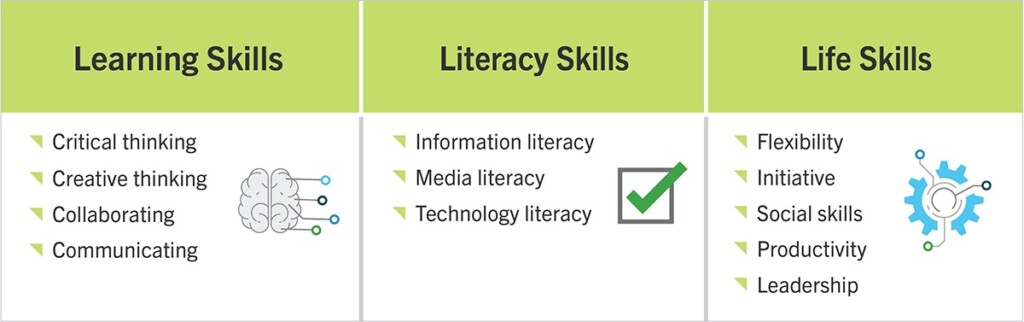
The 21st century skills movement caught on around the beginning of the millennium, when the National Education Association established the Partnership for 21st Century Skills (P21) and developed a “Framework for 21st Century Learning.”
This framework outlined different skills deemed especially valuable and necessary to prepare today’s students for tomorrow’s workforce. Numerous states have since joined P21 through the years and have built these 21st century skills into their school districts’ curriculums.
21st century skills were specifically selected and deemed critical to modern workplaces. Advancements in technology have changed not only the type of work that’s done, but how it’s done. Because of this, the human element is growing more important than ever before.
This is especially true with emerging technologies, such as machine learning and artificial intelligence. With technology taking on more and more of the repetitive, task-based work, it means that humans are left to tackle more dynamic issues that require creativity, critical thinking and collaboration.
What do employers think of 21st century skills?
The term “soft skills” is slowly being replaced by “21st century skills.” Competencies like communication and collaboration have long been characterized as soft skills, and remain important through the evolution into 21st century skills. These are skills that employers are seeking in job candidates.
In fact, a majority of employers find these skills to be just as important as technical skills. In LinkedIn’s 2019 Global Talent Trends Report, over 90 percent of surveyed employers reported that soft skills are just as or even more important to hire for than hard skills.
And in a recent survey of 400 employers, 85 percent reported wanting to hire individuals with a broad range of knowledge and skills, as compared to field-specific skills. These employers listed leadership, written communication, verbal communication, flexibility and teamwork as some of the most-desirable attributes in candidates.
Unfortunately, only 11 percent of business leaders agree that today’s college graduates have the skills needed for today’s dynamic workforce. On the other hand, 96 percent of college academic officers believe in their school’s ability to prepare students for the workforce.
As you can see, there’s a disconnect between academia and corporate America. So what can be done to connect the needs of employers with the qualifications of college graduates?
What role does higher education play in developing 21st century skills?
Some universities or particular programs naturally incorporate these kinds of transferable skills into their curriculum. Liberal arts programs, for example, are notorious for emphasizing soft skills like leadership, communication and teamwork. But 21st century skills aren’t only valuable for communications or philosophy majors.
Even the most technical fields – like computer science or accounting – are in need of professionals who can collaborate, adapt, think critically and take initiative. So how can schools equip students with these types of 21st century skills without overhauling their entire curriculum?
Several higher education institutions have acknowledged the need to better prepare students for the modern workforce using a more innovative approach. This includes new offerings, such as digital badges and micro-credentials, which help arm their graduates with the 21st century skills employers are seeking.
Digital badges can cover anything from blogging to time management or even initiative – competencies that until now have not been formally recognized on resumes or LinkedIn profiles.
Students earn digital badges in a similar manner to competency-based courses. A digital badge typically contains sub-competencies that are outlined within a rubric, and students must prove their proficiency in the specified skill in order to earn the badge. From there, they can add it to their LinkedIn account, website, portfolio or resume.
As many as one in five schools now offer some form of digital badges. And many of these offerings address the interpersonal, transferable-skill emphasis that aligns with the 21st century skillset.
Consider the following examples:
- Colorado State University offers soft skill badges in teamwork, conflict resolution and stress management.
- Johnston Community College in North Carolina offers an intercultural fluency badge.
- George Mason University offers a resilience badge.
- California Community Colleges (CCC) now offer “21st Century Skills Badges” in subjects such as collaboration, digital fluency, entrepreneurial mindset and social/diversity awareness.
Prepare your graduates for the professional world
The workforce has evolved, and higher education must follow suit. Today’s graduates are entering a different type of workforce, so make sure you’re setting yours up for success.
Learn more about how some colleges are adapting to meet this need in our article, “What Are Micro-Credentials? How Colleges Are Adapting to the Modern Workforce.”
Innovation Starts Here
Higher ed is evolving — don’t get left behind. Explore how Collegis can help your institution thrive.