Collegis Education is Participating in the HERDI National Panel Session
Collegis Education is honored to participate in the HERDI National Panel Session, where higher education decision-makers and industry leaders come together to discuss the most pressing challenges facing colleges and universities today. This exclusive event provides a unique opportunity to gain insights directly from community college presidents, chancellors, and senior administrators on how institutions can leverage data, technology, and innovation to drive success.
Event Details
- Date: Thursday, April 8, 2025
- Location: Nashville, TN
- Venue: Loews Nashville Hotel at Vanderbilt Plaza
- Learn More: HERDI National Panel Sessions
Our team will be engaging with higher ed leaders at the HERDI National Panel Session to share expertise and gain valuable insights from institutional leaders.
We look forward to meaningful discussions that drive innovation in higher education!
The future of learning is being shaped by innovation, and Collegis Education is excited to be part of the 2025 ASU + GSV Summit. This premier event brings together education, workforce, and technology leaders to explore the latest advancements in digital learning, AI, and student success strategies. Join us as we engage in meaningful conversations about how data, technology, and talent are transforming higher education.
Event Details
- Dates: April 14-16, 2025
- Location: San Diego, CA
- Venue: Manchester Grand Hyatt San Diego
- Learn More: ASU + GSV Summit Website
Why Attend the 2025 ASU+GSV Summit?
This event is a must-attend for education leaders looking to harness innovation to improve student outcomes, workforce readiness, and institutional success. Key topics include:
- AI and the Future of Education – Exploring the role of artificial intelligence in learning and operations.
- Workforce-Aligned Learning – Designing programs that meet the evolving needs of today’s job market.
- Higher Ed Digital Transformation – Leveraging technology to enhance student engagement and retention.
- Enrollment & Marketing Strategies – Navigating new ways to attract, enroll, and support students in a competitive landscape.
Collegis Education is at the forefront of helping institutions turn insights into action through data-driven solutions that drive real results.
Where to Find Us
Our team will be on-site, ready to connect with higher ed leaders, innovators, and edtech partners. Let’s discuss how Collegis can help your institution optimize operations, enhance student experiences, and grow enrollments.
We look forward to seeing you in San Diego!
As demand for skills-based learning grows, microcredentials are emerging as a key opportunity for higher education institutions to strengthen employer partnerships. But what do businesses actually look for in these programs, and how can colleges and universities position themselves as the preferred partner?
To find out, Collegis Education and UPCEA surveyed 500 organizations to gauge employer perceptions of non-degree credentials. Here’s a snapshot of what we found:
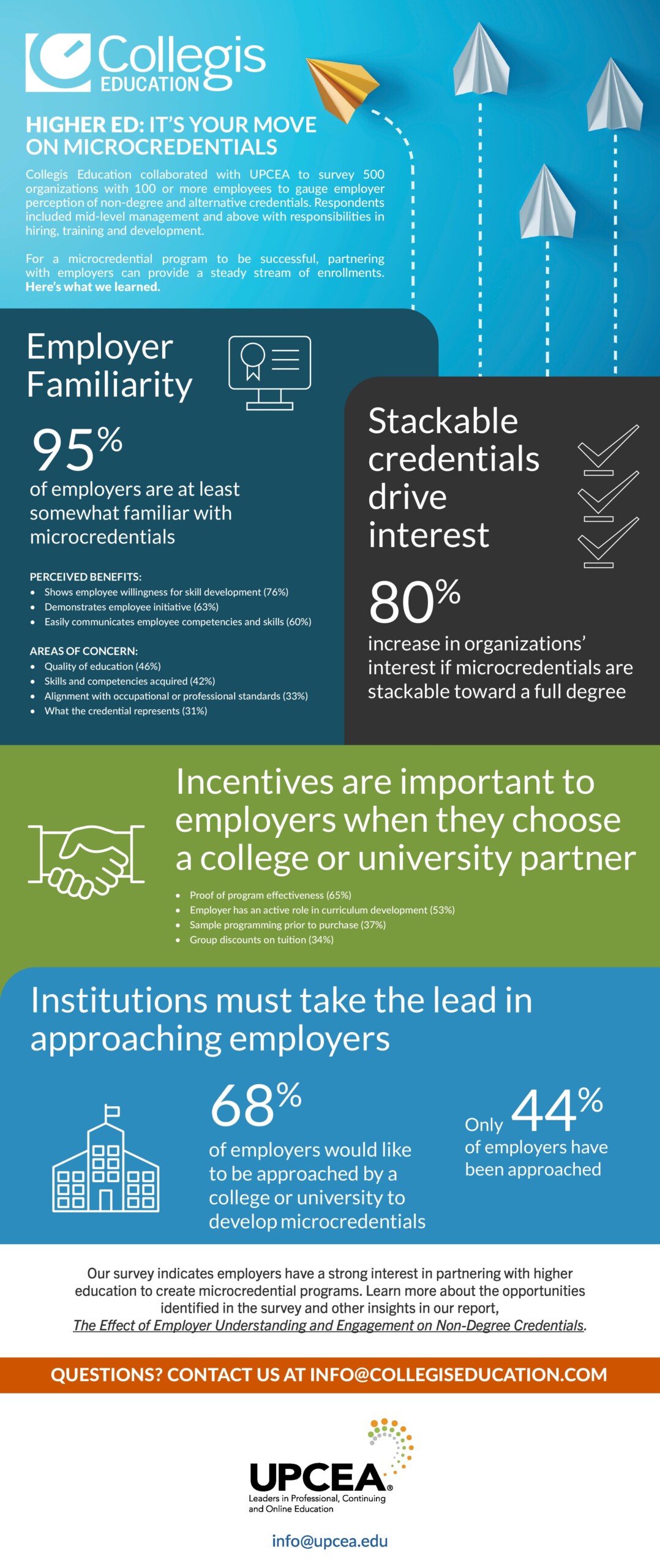
To capitalize on the growing demand for microcredentials, institutions must proactively engage employers with well-designed, industry-aligned programs. By addressing employer concerns and offering flexible, high-value learning pathways, colleges and universities can establish long-term workforce partnerships and create sustainable enrollment pipelines.
The insights found in the infographic only scratch the surface of what the research uncovered. Download the full report to learn what incentivizes employers to work with four-year higher ed schools.
Unlock Employer Insights
Learn what businesses seek in higher ed partnerships. Download the report today.
As the number of high school graduates declines, more and more colleges and universities are looking to the Some College, No Credential (SCNC) population as an opportunity for growth. According to the National Student Clearinghouse, there are 36.8 million people in this group, an increase of 2.9% from the previous year.
While many SCNC individuals stop out of higher education due to cost concerns, life changes, and mental health challenges, there is a segment of this population that has been forced to discontinue their degree program for reasons outside of their control.
Increased closures and mergers in higher education
The higher education landscape has been undergoing significant upheaval in recent years, with an increasing number of colleges and universities facing financial challenges and being forced to close or merge with other institutions. This trend has been driven by a variety of factors, including the looming “enrollment cliff” — a projected decline in the number of high school graduates due to demographic shifts — as well as rising costs, changing student preferences, and the lasting impacts of the COVID-19 pandemic.
For those of us following higher education news and trends, it can feel like a new school closure is announced every week. Higher Ed Dive publishes a tracker that indicates 118 colleges have been impacted by closures or mergers since 2016 (as of June 18, 2024).
Closures often leave students in a precarious position, scrambling to find alternative paths to complete their education. Tragically, a staggering 53% of students from closed colleges ultimately give up on their education altogether, according to a study by the State Higher Education Executive Officers Association (SHEEO). The challenges of navigating the transfer process, coupled with the loss of credits and mounting financial obligations, can become overwhelming, leading many students to abandon their academic aspirations.
Those who do manage to transfer to another institution often face additional hurdles. Fewer than half of the students who transfer stay long enough to earn their degrees, further highlighting the difficulties they encounter in adapting to a new academic environment and overcoming the setbacks caused by the college closure.
Understanding students affected by college closures
The SHEEO study shows the similarities and differences at an aggregate level of students from closed colleges versus students at open colleges. Students from closed institutions are more likely to be black, female, and federal Pell Grant recipients, which are awarded to students from low-income families. They are also likely to be under age 24 and attending college full-time.
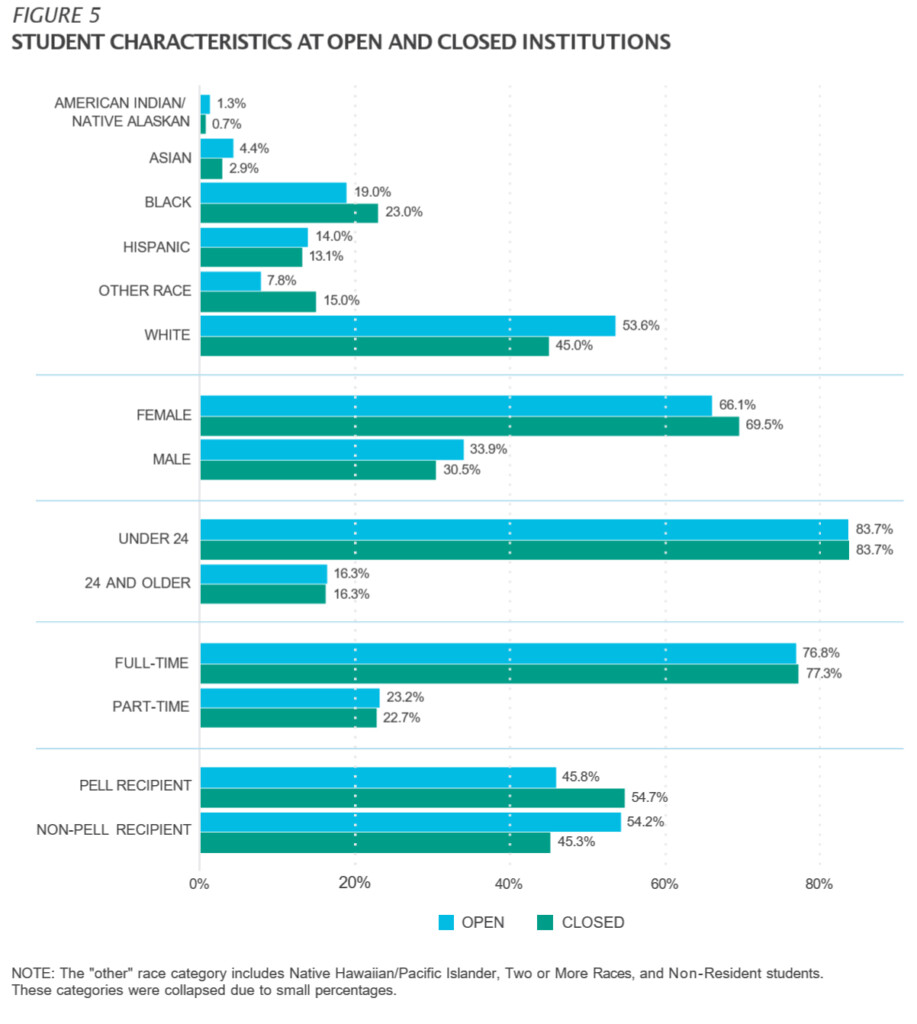
Students who experienced college closures but enrolled within 120 days of closure were mostly female, white, and older than 30 at the time of closure.
Challenges faced by students impacted by school closures
The biggest hurdle students face is understanding their options and next steps. This requires having access to experienced advisors to help them understand and navigate these options. They need guidance on how to access their academic transcripts, which colleges will accept their previously earned credits, and what the implications are for their financial aid and student loans. These are complex issues that can overwhelm students. For those blindsided by their school’s closure, attempting to navigate this landscape alone often leads to confusion and frustration, and many ultimately give up on completing their degree.
Supporting impacted students: Transfer strategies for colleges and universities
Here are some recommendations your school can adopt to support students impacted by closures in your region.
Understand the mindset of students impacted by school closures
Having your school shut down in the midst of your degree program is an incredibly disruptive experience. The path forward seems unclear and daunting. Students impacted by these closures often feel a mix of emotions: anger at the situation, sadness over the loss of their school community, fear about their future prospects, and a sense of hopelessness or of being cheated out of their educational journey.
Many start to question whether continuing to pursue a degree is worth the effort. They may feel the same stresses and anxieties they experienced as high school seniors, having to re-evaluate options, navigate application processes, and make major life decisions all over again. And they’ll be looking for signs of stability and program viability in their next school.
Partner with schools in financial trouble to support student transfers
The more notice a student has of their school closing, the better they do. Unfortunately, some schools have given as little as two weeks’ notice. Students impacted by schools that were transparent about the challenges they were facing, and the possibility of closure, have been able to navigate their experience with more resilience. Proactively offering to partner with schools in financial distress to develop transition plans for their students will not only provide a lifeline for students but also demonstrate your commitment to higher education and the well-being of the community at large.
Transition plans should outline clear pathways for seamless credit transfers, financial aid assistance, and academic advising. By working together, you can ensure that students’ academic progress is not disrupted and their hard-earned credits are recognized.
Engage students impacted by closures and offer transfer options
Help students navigate this challenging time by activating a marketing strategy that provides resources to students who’ve been impacted by a school closure. Key questions students will be asking themselves:
- Does my school have a teach-out plan to help me complete my degree?
- Which schools will accept the credits I have already earned?
- How do I get official copies of my transcript?
- What is the status of my financial aid?
- Can I/should I discharge my student loans?
We recommend including the following tactics in your marketing strategy to reach these students:
- Create a landing page specifically for the identified school with messaging that speaks to their students. Messaging should encourage them to continue with their studies while offering support and detailing the options available at your school. Be as specific as possible around teach-out/transfer details. All marketing activities should direct students to this page.
- Create organic social media posts offering support to students from the identified school. Feature testimonials of transfer students from the closed school if available.
- Prepare statements for leadership and faculty to share on their own social media channels.
- Distribute the messaging and approach for managing inquiries with the admissions team.
- If applicable, plan targeted media campaigns for the geographical area in paid search and paid social channels.
Streamline credit transfer policies and maximize credit acceptance
Ensure your transfer policies are straightforward and lean toward accepting as many credits as possible. Take the time to evaluate course-substitution options from the closing institution to maximize the number of credits that can transfer.
Your admissions team should also be prepared to suggest alternative degrees if they are more aligned with the student’s existing credits. When possible, work with the closing school to receive students’ transcripts to take that burden off the student. Promise students prompt transfer evaluations, ensuring that internal operations are organized to complete evaluations in 24 hours or less.
Waive application fees to remove barriers
You may charge nominal fees during the application process to demonstrate an applicant is serious about wanting to attend the institution. But paying those fees often requires accessing unfamiliar systems and can be one more cumbersome hurdle these transfer students don’t need while their lives are in upheaval.
Ensure support services facilitate adjustment to your school
Students who are motivated to transfer right away are focused on their goal of finishing their degree. They need an institution that is willing and able to move quickly. Identify a core group of employees who can be dedicated to ensuring these students are accommodated. Streamline your admissions process to remove unnecessary requirements for students in this circumstance.
Provide additional support for their transition to your program, understanding that the majority are younger full-time students. Help residential students find appropriate housing or adapt from on-campus learning to an online program.
Once impacted students express interest, create an automated communication journey to help them move through the process of application, transfer evaluation, scholarship and financial aid packages, and enrollment.
Build an agile, student-centered transfer process
According to Jospeh Sallustio, senior vice president for Lindenwood Global at Lindenwood University, schools that can be agile will have increased administrative and academic expenses; but in the long run, they will enjoy a stronger brand through earned respect of their students and alumni.
As you plan to support transfer students from closing schools in your region, Collegis can help you navigate this complex landscape. Through close collaboration with our partners, we meticulously craft processes and messaging that instill confidence in students as they chart their path forward. By testing the effectiveness of our messaging and adapting to their preferred engagement styles, we guide students seamlessly through the enrollment process and illuminate the profound impact that your programs can have on their careers and lives.
To ensure an effective, student-centered approach, we can also map your enrollment process, identify opportunities, and execute strategies that prioritize these students’ unique needs. As an extension of your team and institution, we’ll build a collaborative approach to help students from closing colleges and universities beat the odds and continue their education. Contact us to learn more.
Innovation Starts Here
Higher ed is evolving — don’t get left behind. Explore how Collegis can help your institution thrive.
One of the best ways to navigate the changing higher ed landscape is to attend higher ed conferences. The 2024-2025 conference season is shaping into a promising lineup that will offer invaluable insights and connections for educators, administrators, and thought leaders. Whether you’re looking for professional development, networking opportunities, or just to stay informed, here are the higher ed conferences you won’t want to miss.
We’ll be at each of them this year. Looking forward to seeing you there!
Mackinac Roundtable on Talent
June 23-25, 2024
Mackinac Island, MI
This is an exclusive, invite-only event for top private university and college presidents along with key corporate leaders. The purpose is to facilitate cross-sector dialog and collaboration in preparing students for successful career outcomes.
Our President & CEO Kim Fahey will be discussing “Leveraging Your Technology: From Data Silos to Personalized Pathways” during the breakfast session.
Best for: presidents of private universities and colleges
UPCEA Convergence
September 30 – October 2, 2024
New Orleans, LA
UPCEA Convergence is a place for key campus stakeholders in credential innovation to define and develop their institution’s alternative credentials strategy.
Catch our Chief Academic Officer Tracy Chapman, PhD, as she presents our original research, “Unveiling the Employer’s View: An Employer-Centric Approach to Higher Education Partnerships.”
Best for: senior leaders responsible for their institution’s strategy on alternative credentials as well as registrars and similar professionals
P3•EDU
October 7-9, 2024
Denver, CO
This invitation-only event brings together university leaders and government, association, foundation, and corporate thought leaders to discuss best practices for public-private partnerships.
Our President & CEO Kim Fahey will be speaking with our partner College of Western Idaho about how they’ve leveraged technology and data to stabilize their institution and position themselves for transformative growth.
Best for: college and university cabinet members
University Leadership Summit
October 21-22, 2024
Boston, MA
This invitation-only event brings university executives and innovative suppliers and solution providers together. The Summit’s content is aligned with key educational challenges and interests, relevant market developments, and practical and progressive ideas and strategies adopted by successful pioneers.
Best for: college and university presidents, chancellors, and provosts
2024 CIC Institute for Chief Academic Officers
November 1-4, 2024
Portland, OR
This year’s event focuses on building alliances, creating innovative academic pathways, and unlocking the potential of education for more students. It will evaluate the power of academic leadership and present ways to make teams more inclusive, adaptable, and forward-looking.
Our Chief Academic Officer Tracy Chapman, PhD, will be leading a roundtable session on “Nurturing Enrollment: Enhancing Tech Experiences for Student Retention” featuring our new joint research with Inside Higher Ed.
Best for: chief academic officers and their teams (such as associates, deans, and directors); only independent college and university administrators may participate
UPCEA MEMS
December 3-5, 2024
Philadelphia, PA
Marketing, enrollment growth, and student success are the focus of UPCEA MEMS, specifically in adult, professional, continuing, and online education. It will showcase innovative and proven approaches to grow enrollments and support student success.
Best for: marketing, recruitment, and student success professionals
CIC Presidents Institute
January 4-7, 2025
San Antonio, TX
Presidents from independent colleges and universities — along with industry experts — will come together to strengthen their networks and explore how to connect with communities on and off campus while transforming financial, political, and social disruptions into opportunities.
Best for: presidents of independent colleges and universities
ACCU’s Annual Meeting
January 31 – February 3, 2025
Washington, D.C.
ACCU’s Annual Meeting allows members to come together and discuss important issues affecting Catholic colleges and universities. It’s an opportunity to share ideas and network with those also working in faith-based higher ed.
Best for: presidents and senior leaders of Catholic colleges and universities
P3 New Start Summit
TBD 2025 (Previously February 2024)
This invitation-only summit is an opportunity for key university leaders to meet and exchange best practices around strategic enrollment and workforce connections. It’s an excellent opportunity to network with peers.
Best for: university leaders
UPCEA Annual Meeting
March 24-26, 2025
Denver, CO
The impact of online and professional continuing education units will be in the spotlight at this conference, where you can expect to hear groundbreaking ideas and have opportunities to take part in interactive workshops and networking events.
Best for: deans and other senior university leaders, as well as teams focused on managing or growing professional, continuing, and online education programs
ASU + GSV Summit & AIR Show
AIR Show: April 5-7, 2025
ASU + GSV Summit: April 7-9, 2025
San Diego, CA
Arizona State University and GSV host this annual event focused on transforming society and business around learning and work across the “Pre-K to Gray” — i.e., lifelong learning — global education sectors.
In conjunction with ASU + GSV Summit, the AIR Show (AI Revolution in EDU) is a free event with thought-provoking discussions and interactive workshops to empower educators, innovators, and learners to harness the limitless potential of AI in education.
Best for: educators, strategists, and foundation leaders
Google Cloud Next
TBD 2025 (Previously April 2024)
Google Cloud Next is an annual conference where Google Cloud showcases its latest products and technology. Events include presentations, technical and hands-on sessions, and networking opportunities.
Best for: IT professionals and developers
See you during the 2024-2025 conference season!
The lineup for 2024-2025 higher ed conferences is filled with opportunities for professionals across your college or university to learn and network. Embrace these opportunities to be part of the conversations that will shape the future of higher education.
Contact us to connect in person at one of these inspiring events.
Innovation Starts Here
Higher ed is evolving — don’t get left behind. Explore how Collegis can help your institution thrive.
In our recent blog series, we’ve discussed how to review your school’s academic portfolio and evaluate individual programs. Colleges and universities must continually consider their mix of programs and carefully select new programs to remain relevant to the needs of students, employers, and society.
Institutions increase the likelihood that new programs will thrive by considering complex data sets, including market demand, competition, and financial projections. This data-driven decision making provides the basis for realistic expectations on investments and returns.
Let’s look at recommended data sources.
Identifying workforce needs through market analysis
An analysis of the demand for specific degrees, skills, or disciplines can identify emerging trends, regional workforce needs, and areas of anticipated job growth in the region, which provides a solid foundation for identifying potential program offerings.
By examining a combination of labor market trends, employment projections, and occupational outlooks, colleges and universities can gain valuable insights into areas of growth and demand for skilled professionals.
Data sources may include the following:
- Government agencies, such as the Bureau of Labor Statistics (BLS)
- Job posting and recruitment platforms, which aggregate data on job postings and offer real-time information about the skills and qualifications employers are seeking
- Labor market analytics tools that use big data and machine-learning algorithms to analyze job market trends, skills demand, and salary data
Identifying workforce needs through market analysis
Understanding student needs and preferences is essential for designing programs that resonate with the target audience. Assess student needs by:
- Analyzing enrollment data and trends within existing programs
- Gathering data from your enrollment management team about what prospective students are looking for
- Reviewing Google search trends for insights into student demand outside of the institution
- Analyzing enrollment and completion data from regional competitors
Differentiating your offerings through competitive program analysis
Understanding the competitive landscape is equally important. Identifying programs offered by your competitors — their structure, cost, and delivery — and then comparing that data to your market analysis will provide insights into what competitors are offering and highlight areas of opportunity for differentiating your programs.
By aligning new offerings with student aspirations and career goals, universities can attract and retain a diverse and engaged student body. This can further inform decisions about where to invest resources for new program development.
Securing program sustainability: Financial viability and resource allocation
Financial considerations should play a substantial role in the analysis of new program opportunities. A thorough financial analysis should assess the potential costs, revenue streams, and return on investment associated with launching and sustaining new programs.
Identify resource requirements, including faculty, staff, facilities, technology, marketing, recruitment, retention, and administrative support, to ensure the institution can adequately support the proposed programs.
The uncertainty in the shifting higher education market should be built into financial forecasting. Additionally, flexibility to adjust based on actual performance is necessary. Institutions are well advised to develop a multi-year pro forma that establishes realistic revenues, costs, and ROI timelines based on market conditions.
Leveraging institutional strengths and brand for program development
New academic programs should align closely with the mission, values, and strategic priorities of the institution. Institutions should leverage their existing academic strengths, faculty expertise, resources, and brand when considering new programs.
By building on established areas of excellence and reputation, colleges and universities can create innovative and competitive programs that set them apart in the higher education landscape. New offerings must complement and enhance the academic portfolio of the institution and build on the institutional reputation.
Industry partnerships and engagement
Leveraging relationships with employers and industry associations in the region will provide important insights into workforce needs. Additionally, advisory boards composed of employers who can provide firsthand perspective on workforce realities are a valuable source of insight for developing in-demand programs.
Major employers and associations can provide information about program naming, program outcomes, curricula, marketing channels, and degree levels (associate, bachelors, masters, certificate). These relationships also help you reach your intendent audience and build pathways for internships, hiring opportunities, and program instructor resources.
Continuous program evaluation and adaptation
To maintain a healthy portfolio of programs, the selection of new academic programs must be accompanied by timely and continuous program evaluation and adaptation. Regular monitoring of performance based on agreed-upon metrics will provide decision makers with the information necessary to make data-driven decisions.
Those metrics should include enrollment trends, student outcomes, alumni success, employer feedback, financial performance, and other relevant measures of program success. Flexibility and agility are essential for responding to evolving market demands, technological advancements, and changes in student needs.
Crafting the future
Innovative and sustainable programs that support the institutional mission are essential to a healthy, balanced portfolio. Selecting new academic programs requires a combination of strategy, discipline, and process informed by multiple relevant and current data sources. With careful planning and execution, universities can navigate the path to success and ensure their academic programs remain relevant, impactful, and sustainable in the years to come.
Adopting this culture of continual review and reflection can be challenging. Collegis can provide an objective assessment of your new program opportunities and give you the tools you need to future-proof your academic portfolio.
Contact us to get started.
Innovation Starts Here
Higher ed is evolving — don’t get left behind. Explore how Collegis can help your institution thrive.
The first blog in this program strategy series addressed the difference between assessing a portfolio of programs and conducting an individual program analysis. In that article, we recommended a high-level assessment of a suite of academic programs to understand your portfolio’s strength and highlight opportunities for better management. The next step in the process is to conduct a more targeted academic review.
In today’s rapidly evolving higher ed landscape, colleges and universities face mounting pressures to stay relevant and responsive to the needs of students and employers alike. With the job market becoming increasingly competitive and industries undergoing constant transformations, academic institutions need to adopt a market-driven approach to reviewing academic programs. Considering a variety of market factors helps ensure that academic offerings align closely with industry demands and student aspirations, fostering greater success for both graduates and the institutions themselves.
Introduction to academic program review
At most institutions, the program review process traditionally occurs once every five to seven years and typically includes:
- An in-depth self-study led by program faculty involving program administrators and students,
- A review of the self-study report by a team outside of the department housing the program, and
- Determination of next steps based on program review findings.
This approach focuses primarily with an internal lens, considering factors such as enrollment trends, curriculum coherence, faculty expertise, and student and graduate outcomes.
While these aspects remain essential, supplementing the traditional five-year review cycle with a more frequent, market-driven approach to program evaluation and resource allocation can help institutions adapt swiftly to changing workforce needs and technological advancements.
The role of market data in academic decision-making
The market-driven approach provides three key benefits.
Enhances the employability of graduates
By analyzing industry trends, job market demands, and employer feedback, institutions can tailor the curricula of their academic programs to equip students with the skills and knowledge most valued by employers.
This proactive approach not only increases students’ chances of securing meaningful employment but also enhances the reputation of the institution as a provider of career-ready graduates.
Fosters innovation and agility within academic institutions
By closely monitoring market trends and emerging fields, schools can introduce new programs or modify existing ones to address emerging needs. This flexibility enables institutions to stay ahead of the curve, offering cutting-edge education that prepares students for the jobs of tomorrow.
Enhances partnerships and collaboration with industry stakeholders
By actively engaging with employers, professional associations, and community organizations, universities can gain valuable insights into industry expectations and cultivate opportunities for internships, co-op programs, and applied research projects.
These partnerships not only enrich the learning experience for students but also provide avenues for faculty professional development and research funding.
How to prioritize program analysis
Start with programs classified as Robust Performers, those that are large and growing (see the first blog in the series for details). These programs are more likely to have a shorter timeline for realizing a return on investment.
With the exception of mega-universities (such as Southern New Hampshire, WGU, Grand Canyon, and ASU), college and university enrollment is regionally focused. Students gravitate toward familiar brands, and research continues to show they prefer institutions within 50 miles of their home. Therefore, we recommend, when possible, focusing on regional, external data in program analysis.
Adult learner audiences
Many institutions today are focused on aligning programs to successfully reach the adult learner population.
The snapshot below provides an overview of the fundamental aspects of program design necessary to attract these learners. A comprehensive academic program review should include an evaluation of the program’s alignment with each of these factors.
Affordability
- Cost: competitive to regional providers
- Generous transfer credits
More relevance
- Career relevant
- Employer-recognized credentials
- Stackable pathways
Fewer barriers
- 3-6 start terms
- No entry exams
- “Level-up” course options
- Minimal transcript requirements
- No deposit fees
Flexibility
- Online
- Low/zero residency
- Asynchronous delivery
- “Stop out” re-entry support
- Terms of 6–8 weeks
Metrics for evaluative program demand
In a market-driven approach to program review, it’s crucial to gather and analyze relevant data points that reflect the demands and trends of the job market and industry sectors. Here are some key data points to consider:
- Labor market analysis:
- Employment trends in relevant industries or sectors
- Projected growth or decline in specific occupations
- Regional demand for certain skills or professions
- Industry surveys and feedback:
- Surveys or interviews with employers to identify desired skills and competencies
- Feedback from alumni regarding the relevance of their education to their careers
- Input from professional associations or industry partners on emerging trends and technologies
- Competitors: Enrollment and conferral trends of regional competitors offering similar programs
- Student demand: Key search volume and estimation of inquiry volume (Google search data is often used as a proxy for student demand as well as data from enrollment on what prospective students are looking for)
- Job placement and career outcomes:
- Employment rates and job placement statistics for program graduates
- Average starting salaries and career progression data
- Employer satisfaction with the skills and preparedness of graduates
- Skills and competency mapping:
- Identification of key skills and competencies required for success in relevant fields
- Alignment of program learning outcomes with industry needs and professional standards
- Assessment of student proficiency in critical areas through surveys, assessments, or employer feedback
- Graduate feedback and alumni success:
- Surveys or interviews with program graduates to assess the relevance of their education to their careers
- Tracking of alumni achievements, leadership positions, and contributions to their fields
- Alumni networking events or mentorship programs to foster ongoing engagement and feedback
Tap a partner for job market insights
Collecting this important market data every two to three years may require assistance from an external agency well-versed in collecting and analyzing the data.
When selecting a partner, it’s important to consider their expertise and experience working with higher education programs, knowledge of the institution, and access to analytical tools (such as Collegis Education’s exclusive collaboration with Google Cloud).
Insights into the evolving needs of the market allow academic institutions to make informed decisions that enhance the relevance, quality, and impact of their programs. This market-driven approach ensures that graduates are well-equipped to meet the demands of the workforce and contribute meaningfully to their chosen professions and industries. And that reflects well on the institution.
Innovation Starts Here
Higher ed is evolving — don’t get left behind. Explore how Collegis can help your institution thrive.
Shifting demographics, increasing competition, and budgetary pressures highlight the importance of establishing a proactive, data-driven approach to examining an institution’s overall academic portfolio as well as individual programs within the portfolio.
Offering the right suite of programs positions colleges and universities to grow enrollment, to make effective use of limited resources, and to strengthen their brand.
This article, the first in the series on optimizing your program offerings, recommends starting with a review of your academic portfolio to understand the strength of your overall suite of programs.
What is a portfolio review?
Portfolio review refers to an evaluation of a suite of programs offered by an institution. The scope of a portfolio review may include all of the institution’s programs or a subset of programs, such as master’s programs or online programs.
A portfolio review uses a set of agreed-upon metrics to provide a snapshot of the program mix and performance to inform institutional strategic planning, resource allocation, and alignment with institutional mission. Optimizing program offerings starts with a portfolio review, which can help identify specific programs for deeper examination.
A benchmark for review frequency
Many institutions have a long-standing program review cycle for examining individual programs, often once every five to seven years. The process is typically faculty-led and involves individual academic departments conducting an in-depth self-study of the program under review.
This traditional program review process cannot provide institutional leaders the real-time insights they need to make strategic decisions in today’s rapidly evolving market.
Reviewing programs every two to three years is a good benchmark. Establishing a program review process that takes into account external market conditions, internal program data, institutional goals, and a timely review process is critical for sustaining a viable portfolio of academic programs.
How to conduct a holistic portfolio review
Conducting a high-level review of an academic portfolio before delving into the specifics of an individual program is crucial for gaining a comprehensive understanding of an institution’s overarching goals, strengths, and areas for improvement.
By examining the broader spectrum of academic offerings, administrative structures, and institutional priorities, stakeholders can identify patterns, trends, and disparities that may influence decision-making at the program level. This holistic approach enables administrators to contextualize the performance of individual programs within the broader institutional framework, fostering a more informed and strategic approach to academic planning and resource allocation.
Furthermore, starting with a review of the academic portfolio promotes transparency, accountability, and equity within the institution. It allows for an inclusive assessment process that considers the diverse needs, perspectives, and contributions of various academic departments, disciplines, and stakeholders.
Categorizing your programs
The first step is to categorize programs based on a national view of program size and growth trends. This analysis provides a snapshot of the program mix to identify individual programs for further analysis.
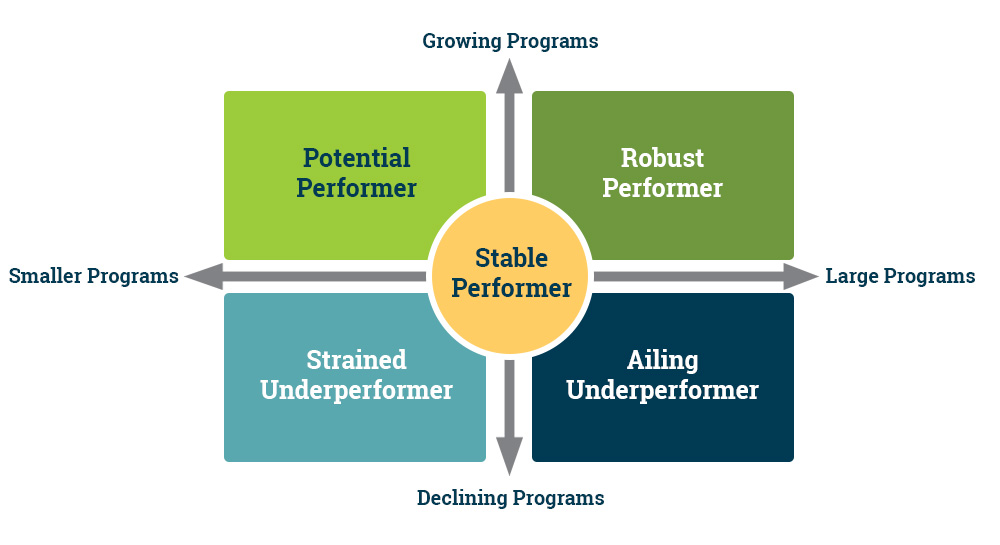
Figure 1: Portfolio Growth Segments
Here’s how we define growth segments:
- Robust Performer: Large and growing programs, considered good prospects for driving growth
- Potential Performer: Small but growing programs that have the potential to become robust if they can scale
- Stable Performer: Often large, commoditized legacy programs with stagnant growth
- Strained Underperformer: Small programs with declining enrollment where growth is limited
- Ailing Performer: Large programs with declining enrollment, determine whether a program refresh may turn the dial
Institutions should strive to achieve a balanced portfolio that prioritizes segments with growth and volume (Robust and Stable). Forward-looking schools dedicate some budget and resources to testing emerging programs (Potential). Strained and Ailing programs should be limited to those deeply aligned to the institution’s mission or a strong regional need.
The table below is an example of an institution’s portfolio review showing how its programs align with these growth segments and institutional data: conferrals, the 1-year growth trend, and 5-year growth trend. It illustrates the right mix of growth segments in a nicely balanced portfolio.
Next steps for portfolio management
Once you’ve completed this assessment, you have powerful data to inform strategic planning. The resulting categories highlight opportunities for better managing your portfolio and suggesting areas for potential shifts in budget, scaling up, or additional data analysis. For example, begin by further investigating programs classified as Robust Performers. Optimizing these programs typically provides a relatively quick return on investment.
- Robust Performers: Maintain strength in this segment and increase market share with ongoing investment.
- Potential Performers: Identify specific programs with realistic growth potential based on regional market factors.
- Stable Performers: Analyze programs to determine alignment with institutional priorities and streamline those misaligned. Innovative approaches are required to maintain market share.
- Strained Underperformers: Seek to “right size” number of programs with conferrals and divest in those without growth potential.
- Ailing Underperformers: Assess future viability of programs in decline and shift resources to Robust Performers.
Recommendations for the most meaningful results
The point of a portfolio review is to look at the holistic picture of your program offerings. Often the best way to achieve this data-driven assessment is to partner with an objective third party or identify a neutral internal party who is able to review data from multiple angles beyond academics.
The next article in this series will offer recommendations for using internal and external data for individual program evaluation. In the meantime, contact us to discuss how we can help you conduct a comprehensive portfolio review.
Innovation Starts Here
Higher ed is evolving — don’t get left behind. Explore how Collegis can help your institution thrive.
Employers want to partner with external providers to upskill and reskill their employees — presenting an opportunity for higher ed institutions to grow revenue by creating programs for employers. Our recent research with UPCEA found that from 2022 to 2023, companies partnering with external organizations to provide employee training/professional development increased 26%.
Challenges for higher education institutions
Higher ed is quickly losing these opportunities to private providers like Coursera and LinkedIn Learning. While partnerships with professional organizations and private providers rose year over year, partnerships with higher ed institutions fell. Schools need to aggressively align programs and processes with market demand and employer partnerships, or the market will go elsewhere.
The best way to take advantage of these opportunities is to play to your school’s strengths, prioritize program growth, and avoid overextending your resources. Consider using existing courses in high-demand areas to create online certificates and pathways to stack certificates into degree programs.
Top graduate certificate programs for 2024
Here’s a list of graduate certificate programs with the best growth potential (according to national conferral volume and growth). Are there any programs your school could develop to take advantage of this growing need?
Business
- Business Administration and Management
- Organizational Leadership
- Entrepreneurship
Education
- Teacher Education and Professional Development, Specific Levels and Methods, Other
- Special Education and Teaching, General
- Teaching English as a Second or Foreign Language/ESL Language Instructor
Healthcare/Nursing
- Psychiatric/Mental Health Nurse
- Family Practice Nurse
- Registered Nursing
Multidisciplinary
- Sustainability Studies
- Data Analytics, General
- Business Analytics
Science
- Epidemiology
- Natural Resources Management and Policy
- Biology/Biological Sciences, General
Social and Psychological Sciences
- Applied Behavior Analysis
- Geographic Information Science and Cartography
- Criminal Justice/Safety Studies
Technology
- Computer Systems Networking and Telecommunications
- Computer Programming/Programmer, General
- Computer and Information Sciences, General
Partnering with employers for program growth
After determining the most in-demand certificates for your school, partnering with employers to design the curriculum and develop enrollment pathways can help scale enrollments. Collegis can help you analyze your regional competition and the skills demanded most by local employers to develop the right programs for your market, support employer partnerships, and develop custom strategies for growth and differentiation.
Understanding Employer Perceptions: The Collegis-UPCEA 2024 report
Our new report “Unveiling the Employer’s View: An Employer-Centric Approach to Higher Education Partnerships” reveals what employers want and how to approach them. We’ll be here to help you get started.
Innovation Starts Here
Higher ed is evolving — don’t get left behind. Explore how Collegis can help your institution thrive.
How Spelman Expanded Reach to Working Adults
Like many colleges and universities today, Spelman was faced with the challenge of generating more revenue, particularly to help decrease the amount of debt its students graduate with. To begin combatting this challenge, the college ventured into online learning with summer courses that students could use to get ahead or catch up.
Keen interest in these courses prompted the college to leverage this model for a wider adult learner audience than their core population of women of color, and they scaled quickly:
In January 2022, eSpelman launched three courses and 49 learners. In 2023, enrollments rose to 1,300 learners. Today, eSpelman works with 19 corporate partners.
Collegis plays an integral role in faculty training and program planning for continued growth. Download “Expanding Vision to Reach Adult Learner Market” to learn how their marketing strategy, a partnership with Guild and alumni support contribute to eSpelman’s success.
Download Now



Transform Challenges Into Opportunities
Facing challenges in enrollment, retention, or tech integration? Seeking growth in new markets? Our strategic insights pave a clear path for overcoming obstacles and driving success in higher education.
Unlock the transformative potential within your institution – partner with us to turn today’s roadblocks into tomorrow’s achievements. Let’s chat.