IT Readiness Assessment
The higher education landscape is rapidly changing. Colleges and universities need to make the most of their data and technology to achieve strategic initiatives like enrollment growth, anywhere/anytime learning, student retention, academic value, operational efficiency and seamless digital experiences.
Our IT Readiness Assessment can help you prioritize where to focus your institution’s future efforts and investments. You don’t need to be a tech expert to take this assessment – it is meant for leaders responsible for their institution’s organizational strategy and growth.
Assess Your Institution’s Technological Capabilities
You will be guided through six vital areas of technological capabilities to help you assess where your institution stands today and which capabilities need attention. They are:
- Institutional Alignment
- IT Organization and Skill
- Stability
- Scalability and Innovation
- Student Experience
- Security
Additional Quizzes
No posts found.
Transform Challenges Into Opportunities
Facing challenges in enrollment, retention, or tech integration? Seeking growth in new markets? Our strategic insights pave a clear path for overcoming obstacles and driving success in higher education.
Unlock the transformative potential within your institution – partner with us to turn today’s roadblocks into tomorrow’s achievements. Let’s chat.
Do You Know How Technology Affects Your Higher Ed Institution?
Technology touches every aspect of every higher ed institution. As a leader who may not work in IT, it’s important to understand how technology affects your everyday functions so you can ensure it is aligned to your strategic goals – and investments are made in the right areas.
Get helpful content to take the next step in understanding just how essential it is for the future of your college or university – and the challenges IT is facing.
Collegis Education can partner with you to create a technology management strategy that aligns with your strategic goals. To learn more, reach out to us.
Take the quiz
Take our quick, 7-question quiz to see how much you know about higher ed technology.
Additional Quizzes
No posts found.
Transform Challenges Into Opportunities
Facing challenges in enrollment, retention, or tech integration? Seeking growth in new markets? Our strategic insights pave a clear path for overcoming obstacles and driving success in higher education.
Unlock the transformative potential within your institution – partner with us to turn today’s roadblocks into tomorrow’s achievements. Let’s chat.
Optimizing IT Spend Without Sacrificing Performance
How Saint Francis University partnered with Collegis to reduce its IT budget and reinvest savings into strategic technology modernization.
As Saint Francis University (SFU) expanded online and hybrid learning, leadership recognized a critical need: its technology infrastructure had to evolve just as quickly. The university lacked a cohesive IT strategy, governed systems, and scalable infrastructure to support growth. Through a strategic IT Managed Services partnership with Collegis, SFU implemented a long-term technology roadmap that stabilized operations, standardized systems, and positioned the institution for sustainable transformation.
An Aging, Fragmented IT Environment Limited Scalability and Growth
To support expanded digital learning and institutional modernization, SFU needed a stronger technology foundation.
Key challenges included:
- No cohesive long-term IT strategy aligned to institutional growth goals
- Limited governance and inconsistent system standards
- Infrastructure gaps impacting security, connectivity, and reliability
- Technology constraints hindering online and hybrid program expansion
Without stabilization and structure, IT operations remained reactive — limiting the university’s ability to scale confidently.
A Strategic Roadmap for IT Stability and Growth
Collegis partnered with SFU to assess the environment, reduce risk, and design a phased roadmap for long-term success.
Key actions included:
- Conducted a full IT assessment and built a multi-year strategic roadmap
- Established formal IT governance to standardize systems and decision-making
- Modernized core infrastructure, including Active Directory, Wi-Fi, security, and help desk support
- Delivered virtual CIO leadership to align IT strategy with institutional goals
This coordinated approach transformed IT from a support function into a strategic enabler of institutional progress.
The Collegis Impact
Measurable Savings, Stronger Infrastructure, and Exceptional User Satisfaction
SFU’s roadmap execution delivered clear, quantifiable outcomes:
- 14% reduction in the university’s IT budget, enabling reinvestment in strategic upgrades
- 96.3 average Net Promoter Score for help desk satisfaction (six-month average)
- Major infrastructure upgrades completed, improving security, connectivity, and system reliability
- Seamless transition to remote and hybrid operations supported by a stabilized, scalable IT environment
The partnership didn’t just modernize systems. It strengthened institutional confidence in technology as a strategic enabler.
The Takeaway
Stabilize First. Standardize Second. Transform with Intention.
Digital transformation requires more than isolated upgrades. It demands governance, leadership, and a clear roadmap aligned to institutional goals. Saint Francis University’s partnership with Collegis demonstrates how structured planning and strategic IT management reduce risk, improve efficiency, and create a foundation for long-term growth.
Build a Technology Foundation Designed for What’s Next
If your institution is navigating aging infrastructure, inconsistent systems, or stalled modernization efforts, it’s time for a strategic roadmap. Collegis partners with colleges and universities to stabilize operations, standardize environments, and transform IT into a catalyst for institutional growth. Learn more about our Managed IT Services.
Let’s Start Writing Your Success Story
See what’s possible when strategy, creativity, and execution come together. Partner with Collegis to turn your challenges into outcomes worth sharing.
Transform Challenges Into Opportunities
Facing challenges in enrollment, retention, or tech integration? Seeking growth in new markets? Our strategic insights pave a clear path for overcoming obstacles and driving success in higher education.
Unlock the transformative potential within your institution – partner with us to turn today’s roadblocks into tomorrow’s achievements. Let’s chat.
Finding efficiencies and reinvesting in upgrades
Looking to broaden their reach and serve students outside of their region, Saint Francis University decided to expand their online program offerings. To reach this goal, they needed to scale their operations to deliver a quality, technology-enabled student experience.
Situation: Tech infrastructure assessment
Saint Francis recognized the need to modernize their technology infrastructure and strengthen their capabilities in order to achieve their goals and improve long-term stability. The institution was searching for a partner that could support their entire IT department’s daily operations, while also building a strategic roadmap to enable and transform their digital infrastructure. Collaborating with Collegis Education, Saint Francis found a partner that could implement a comprehensive IT managed services solution and make progress toward their longer-term goals. Through the partnership, the university gained access to a wealth of technology expertise and new capabilities.
The Collegis managed services solution for Saint Francis included stabilizing their technology and infrastructure, standardizing expectations through strong IT governance, and optimizing business processes and infrastructure for increased efficiencies.
Collegis conducted an assessment of key digital infrastructure to find efficiencies and cost savings. The result was a strategic roadmap that included recommendations for technology transition projects, augmentation of staff, and an expansion of student and staff help desk services.
In addition, Saint Francis leadership worked with Collegis to install a virtual CIO to oversee strategy and operations for the department and to transition Saint Francis staff to the Collegis technology team.
Results: Reduced technology debt and improved help desk satisfaction
Collegis created a transition plan to retire technology debt by upgrading major platforms. Significant transition projects to stabilize the university’s infrastructure were completed, including:
- A new card access system
- A more secure, robust Active Directory to replace outdated authentication
- Upgraded campus-wide Wi-Fi network
Collegis helped the entire university adapt to remote work and transition to hybrid classrooms and virtual technology. Additionally, the Saint Francis IT help desk transitioned to the Collegis Personal Support Center (PSC) technology support program. Since the transition, the 6-month average Net Promoter Score is 96.3, as rated by faculty, students and staff.
Just one year into the partnership, Collegis began to optimize and transform Saint Francis’s technology landscape, conducting business process assessments, streamlining student laptop programs, and implementing the Microsoft Office 365 suite to increase security and improve user experience.
Overall, the strategic planning and implementation of a long-term technology roadmap identified efficiencies and a 14-percent cost savings in the university’s IT budget, allowing the funds to be reinvested into digital transformation initiatives.
During the global COVID-19 pandemic, Collegis also provided strategic technology leadership and recommendations to deploy CARES Act funds for a smooth transition to remote and hybrid learning delivery and paved the way for capital projects that continue to help Saint Francis University transform.
About Saint Francis University
Institution Type:
Private Catholic liberal arts university
Location:
Loretto, Pennsylvania
Total Enrollment:
2,232
Services:
- Comprehensive IT Managed Services
- Enterprise Applications
- IT Leadership & Governance
- Infrastructure & Operations
- Virtual CIO
- 24/7 Tech Support & Help Desk
Key Takeaways:
- 3 year-one transition projects
- 14% IT budget cost savings
- 96.3 Net Promoter Score
Other Case Studies


Transform Challenges Into Opportunities
Facing challenges in enrollment, retention, or tech integration? Seeking growth in new markets? Our strategic insights pave a clear path for overcoming obstacles and driving success in higher education.
Unlock the transformative potential within your institution – partner with us to turn today’s roadblocks into tomorrow’s achievements. Let’s chat.
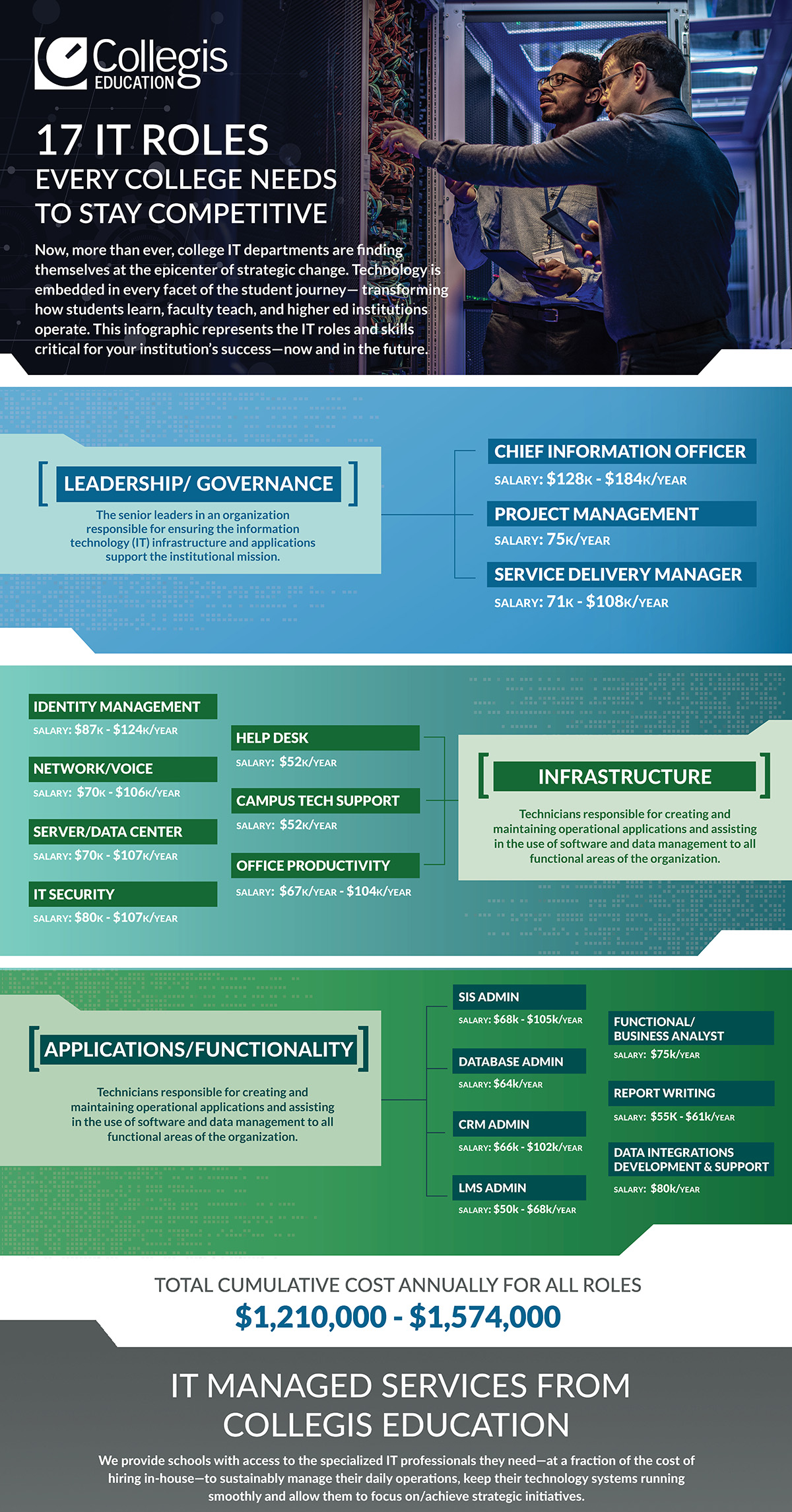
In today’s digital-driven education landscape, higher ed IT departments are at the heart of institutional success. From student engagement and online learning to cybersecurity and data management, technology now powers every aspect of the higher ed experience.
However, many institutions struggle to maintain a fully staffed IT team capable of managing daily operations while also driving innovation. To help colleges understand the essential IT roles required for success, our latest infographic outlines the critical positions institutions should prioritize.
Innovation Starts Here
Higher ed is evolving — don’t get left behind. Explore how Collegis can help your institution thrive.
As colleges and universities become increasingly digitally connected, the risk of cyber threats continues to rise. Higher education institutions store vast amounts of sensitive data, from student records and financial information to research and faculty communications. Unfortunately, this makes them a prime target for cyberattacks.
Our latest infographic highlights the top cybersecurity risks institutions face and provides key strategies to protect against them.

Innovation Starts Here
Higher ed is evolving — don’t get left behind. Explore how Collegis can help your institution thrive.
Reinvesting IT Savings into Strategic Upgrades
How Collegis helped modernize IT governance, cutting operational expenses and freeing resources for strategic technology advancement.
As Saint Francis University (SFU) advanced its commitment to delivering a modern, student-centered experience, leadership recognized a critical need: technology had to be more strategically aligned with institutional priorities. Through a partnership with Collegis, SFU implemented a formal IT governance structure and strengthened its digital infrastructure — creating clarity, accountability, and long-term scalability across the institution.
Fragmented Systems and Unclear Governance Limited Digital Progress
SFU had a strong institutional vision, but technology processes and oversight needed refinement to support enterprise-wide transformation.
Key challenges included:
- No formal IT governance structure, limiting oversight and strategic technology investment
- Disconnected systems and fragmented data, reducing visibility and cross-campus alignment
- Unclear prioritization of IT initiatives, creating inefficiencies and duplicated effort
- Reactive IT operations focused on maintenance over strategy
Without a clear governance framework, technology initiatives risked becoming siloed, duplicative, or misaligned with broader institutional goals.
A Governance-First Approach to Sustainable Digital Transformation
Collegis partnered with SFU to design and implement a structured IT governance model while strengthening the institution’s digital foundation.
Key actions included:
- Establishing a formal IT governance framework with defined roles, decision rights, and accountability
- Aligning technology planning with institutional strategy and student lifecycle priorities
- Improving systems integration to enhance cross-campus data flow
- Developing a strategic IT roadmap to guide future investments
Rather than implementing isolated upgrades, the partnership created an intentional structure to support long-term digital evolution.
The Collegis Impact
Measurable Savings, Stronger Governance, and Trusted Partnership
Through strategic IT alignment and infrastructure modernization, Saint Francis University achieved:
- $200K in IT cost savings, with funds reallocated to support high-priority campus technology upgrades
- An average Net Promoter Score of 88, reflecting strong institutional satisfaction and partnership confidence
- Formalized IT governance and decision-making structures, improving prioritization and accountability
- Improved systems integration and digital infrastructure, enabling a more connected, student-centered experience
The Takeaway: Governance Transforms IT from Operational Support to Strategic Enabler
When institutions formalize governance and align infrastructure with institutional goals, technology becomes a catalyst for growth rather than a constraint. SFU’s partnership with Collegis demonstrates how structured decision-making and modern systems create the conditions for sustainable, student-centered innovation.
Align Your Technology with Your Institutional Vision
If your institution is navigating fragmented systems, unclear IT oversight, or stalled digital initiatives, it’s time to establish a stronger foundation. Collegis partners with colleges and universities to provide full managed IT services, implement governance frameworks, modernize infrastructure, and unlock technology’s full strategic value.
Let’s Start Writing Your Success Story
See what’s possible when strategy, creativity, and execution come together. Partner with Collegis to turn your challenges into outcomes worth sharing.
Transform Challenges Into Opportunities
Facing challenges in enrollment, retention, or tech integration? Seeking growth in new markets? Our strategic insights pave a clear path for overcoming obstacles and driving success in higher education.
Unlock the transformative potential within your institution – partner with us to turn today’s roadblocks into tomorrow’s achievements. Let’s chat.
Comprehensive IT management
In 2019, Saint Francis University decided to expand their online program offerings to reach students outside their immediate market. They first needed to transform their operations to deliver a quality, technology-enabled student experience, both on and off campus. Because of the campus’s remote location, they struggled with power outages, Wi-Fi issues, as well as attracting and retaining the right staff to help the university realize their objectives. The institution was searching for a partner that could support the entire IT department’s rapidly expanding list of daily operations and build a long-term strategic roadmap.
Situation: Technology roadmap and staffing
Saint Francis recognized the need to modernize their infrastructure to achieve their goals and provide long-term stability. They began a partnership with Collegis for a comprehensive technology management solution. Collegis designed a strategic, multi-year roadmap for digital transformation that first prioritized developing the infrastructure that would immediately improve the student experience and ultimately allow the university to expand its online programs.
Collegis worked collaboratively with school leadership to install a virtual CIO to oversee strategy and operations for the IT department. The virtual CIO quickly became a key advisor to the president and board, bridging the gap between technology initiatives and how they align with enrollment and revenue goals. Saint Francis staff also transitioned to the Collegis technology team, allowing the university to mitigate their talent acquisition and retention issues.
Results: Cutting-edge student experiences
The Collegis team has identified and completed several major initiatives to stabilize the university’s infrastructure since the start of the partnership:
- Simplified the technology infrastructure, resulting in $200K reallocated to help fund upgrades
- Upgraded the card access system for campus staff and students
- Implemented Active Directory, a secure and robust authentication technology
- Installed an uninterruptible power supply (UPS) backup to keep power running during outages
- Transitioned from the school’s overworked help desk to the Collegis Personal Support Center (PSC)
- Upgraded to a reliable campus-wide Wi-Fi network
The Collegis PSC has accommodated a wide variety of technology support calls while maintaining a high satisfaction rate. Between 2020 and 2022, Collegis has maintained an average Net Promoter Score of 88 – a measure that exceeds most industries’ benchmarks for excellent customer satisfaction. In other words, the implementation of the PSC has enabled a comprehensive, smooth student experience.
A variety of Collegis’s technology changes were immediately apparent to students, including introducing Active Directory for single-sign-on (SSO) authentication into a suite of programs, enjoying reliable Wi-Fi and feeling safer thanks to an updated card access system that helps keep the campus secure. In addition, behind the-scenes upgrades, like a state-of-the-art data center, stabilized the aging technology for more reliability. Overall, Collegis has optimized and transformed Saint Francis’s framework to offer a technology-enabled student experience. With their infrastructure now on the cutting edge, Collegis experts are rolling up their sleeves to develop and grow the university’s online programs across the globe.
About Saint Francis University
Institution Type:
Private Catholic liberal arts university
Location:
Loretto, Pennsylvania
Total Enrollment:
2,232
Services:
- Comprehensive IT Managed Services
- 24/7 Tech Support & Help Desk
- Application Administration & Support
- IT Leadership & Governance
- Infrastructure & Operations
- Virtual CIO
Key Takeaways:
- $200K reallocated toward technology upgrades
- 88 Average Net Promoter Score
Other Case Studies
Transform Challenges Into Opportunities
Facing challenges in enrollment, retention, or tech integration? Seeking growth in new markets? Our strategic insights pave a clear path for overcoming obstacles and driving success in higher education.
Unlock the transformative potential within your institution – partner with us to turn today’s roadblocks into tomorrow’s achievements. Let’s chat.
In a brick-and-mortar classroom, technical difficulties can be overcome with alternatives. But in an online course, where the internet and associated hardware and software components are the medium for all activity, technical difficulties can bring everything to a halt.
A student’s inability to log in to the learning management system (LMS), for example, can prevent them from getting coursework done. An online faculty member whose computer isn’t working properly will struggle to facilitate their class. If these issues can’t be quickly resolved, the overall learning experience will suffer. This is why it’s essential for colleges and universities to have on-demand IT support services to rapidly resolve these issues.
Advice for providing online learners with effective IT support
The primary motivation behind online learning – whether synchronous or asynchronous – is to offer a way for a person to fit education into their life, according to Justin Denton, director of support services at Collegis Education.
The negative impact that technical issues can have on students’ learning experiences and persistence can be mitigated with effective technical assistance for both online learners and faculty.
Here are five key factors higher education IT directors or chief information officers (CIO) must consider when building a successful IT support team:
1. Help requests may come in waves
Online learners’ lifestyles may vary distinctly from campus-based learners. For example, many may be working 9–5 jobs and have childcare responsibilities that prevent them from starting schoolwork until late at night. Schools’ IT teams need to be prepared to field an increased volume of support requests at specific times.
“Effective tech support for online learners should have the ability to predict and proactively prepare staffing to address influxes of requests during certain times, as well as during cyclical academic events, such as term starts,” Denton says.
2. COVID-19 has dramatically increased workload
Since the shift to remote and hybrid learning, IT teams have become around-the-clock, on-call operators who are working hard to keep education flowing despite drastically increased volume.
During the pandemic, schools rapidly repurposed technologies to deliver education content and instruction to all students remotely. Understandably, this has greatly increased the strain on IT teams, which are now tasked with facilitating uninterrupted learning via managing IT infrastructure, providing access to VPNs and resolving all other incidents. To keep up with the increased demand for tech support, IT departments must be adequately staffed to keep up, act quickly and perform in a way that satisfactorily represents your school’s brand.
3. Support must be provided remotely
Tech support teams that effectively serve online learners must have the capability to assist without having access to the students’ physical hardware. This may include the usage of remote access software.
“When on-campus students have a technical issue, it’s easier for them to consult a fellow student or take their computer in to the school’s IT department for troubleshooting. But because remote learners are spread across many different locations, IT teams must find a way to remotely provide desktop support,” Denton explains.
4. Online learners work at all hours – across multiple time zones
Not only are distance learners working from different places, but they’re also working at different times. Online learners are logging in at all hours of the day, every day of the year. This means IT professionals need to make sure that the technology is working, and 24/7/365 user support is available if there ever is a problem.
5. Types of help requests will vary widely
Technology is embedded in every aspect of an online student’s learning experience. From course registration, communication with advisors and faculty, receiving grades, using LMS and student information systems (SIS) and writing papers and recording presentations, every facet of learning is powered by technology.
“A school’s IT support staff must have a great breadth and depth of knowledge of all systems and applications being used in each course to effectively solve a wide variety of requests quickly,” Denton says. “Requests may be as simple as how to install Microsoft Office or as complicated as deciphering the online faculty member’s instructions and assisting with general course navigation.”
Step up your IT support
As your institution looks to improve and potentially expand its online program offerings, robust IT support must be a top priority. Technology hiccups and questions are inevitable, but if your IT team is an accessible and reliable resource, you can improve the satisfaction and retention of students and faculty alike.
If your institution’s IT team is already stretched thin or your current outsourced IT provider is struggling to keep up with the increased demand for support, learn more about the IT help desk services offered by Collegis Education.
Highly trained support specialists provide the foundation for our multi-tiered support system capable of handling calls, emails, chats and web submissions that relate to a broad variety of topics and systems, including application support, course/learning management systems, campus bookstores and libraries and first-level hardware/software problem-resolution and determination.
Innovation Starts Here
Higher ed is evolving — don’t get left behind. Explore how Collegis can help your institution thrive.
The COVID-19 pandemic has been the driving force behind a whole slew of challenges society has faced so far in 2020. Its detrimental effects have hit every industry in some way, but higher education has been dealt some especially devastating blows.
When colleges and universities were called to abruptly close down campuses in the spring, they were forced to transition residential operations online virtually overnight. For many schools, this was a rude awakening that outdated technology ecosystems simply weren’t able to deliver the quality online experience and support that today’s students and faculty have come to expect.
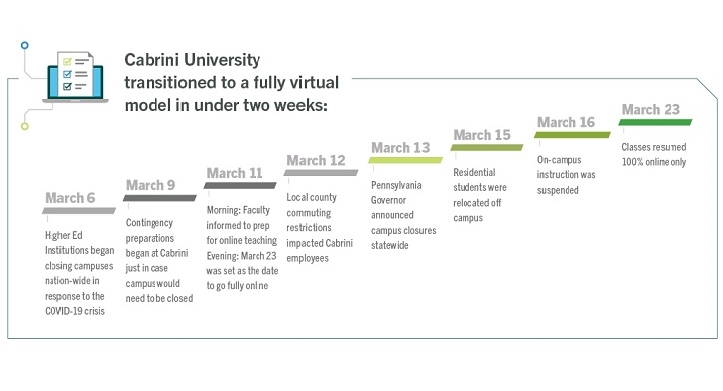
But that wasn’t the case for Cabrini University. The private institution located outside of Philadelphia, Pennsylvania had already established a strong partnership with Collegis Education to digitally transform their online presence. So when the governor of Pennsylvania ordered all higher ed institutions to go fully remote on March 13, Cabrini was up for the challenge.
Building on an established foundation in technology
Cabrini was aware of the importance of investing in technology long before disaster struck. Prior to the pandemic, the college had partnered with Collegis to help strengthen its technology infrastructure and online learning platforms, putting them a step ahead of most schools at the time.
So when the Cabrini campus was closed, the following key elements were already in place:
- Online platform: An LMS platform with training materials was in place for all online programs.
- 24/7 virtual helpdesk: Technology support resources were available to help remote students and employees any time day or night.
- Connectivity: Most technology systems were remotely accessible through cloud-based apps and VPN solutions.
- Laptops: Most faculty and staff had laptops available to them, allowing for an easy transition to remote work.
Eric J. Olson, vice president of finance and treasurer at Cabrini University, believes the foundation that was put in place before COVID-19 helped the institution weather the storm that struck.
“The effort that went into building this infrastructure payed a lot of dividends for us when met with this crisis,” Olson says.
“The processes we’ve put in place have really made a lot of difference,” he adds.
Anticipating and addressing new challenges
Fortunately, when disaster hit, Cabrini already had access to the expanded technology support offered by Collegis’s large IT organization to implement or scale new technology quickly. But even so, the team faced new challenges that required immediate action:
- All programs required electronic course materials and exam proctoring.
- Some students lacked the technology needed to access online courses.
- Many faculty members were unfamiliar with online teaching.
- Digital communication and outreach became far more important and required greater access and training.
- In-person campus events had to be reimagined with virtual solutions.
- The entire Cabrini staff had to transition into a fully remote workforce.
- New information security vulnerabilities had to be anticipated and protected against.
Of these concerns, faculty adoption of online teaching was of utmost importance. Cabrini has a legacy of providing excellence in education and was determined to live up to that reputation even in a virtual environment.
With help from Collegis, training sessions were initiated around the clock along with the development of LMS user guides and materials for all faculty. Regular communication was established between Cabrini leadership and the Cabrini community via email, virtual townhall meetings and the campus portal.
New collaboration technology – such as Zoom and Microsoft Teams – deployed immediately to allow for convenient communication and synchronous learning options. 24/7 tech support was offered for students and staff, along with access to loaner laptops for those who needed one. Investments were also made in software programs that could help ensure exam integrity.
With the existing technology foundation and the support and guidance from Collegis to address new obstacles, Cabrini was able to transition to a fully virtual model in less than two weeks.
Empowering and supporting the virtual campus
Nearly every higher education institution across the country was faced with a similar timeline for quickly migrating residential classes to a virtual format. A handful of tactics were universally used to provide a temporary fix to finish out the term online, but Cabrini was determined to go a step further and provide the most enriching experience possible for their students.
Technology was the vital enabler in order to achieve this. With the help of Collegis, they were able to stream digital events via video platforms, provide virtual campus visits for new students and even host their highly anticipated annual Accepted Students Day in a remote format.
Collegis was also able to play an integral role in providing ongoing IT support for Cabrini through the crisis. This included providing the following:
- Virtual CIO services
- 24/7 student and staff IT support (including prospective students)
- Recommendations and guidance on use of technology platforms
- Training and support on expanded use of technology
- Assistance in processing CARES payments and refunds for students
- Information security vigilance of remote computers and connections
- Evaluation of enhanced classroom technology for the fall term
Moving forward with an uncertain future
With the uncertainty of the length and extent of the COVID-19 crisis, Cabrini and Collegis have continued to prepare for changes to teaching and learning for the remainder of the year and into 2021. This has involved planning for the increased usage of video learning options, scaling online learning platforms, embracing technology innovation and new features to platforms, and extending campus wi-fi coverage to include outdoor common areas.
Cabrini University’s rapid transition to fully remote operations is certainly a success story. The investments made over the past few years to strengthen their technology infrastructure undoubtedly helped prepare them to persevere through these unprecedented times. The importance of such efforts is more evident than ever in today’s higher education landscape.
But you don’t have to go at it alone. Implementing a full digital transformation is a lofty task. This is especially true for smaller institutions, like Cabrini, that simply don’t have the capacity to handle it all in-house.
“For schools like us that are small and resource-challenged, it doesn’t mean your technology needs are any less. So, you’re faced with issues of ‘how are we going to meet those needs?’” Olson shares. But in partnering with Collegis, Cabrini was able to overcome the challenges brought by COVID-19 and continue pushing forward in their mission of academic excellence, leadership development and a commitment to social justice.
Check out this on-demand webinar to hear firsthand about this successful partnership from Cabrini and Collegis leaders.
Other Case Studies
Transform Challenges Into Opportunities
Facing challenges in enrollment, retention, or tech integration? Seeking growth in new markets? Our strategic insights pave a clear path for overcoming obstacles and driving success in higher education.
Unlock the transformative potential within your institution – partner with us to turn today’s roadblocks into tomorrow’s achievements. Let’s chat.