Last year, higher education leaders were preparing for the possibility of Workforce Pell. Now, institutions have federal guidance, implementation timelines, and growing pressure to act.
The U.S. Department of Education’s (DOE) final Workforce Pell rule establishes a framework for short-term, Pell-eligible programs beginning July 1, 2026. For colleges and universities facing enrollment pressure, changing learner expectations, and increased scrutiny around career outcomes, this development represents a meaningful strategic opportunity.
It’s time for institutions to move from awareness to preparation.
What changed in the final Workforce Pell rule?
The Workforce Pell Grant program expands Pell eligibility to certain short-term undergraduate workforce training programs. The goal is to create new pathways for students seeking faster, career-focused education opportunities.
Under the DOE’s newly released guidance, eligible programs must generally:
- Run at least eight weeks, but less than 15 weeks
- Include between four and 15 semester credit hours
- Prepare students for “high-skill, high-wage, or in-demand” occupations
- Receive approval from governors and state workforce boards
- Meet accountability benchmarks tied to completion, placement, and earnings outcomes
- Receive final approval from the Department of Education
The rule also allows governors to establish agreements that enable approved workforce programs to be offered across state lines through distance education.
While institutions now have a clearer framework, many details will continue evolving over the next several years. State workforce priorities, approval standards, and accountability expectations may vary during the transition period leading up to the federal earnings metrics scheduled for 2030–31.
For institutions, Workforce Pell creates a new category of aid-eligible programming that connects workforce development more directly to academic strategy.
Why Workforce Pell matters strategically
The institutions most likely to benefit from Workforce Pell are the ones that focus on aligning academic portfolios with workforce demand and student expectations.
The opportunity extends beyond launching additional certificate programs. Workforce Pell creates new ways to engage adult learners, working professionals, career changers, and stop-out students seeking shorter educational pathways tied directly to employment outcomes.
Many of these learners prioritize flexibility, affordability, and clear career value. Short-term workforce programs supported by Pell funding align closely with those priorities.
At the same time, institutions may uncover opportunities to expand or refine their portfolios through stackable credentials, workforce-focused certificates, and employer-aligned education pathways.
As opportunities expand, accountability expectations will also increase. Institutions will need to demonstrate that programs lead to meaningful workforce outcomes and sustainable earnings potential. That reality places greater emphasis on labor market alignment, employer engagement, and data-informed planning.
The gray areas institutions need to watch
Although the final rule provides important direction, several operational questions remain unresolved.
Governors and state workforce boards will play a major role in defining workforce priorities and approval standards until federal earnings metrics take effect. Institutions operating across multiple states may encounter varying expectations regarding program eligibility and workforce demand.
Operational readiness will also become a major factor in institutional success. Launching Workforce Pell-eligible programs requires coordination across academic leadership, enrollment operations, marketing, financial aid, instructional design, and employer partnerships.
Many institutions already have promising workforce concepts in place. The larger challenge may involve building the infrastructure and processes needed to implement programs efficiently while maintaining compliance and quality standards.
Ready for a Smarter Way Forward?
Higher ed is hard — but you don’t have to figure it out alone. We can help you transform challenges into opportunities.
How institutions should start preparing now
Schools don’t need to wait for every detail to be finalized before beginning strategic planning. Early preparation will help colleges and universities move more confidently as Workforce Pell implementation approaches.
1. Start with a portfolio audit
Many institutions may already offer undergraduate programs that align with Workforce Pell requirements or could qualify with modest adjustments.
Key questions to evaluate include:
- Which existing programs may already meet eligibility requirements?
- Which offerings could be adapted into shorter formats?
- Where are the gaps in workforce-focused programming?
- Which programs align with high-demand industries in the institution’s region?
This process can help institutions identify existing opportunities within their current portfolio.
2. Use labor market data to guide decisions
Workforce Pell eligibility will depend heavily on workforce demand and earnings potential. Institutions should evaluate regional employment trends, high-growth industries, wage projections, employer hiring demand, and skills shortages before making program expansion decisions.
Data-informed planning will become increasingly important as institutions compete to launch workforce-relevant offerings.
Collegis helps institutions identify high-demand, high-wage program opportunities through labor market analysis, publicly available workforce data, and Lightcast-powered insights. These resources help institutions align academic strategy with student demand and regional economic needs.
Learn more about this process in our article, “Leveraging Data to Guide Academic Portfolio Strategy”.
3. Assess operational readiness
Institutions should also evaluate whether they have the operational infrastructure needed to support Workforce Pell implementation.
Areas to assess include:
- Program approval workflows
- Online and hybrid delivery capabilities
- Enrollment and marketing strategy
- Student support services
- Financial aid administration
Institutions that can move efficiently while maintaining strong student outcomes will be better positioned for long-term success.
Workforce Pell reflects a broader shift in higher education
Workforce Pell aligns with broader changes already shaping higher education. Students increasingly seek faster and more flexible pathways connected directly to career advancement. Policymakers continue focusing on measurable return on investment, while employers need workforce-ready talent equipped with in-demand skills.
Institutions that respond effectively will strengthen their ability to adapt to changing workforce needs and evolving student expectations.
Position your institution now for the next era of workforce education
Workforce Pell reinforces the shift toward workforce-connected, career-focused education. As institutions prepare for implementation, leaders will need to evaluate how their academic portfolios align with workforce demand, student expectations, and regional economic needs.
The colleges and universities that begin assessing program opportunities, market alignment, and operational readiness now will be in a stronger position when these regulations take effect in 2026.
If your institution is evaluating how Workforce Pell could shape future program strategy, Collegis is here to help. Through market research and portfolio development support, we help colleges and universities identify high-demand opportunities and make informed decisions about future growth.
Innovation Starts Here
Higher ed is evolving — don’t get left behind. Explore how Collegis can help your institution thrive.
Most higher education institutions aren’t struggling to generate interest. They’re struggling to turn that interest into enrollment, revealing a growing challenge within higher education lead generation today.
For many institutions, inquiry numbers look strong on paper, but downstream conversions are telling a different story. As a result, marketing teams are under pressure to deliver more leads. Enrollment teams are tasked with converting them faster. And institutional leaders are left asking the same question: Why isn’t this working the way it used to?
The answer is simple — and uncomfortable. Visibility alone doesn’t drive enrollment growth. Viability does.
To compete in today’s enrollment environment, institutions must move beyond lead volume and focus on attracting, engaging, and converting the right inquiries. This is an essential shift in student lead optimization.
The disconnect between inquiry growth and enrollment results
For years, success in higher ed marketing was measured by reach and response. More impressions. More clicks. More inquiries. But rising acquisition costs and shifting student expectations have exposed the limits of that approach.
Institutions now face a familiar set of challenges:
- Inquiry growth that doesn’t translate to applications or enrollment
- Increased spend on channels with diminishing returns
- Limited visibility into which prospects are truly enrollment-ready
- Enrollment teams overwhelmed by volume but underpowered by insight
The result? Teams work harder, pipelines look fuller, and outcomes stay flat. This isn’t a performance problem. It’s a strategy problem, one that requires more intentional enrollment pipeline growth strategies across marketing and enrollment teams.
Redefining what inquiry success really means
Inquiry success can no longer be defined by volume alone, especially in modern higher education lead generation efforts. Viable inquiries are students who demonstrate clear program interest, academic fit, and intent to move forward.
That shift changes everything.
Instead of asking, “How do we get more leads?”, institutions must ask:
- Who is most likely to enroll and why?
- Which channels attract students with long-term potential?
- Where are we losing qualified prospects in the funnel?
Answering those questions requires more than tactics. It requires alignment across research, marketing, and enrollment.
How market research strengthens inquiry quality
Institutions can’t improve inquiry quality without understanding the market they’re recruiting from. Higher ed market research provides that clarity.
Done well, it reveals:
- True demand for programs and modalities
- How prospective students perceive value, outcomes, and cost
- Where competitors are winning — or overreaching
- What motivates students to inquire, apply, and enroll
This insight informs smarter decisions before dollars are spent. Messaging becomes more precise and channel strategy becomes more intentional. This ensures program positioning aligns with real student needs, not assumptions.
Market research turns recruitment from reactive to strategic. And it ensures institutions invest in visibility that attracts viable demand.
Ready for a Smarter Way Forward?
Higher ed is hard — but you don’t have to figure it out alone. We can help you transform challenges into opportunities.
Marketing strategies that prioritize fit and intent
Marketing still plays a critical role in enrollment growth, but its role has evolved.
Effective higher ed marketing doesn’t just attract attention. It plays a critical role in student lead optimization by qualifying interest before a student ever submits an inquiry.
That shift demands a more disciplined approach that requires:
- Data-informed audience segmentation
- Messaging that balances inspiration with transparency
- Channel strategies that integrate paid and organic performance
- Measurement tied to downstream enrollment outcomes, not surface-level metrics
When marketing is aligned to enrollment viability, institutions see fewer unqualified inquiries and stronger funnel progression. Brand visibility becomes a lever for enrollment efficiency — not just awareness.
The role of enrollment execution in inquiry conversion
Even the most qualified inquiry can be lost without the right follow-up experience.
Once a student raises their hand, expectations are high. Delays, generic outreach, or disconnected communication quickly erode momentum. And when enrollment teams lack insight into inquiry intent, prioritization becomes guesswork.
High-performing higher ed enrollment operations focus on:
- Personalized, multichannel engagement aligned to student preferences
- Clear prioritization of high-intent inquiries
- Seamless coordination between marketing and admissions
- Visibility into funnel behavior and progression
Inquiry quality doesn’t end at the form fill. It’s reinforced — or undermined — by every interaction that follows.
The power of alignment across the enrollment lifecycle
The most successful institutions don’t treat inquiry quality as a single-team responsibility. They treat it as a system.
Market research informs marketing strategy. Marketing insights guide enrollment engagement. Enrollment outcomes feed continuous optimization across the funnel.
When teams operate in silos, inquiry viability suffers. When they align around shared data, goals, and outcomes, institutions gain clarity and control over enrollment performance.
This integrated approach enables institutions to:
- Reduce wasted spend
- Improve conversion efficiency
- Strengthen collaboration across teams
- Build a sustainable enrollment pipeline
Alignment isn’t just operationally efficient. It’s strategically essential.
Building an inquiry strategy that scales — and converts
Enrollment growth doesn’t come from chasing volume. It comes from intentional visibility, informed by insight, and reinforced through experience. While many institutions are already working toward this alignment, sustaining it can be challenging without the right infrastructure, integrated data, and capacity to support ongoing optimization.
At Collegis Education, we partner with institutions to help connect strategy, data, and execution across the entire enrollment lifecycle. Through our Connected Core® platform, we bring marketing, enrollment, and institutional data together into a shared, actionable view — enabling clearer insight, smarter prioritization, and more consistent conversion. The result is greater efficiency and momentum, without adding unnecessary complexity for internal teams.
If this approach aligns with your enrollment goals, our team is ready to connect and explore what’s possible.
Innovation Starts Here
Higher ed is evolving — don’t get left behind. Explore how Collegis can help your institution thrive.
Turning Market Insight Into Program Launch Success
How Collegis helped Mass General Brigham University of Health Professions validate demand, shape a competitive Doctor of Health Sciences program, and generate strong enrollment for its first cohort.
While Mass General Brigham University already offered a PhD in Health Professions Education and discipline-specific clinical doctorates, leadership saw an opportunity to develop a distinct Doctor of Health Sciences (DHSc) program aligned with evolving workforce and market needs.
As the degree-granting entity of Mass General Brigham — with a system spanning 12 hospitals and more than 82,000 employees — the University is closely connected to a large and growing population of clinical leaders and educators. In exploring this new offering, the University partnered with Collegis to better understand market and consumer demand, assess the competitive landscape, and ensure the program was both relevant and accessible to prospective learners.
This work helped shape a program designed to meet real-world needs that balanced clinical leadership development, applied scholarly knowledge, skills, and experiences, and a strong emphasis on quality, safety, and continuous quality improvement. The resulting program is grounded in interprofessional education and practice and responsive to both external demand and internal workforce needs across the health system.
Evaluating a New Program Opportunity in a Changing Market
Mass General Brigham University needed deeper insight into market demand and competitive positioning to inform its program development strategy.
Key considerations included:
- Determining whether sufficient market demand existed
- Understanding the evolving competitive landscape
- Identifying ways to differentiate the program
- Evaluating tuition pricing to ensure the program remained competitive within the market
The market scan revealed an emerging opportunity with relatively low competition, but also declining search demand — making strong positioning, competitive pricing, and targeted marketing essential for success.
Market Research and Targeted Go-to-Market Strategy
Collegis partnered with Mass General Brigham University to translate market insights into a clear program strategy and targeted outreach plan.
Key components included:
- Program research and market scan to evaluate demand, competitive programs, and pricing benchmarks
- Strategic program positioning to help differentiate the offering and align it with market opportunity
- Enrollment outreach and support from inquiry through application completion
- LinkedIn-focused media strategy targeting healthcare professionals based on limited search demand
Together, these efforts helped the University launch a competitively positioned program and generate strong early interest among prospective students.
The Collegis Impact
Mass General Brigham University launched its Doctor of Health Sciences program in Fall 2025 with strong initial demand.
Key results include:
- Inaugural cohort filled for the Fall 2025 launch
- Exceeded first-year enrollment goal by 130%
- Additional prospective students waitlisted for future starts
- A streamlined curriculum designed to leverage existing institutional strengths
- Competitive tuition pricing with special benefits for employees at partner institutions
These outcomes demonstrate how a market-informed strategy can help institutions launch new programs with confidence and generate early enrollment momentum.
The Takeaway: Strategic Market Intelligence Drives Successful Program Launches
Launching a new academic program requires more than a promising idea. Institutions need clear insights into market demand, competition, and positioning. With the support of Collegis program research and marketing strategy, Mass General Brigham University launched a doctoral program aligned with market opportunity — resulting in a successful first cohort and strong student demand.
Launch Your Next Academic Program with Confidence
Mass General Brigham University’s success highlights the value of data-driven program development. With the right market research, marketing strategy, and enrollment support, institutions can turn program ideas into market-ready offerings.
Let’s Start Writing Your Success Story
See what’s possible when strategy, creativity, and execution come together. Partner with Collegis to turn your challenges into outcomes worth sharing.
Transform Challenges Into Opportunities
Facing challenges in enrollment, retention, or tech integration? Seeking growth in new markets? Our strategic insights pave a clear path for overcoming obstacles and driving success in higher education.
Unlock the transformative potential within your institution – partner with us to turn today’s roadblocks into tomorrow’s achievements. Let’s chat.
In today’s higher education landscape, the pressure to adapt has never been higher. Institutions are facing increased demands for transparency, affordability, and accountability from both students and the federal government. To thrive amid this scrutiny, colleges and universities must shift from periodic academic program reviews to an “always-on” portfolio management approach.
The institutions that succeed in the coming years won’t be those with the biggest catalogs. They’ll be the ones with the most disciplined, data-informed portfolios. Those that are regularly evaluated and refined to meet student, market, and regulatory expectations.
3 market trends forcing a new approach to program strategy
The following trends are reshaping how institutions must approach academic program strategy. Each highlights why traditional review cycles are no longer enough, and why a continuous, data-informed portfolio management model is essential.
- Student affordability sensitivity is rising: Students and families are making more value-conscious decisions. They want proof that an academic program will lead to career outcomes that justify the investment. Programs with unclear value propositions face enrollment decline and reputational risk.
- Labor market and skills cycles are accelerating: The pace of change in the workforce means skills needs are evolving faster than ever. If academic offerings don’t keep pace, institutions risk graduating students into irrelevance. Agility is crucial for staying aligned with industry demand.
- Program-level scrutiny is intensifying: New regulations, such as those proposed in the bipartisan OBBB bill, formalize expectations around gainful employment and financial value transparency. These changes mark a shift from access-based accountability to market- and outcomes-based accountability. They require institutions to know, show, and grow the value of every program they offer.
A new operating rhythm: Annual program review
Many institutions still operate on a five-year program review cycle, a cadence that no longer supports sustainable decision-making. In a faster-moving environment, annual review is the new standard.
“Program review must evolve into a dynamic, ongoing process. Institutions need a defined, strategic, and systematic rhythm — one that uses valid data to ensure alignment with student demand, workforce needs, and financial sustainability.”
— Dr. Tracy Chapman, Chief Academic Officer
A modern review process should include:
- Internal metrics: enrollment trends, revenue contribution, cost of delivery, and student learning outcomes
- External data: student and employer demand, competitive positioning, and alignment with learner expectations
- Financial performance: program profitability, tuition pricing, and resource optimization
When done consistently, this evidence-based practice can help institutions scale what’s working, fix what’s slipping, and sunset programs that no longer serve students or the institution.
Make market research a strategic discipline
Just as accreditation is a continuous, evidence-based process tied to institutional decisions, so too should market research. It cannot be treated as a one-time validation for new programs or a compliance box to check. It should be embedded into institutional strategy.
That means investing in:
- Reliable, valid data sources
- Systems and platforms that connect market signals to internal performance
- Skilled analysts and decision-makers who can interpret and act on insights
What it takes to operationalize strategic program management
To make continuous portfolio management a reality, institutions need the following:
- Time: Strategic prioritization of program review as a leadership function
- Talent: Cross-functional collaboration across academic, enrollment, finance, and IT teams
- Technology: Data platforms like Collegis Connected Core® to unify insights and enable evidence-based decisions at scale
For institutions that have yet to build the internal expertise or data infrastructure to support this work, Collegis Education brings the strategy, technology, and insight needed to support this type of transformation. From market research and academic portfolio development to data integration and instructional design, we help colleges and universities move from reactive review cycles to proactive portfolio optimization.
Disciplined portfolios drive sustainable growth
Whether the White House and Congress tilt red or blue, regulatory oversight of higher education isn’t going anywhere. The institutions that are best suited for long-term success will be those that treat program portfolio management not as a reactive task, but as a continuous, strategic discipline.
It’s time to make market analysis a routine leadership practice. Protect your students. Protect your resources. And double down on the programs that deliver the most value — to students, to employers, and to your institution’s future.
Reach out to learn how we can help you make this shift with confidence and clarity.
Innovation Starts Here
Higher ed is evolving — don’t get left behind. Explore how Collegis can help your institution thrive.
Higher education is seeing a surge of interest in non-degree credentials. Learners are seeking faster, more affordable pathways to workforce advancement. Employers are increasingly open to (and in some cases requesting) alternatives to traditional degrees. And with new federal policy expanding Pell Grant eligibility to non-degree programs, institutions are feeling the urgency to act.
But not all certificate programs are created equal. And while the trend line is clear, the strategy behind how institutions respond is anything but. This moment presents an opportunity, but only for those willing to plan with purpose and set realistic expectations.
What’s driving demand for short-term credentials?
Recent data underscores a clear increase in interest:
- Undergraduate certificate enrollment grew 33% and graduate certificate enrollment grew 21% from Fall 2020 to Fall 2024, according to National Student Clearinghouse data.
- Google search volume for certificates has increased 19% from 2020 to 2025, according to Google Trends data.
Today’s learners are drawn to programs that offer accelerated timelines, reduced costs, and clear pathways to meaningful career outcomes. Many working adults are looking to upskill or pivot careers, and a certificate can be a more practical option than a full degree — especially in disciplines where market demand is accelerating and new opportunities are emerging.
On the employer side, organizations want proof of skills and are increasingly willing to collaborate with institutions on curriculum design. In fact, according to a 2022 employer survey from Collegis and UPCEA, 68% of respondents said they would be interested in teaming up with an institution to develop non-degree credentials to benefit their workforce.
Certificates are a piece of the puzzle — not the whole strategy
Despite the interest, many institutions struggle to meet enrollment goals for certificate programs. Strong market trends do not automatically translate into high enrollment volume. The reality is that most certificates serve niche audiences and deliver modest numbers. When treated as stand-alone growth drivers, they often fall short.
The institutions that see the most strategic value from certificates do so by positioning them within a larger enrollment and academic ecosystem. For example, we’ve helped our partner institutions find success in using certificate interest as a marketing funnel to drive engagement in related master’s programs. Once a prospective student engages, enrollment teams can advise them on the best fit for their career goals, which, for some students, is enrolling in the full degree program.
Ready for a Smarter Way Forward?
Higher ed is hard — but you don’t have to figure it out alone. We can help you transform challenges into opportunities.
What a strategic certificate model looks like
A certificate program with purpose isn’t just a set of courses — it’s a product with clear value to both learners and the institution. Key elements of a strategic approach include:
- Workforce alignment: Programs must be rooted in real-time labor market data. What skills are employers seeking? Which certifications are valued? Aligning with reputable industry certifications is a proven way to ensure relevance and employer recognition.
- Accessibility: Pricing should reflect the certificate’s value relative to degree programs, and eligibility for financial aid must be prioritized. Lack of aid is a significant barrier to enrollment for many prospective learners.
- Laddering and stackability: Certificates should not be terminal unless intentionally designed that way. They should stack into larger degree pathways or offer alumni incentives for continuing their education.
- Delivery speed and flexibility: Busy adult learners expect quick starts, clear outcomes, and minimal red tape. Institutions need streamlined onboarding and agile curriculum design.
- Internal collaboration: Designing certificates in isolation often leads to friction. Academic, enrollment, and marketing teams must be aligned on purpose, target audience, and outcomes.
- Employer engagement: Employers want to be part of the development process and seek assurance that certificate programs teach the skills they need. Their involvement enhances the recognition and credibility of the credential.
The role of institutions: Balance mission with market
Certificate programs are not a shortcut to growth. But they can be a smart strategic lever when grounded in data and designed to complement an institution’s broader mission. They offer colleges and universities an opportunity to:
- Expand access to underserved learners
- Respond more nimbly to labor market shifts
- Strengthen ties with regional employers
- Drive awareness and enrollment for degree programs
The key is alignment. When certificate offerings reflect both market demand and institutional mission, they can play a powerful role in expanding reach and impact.
Plan with purpose, execute with intent
Certificates are more than just a trending credential. They’re a tool to serve learners in new ways. But institutions must resist the urge to chase quick wins. Success requires thoughtful design, realistic expectations, and cross-functional collaboration.
With the right foundation, certificate programs can do more than fill a gap. They can open doors for learners, employers, and institutions alike. Collegis supports this effort with integrated services in market research, instructional design, and portfolio development — empowering institutions to make informed, mission-aligned decisions that deliver impact.
Innovation Starts Here
Higher ed is evolving — don’t get left behind. Explore how Collegis can help your institution thrive.
For decades, the term “traditional student” referred to an 18–22-year-old, full-time student living on campus and largely unencumbered by adult responsibilities. That definition may have been true in the past, but today, it’s holding institutions back.
Across the country, Gen Z students increasingly look like their older counterparts in how they approach higher education. They’re working while enrolled, choosing flexible learning formats, weighing cost against career ROI, and demanding that programs fit into — not disrupt — their lives. At the same time, adult learners remain a vital audience, and their motivations often mirror those of younger students.
For enrollment and marketing leaders, the takeaway is clear: Stop relying on outdated labels and start building strategies for the actual students you serve.
The blurred lines between traditional and adult learners
Recent Gallup-Lumina research shows that 57% of U.S. adults without a degree have considered enrolling in the past two years, and more than 8 in 10 say they’re likely to do so within the next five years. While adult learners have long valued affordability, flexibility, and career outcomes, these same factors now dominate Gen Z’s expectations.
Cost concerns are particularly telling, as highlighted by The CIRP Freshman Survey 2024. The study found that 56.4% of incoming first-year students reported some or major concern about paying for college, with even higher rates among Hispanic or Latino (81.4%) and Black or African American (69.6%) students.
Work and life responsibilities are also playing a growing role. Georgetown University’s Center on Education and the Workforce (CEW) reports that between 70-80% of undergraduate students are employed while enrolled, with about 40% working full-time.
For many, this isn’t a nice-to-have — it’s the only way they can afford school.
Why this matters for enrollment strategy
If your enrollment marketing still segments audiences primarily by age, you’re likely missing the mark. Here’s the reality:
- An 18-year-old commuter working 30 hours a week and taking hybrid classes might have more in common with a 35-year-old career changer than with a residential peer.
- Transfer and degree completer students (36.8 million Americans with some college but no credential) are often juggling similar priorities.
- Both groups respond to messaging that clearly connects program design to life balance, affordability, and employment outcomes.
The “traditional vs. adult” distinction no longer works for understanding motivations, predicting behaviors, or designing student experiences.
Ready for a Smarter Way Forward?
Higher ed is hard — but you don’t have to figure it out alone. We can help you transform challenges into opportunities.
4 Priorities that span generations
Regardless of age, today’s students share a core set of expectations that shape their enrollment decisions. These priorities now cut across the full spectrum of higher education audiences.
1. Affordability
The Gallup-Lumina report states that finances are among the most influential factors in enrollment decisions for unenrolled adults. Cost is also the top reason adults have stopped out of higher education and a leading reason current students consider doing so.
Gen Z mirrors this cost-conscious mindset, with many forgoing the traditional four-year route and embracing community colleges or transfer pathways as a lower-cost way to begin their degree journey.
2. Flexible learning programs
Hybrid, online, and asynchronous options are no longer “adult learner perks” — they’re mainstream expectations. Traditional-aged students now seek flexible schedules to balance work, internships, and other commitments, mirroring adult learners. The pandemic accelerated digital comfort across age groups, making flexibility table stakes for recruitment.
3. Career outcomes
The Gallup-Lumina report shows that 60% of currently enrolled students cite expected future job opportunities as a “very important” factor in choosing to enroll. For stopped-out adult students, career prospects were also the top motivator.
Knowing this, institutions should ensure career outcomes are central to program design, marketing, and student advising. Those that clearly articulate skill alignment, employment pathways, and alumni success stories will attract and retain students.
4. Work-life balance
More students than ever are balancing jobs, caregiving, and other priorities with their academic responsibilities. For adult learners, this has always been true, but for traditional-aged students it’s increasingly the norm.
Institutions should respond by offering flexible schedules, targeted support, and streamlined services that help students balance academics with work and family demands.
Moving from segmentation to personalization
The solution isn’t to erase audience differences but to recognize that motivations and needs cut across age lines. Institutions should:
- Use behavioral and attitudinal data (not just demographics) to inform personas.
- Map programs to shared priorities, ensuring flexible formats and clear ROI messaging.
- Equip enrollment teams to surface emerging trends from student conversations.
- Invest in CRM and marketing automation to deliver personalized, timely outreach.
The opportunity for forward-thinking institutions
Institutions that adapt now can capture a larger share of a changing student market. Meeting the needs of today’s learners, who span generations, life stages, and responsibilities, requires more than minor adjustments. It calls for rethinking how programs are designed, marketed, and delivered to address shared priorities and remove persistent barriers.
Consider the following tactics:
- Retooling marketing messages to emphasize affordability, flexibility, and career outcomes.
- Rethinking program delivery models for a mixed audience.
- Breaking down internal silos between “traditional” and “adult learner” recruitment.
From outdated labels to modern enrollment strategies
The traditional student still exists, but they’re no longer the majority. Today’s demand for higher education comes from learners of all ages and circumstances.
The lines are blurred, and the labels are outdated. It’s time to create enrollment strategies that reflect today’s student realities and anticipate tomorrow’s opportunities.
Innovation Starts Here
Higher ed is evolving — don’t get left behind. Explore how Collegis can help your institution thrive.
In today’s competitive higher education landscape, institutions can no longer afford to rely on instinct alone when it comes to academic program planning. The stakes are too high and the margin for error too slim.
Leaders are facing increasing pressure to align their portfolios with market demand, institutional mission, and student expectations — all while navigating constrained resources and shifting demographics.
The good news? You don’t have to guess. Market intelligence offers a smarter, more strategic foundation for building and refining your academic program mix.
Why program optimization matters now more than ever
Most institutions have at least one program that’s no longer pulling its weight — whether due to declining enrollment, outdated relevance, or oversaturated competition. At the same time, there are often untapped opportunities for growth in emerging or underserved fields.
But how do you decide which programs to scale, sustain, or sunset?
Optimizing your portfolio requires more than internal performance metrics. It calls for an external lens — one that brings into view national and regional trends, labor market signals, and consumer behavior. When done effectively, academic portfolio strategy becomes less about trial and error, and more about clarity and confidence.
The first step: Start with the market
The strongest portfolio strategies begin with robust external data. At Collegis Education, we draw from sources like the National Center for Education Statistics (IPEDS), Lightcast labor market analytics, and Google search trends to assess program performance, student demand, and employment outlooks.
National trends give us the big picture and a foundation to start from. But for our partners, we prioritize regional analysis — because institutions ultimately compete and serve in specific geographic contexts, even with fully online programs. Understanding what’s growing in your state or region is often more actionable than knowing what’s growing nationwide.
Our proprietary methodology filters for:
- Five-year conferral growth with positive year-over-year trends
- Programs offered by a sufficient number of institutions (to avoid anomalies)
- Competitive dynamics and saturation thresholds
- Job postings and projected employment growth
This data-driven process helps institutions avoid chasing short-term trends and instead focus on sustainable growth areas.
Ready for a Smarter Way Forward?
Higher ed is hard — but you don’t have to figure it out alone. We can help you transform challenges into opportunities.
Data in action: Insights from today’s growth programs
Collegis’ latest program growth analyses — drawing from 2023 conferral data — surface a diverse mix of high-opportunity programs. While we won’t detail every entry here, a few trends stand out:
- Technology and healthcare programs remain strong at the undergraduate level, with degrees like Computer Science and Health Sciences showing continued growth.
- Graduate credentials in education and nursing reflect both workforce need and strong student interest.
- Laddering potential is especially evident in fields like psychology and health sciences, where institutions can design seamless transitions from associate to bachelor’s. In fields such as education, options to ladder from certificate to master’s programs are growing in demand.
What’s most important isn’t the specific programs, it’s what they reveal: external data can confirm intuition, challenge assumptions, and unlock new strategic direction. And when paired with regional insights, these findings become even more powerful.
How to turn insight into strategy
Having market data is just the beginning. The true value lies in how institutions use it. At Collegis, we help our partners translate insight into action through a structured portfolio development process that includes the following:
- Market analysis: Analyzing external data to identify growth areas, saturation risks, and demand signals — regionally and nationally.
- Gap analysis: Identifying misalignments between current offerings and market opportunity.
- Institutional alignment: Layering in internal metrics — enrollment, outcomes, mission fit, modality, and margin.
- Strategic decisions: Prioritizing programs to expand, launch, refine, or sunset.
- Implementation support: Developing go-to-market plans, supporting change management, and measuring results.
By grounding these decisions in both internal and external intelligence, institutions can future-proof their portfolios — driving enrollment, meeting workforce needs, and staying mission-aligned.
Put data to work for your portfolio
Program portfolio strategy doesn’t have to be a guessing game. With the right data and a trusted partner, institutions can make bold, confident moves that fuel growth and student success.
Whether you’re validating your instincts or exploring new academic directions, Collegis can help. Our market research and portfolio development services are built to support institutions at every step of the process — with national insights and regional specificity to guide your next move.
Innovation Starts Here
Higher ed is evolving — don’t get left behind. Explore how Collegis can help your institution thrive.
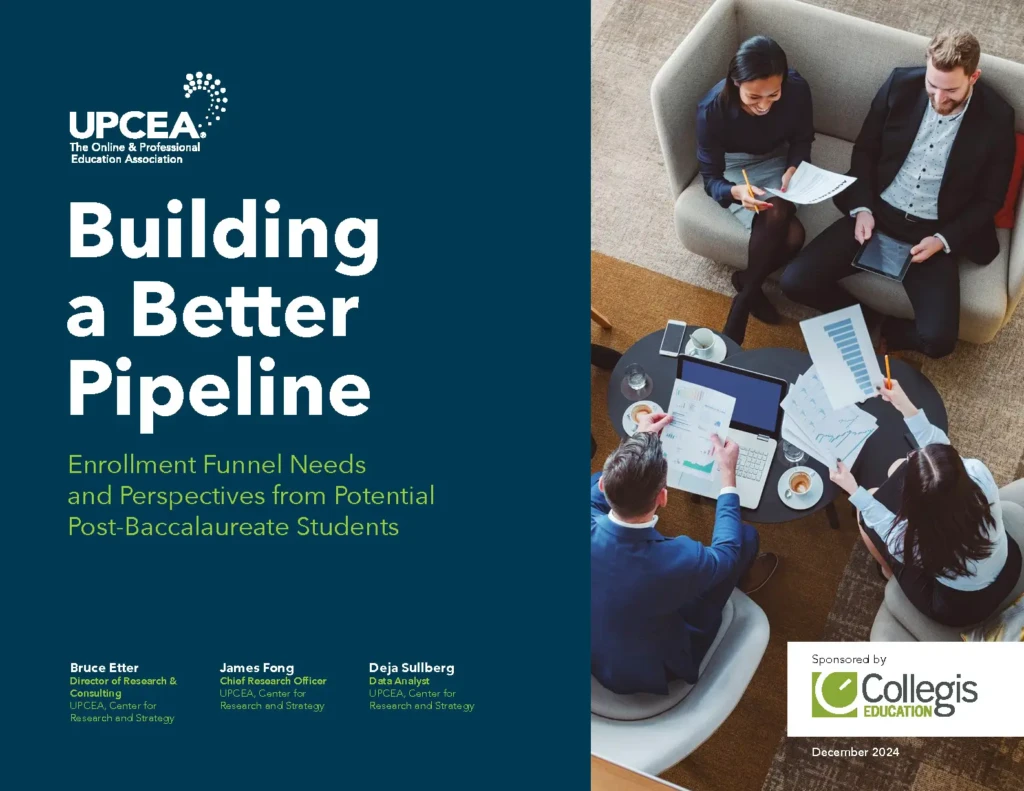
Report Title: Building a Better Pipeline: Enrollment Funnel Needs and Perspectives from Potential Post Baccalaureate Students
Author: Collegis Education + UPCEA
Published: December 2024
Who should read:
- Presidents
- Provosts
- Marketing leaders
- Enrollment leader
Key points addressed
In this ebook, you’ll learn more about prospective graduate students’ needs and expectations as they move through the enrollment funnel, including:
- The level of degree desired, as well as the preferred learning format
- Factors that cause disengagement during the inquiry and application processes
- Prospective students’ communication preferences and application expectations
- How institutions can tailor recruitment strategies accordingly
Overview
While higher education institutions face tightening budgets, demographic cliffs, and other market headwinds, many schools see graduate enrollment growth as a critical strategy despite the increasingly competitive landscape. Strategic investments in outreach have never been more vital.
With more and more programs sharing similarities in their structure than differences, one way schools can win is by delivering frictionless and exceptional student experiences, using prospective graduate students’ preferences, behaviors, and other insights to personalize engagements and outreach.
By understanding these preferences, institutions can better tailor their recruitment strategies and allocate resources more effectively in an increasingly competitive landscape., and recommendations for technology investments to improve student success.
Download Now
Additional Resources




Transform Challenges Into Opportunities
Facing challenges in enrollment, retention, or tech integration? Seeking growth in new markets? Our strategic insights pave a clear path for overcoming obstacles and driving success in higher education.
Unlock the transformative potential within your institution – partner with us to turn today’s roadblocks into tomorrow’s achievements. Let’s chat.
As a higher education leader, it’s no secret that you’re facing a fiercely competitive graduate enrollment landscape. You know as well as I do that understanding what prospective students want and how they behave isn’t just helpful – it’s crucial to your institution’s success. That’s why we teamed up with UPCEA to conduct a deep dive into today’s post-baccalaureate students, uncovering their unique needs, expectations, and wants.
We’ve published those insights in our latest report to help colleges and universities fine-tune their graduate enrollment strategies and deliver real results. You can download the complete report here: “Building a Better Pipeline: Enrollment Funnel Needs and Perspectives from Potential Post-Baccalaureate Students“
Our research focused on individuals who expressed at least some interest in pursuing advanced education, and this study sheds light on what matters most to potential graduate students—everything from program types and communication preferences to application expectations.
As we dug into the data, some obvious themes emerged. Here are five key findings that can prepare your institution to stand out in this tight market and guide you in shaping strategies that resonate, engage, and deliver results.
5 insights to sharpen your graduate enrollment strategy
1. Graduate enrollment is a crowded market—and the stakes are high
This is no surprise to those working in higher ed in recent years. Graduate enrollment is slowing, with just a 1.1% projected increase over the next five years. Adding to the challenge, 20% of institutions dominate 77% of the market. For everyone else, it’s a fierce battle for a shrinking pool of candidates. To win, you’ll need a sharp, focused approach.
2. Online programs are the clear favorite
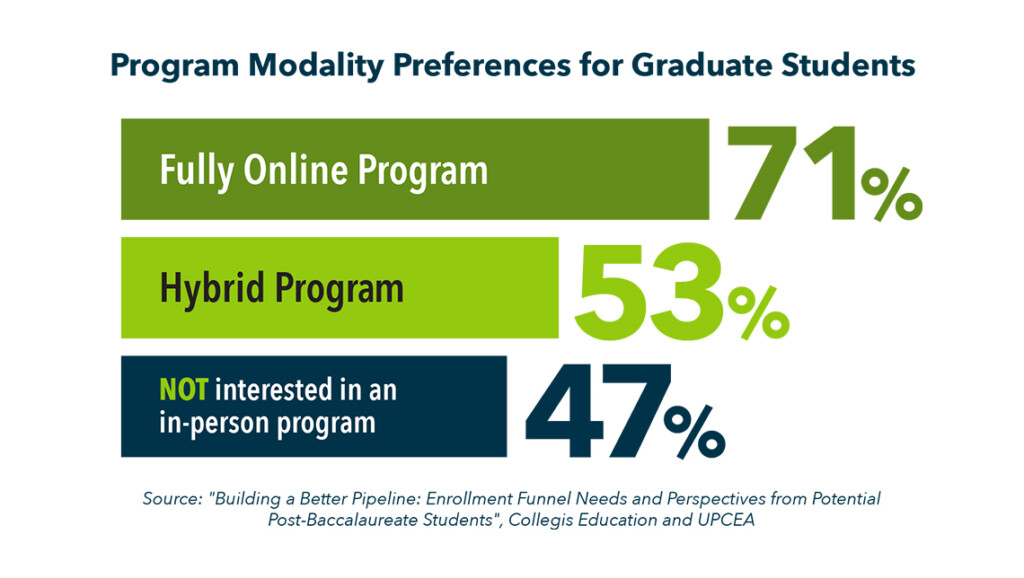
Did you know that 71% of prospective students are “extremely” or “very” interested in fully online programs? Hybrid formats come in a close second, while traditional in-person options are struggling to keep pace. The data confirms that flexibility isn’t a trend—it’s a necessity.
3. Program information is a make-or-break factor
Here’s something we see far too often: quality programs losing prospective students simply because critical details—like tuition costs and course requirements—are buried or missing entirely from the school’s website. In fact, 62% of students indicated they would drop off early in their search for this exact reason.
The fix? It’s simpler than you might think. By optimizing your program pages and doubling down on SEO, you can turn passive visitors into engaged prospects.
4. Financial transparency builds trust
Sticker shock is real. High application fees, vague cost information, and limited financial aid details are among the top reasons students abandon the application process late in the game. By addressing these concerns clearly and directly, you’re not just solving a problem, you’re building trust.
5. Email is still king
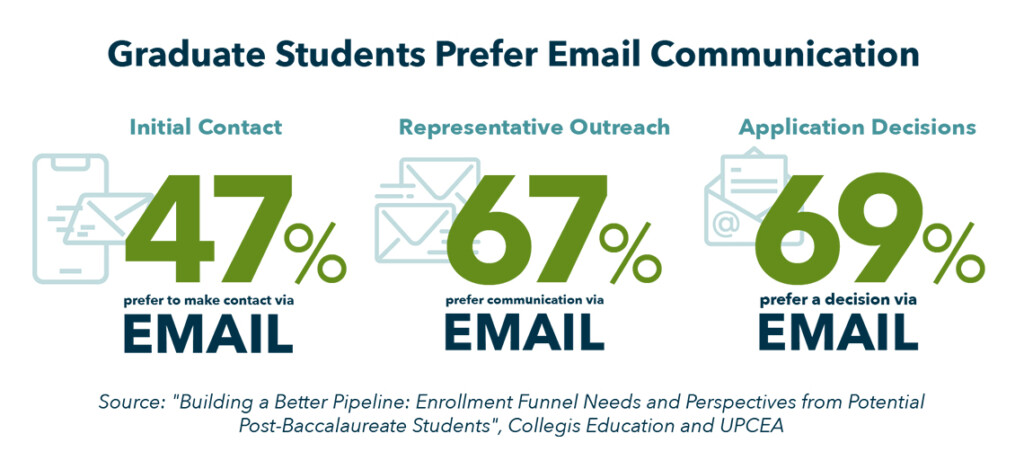
When it comes to connecting with prospective graduate students, email reigns supreme. Whether it’s inquiring about programs (47%), application follow-ups (67%), or receiving application decisions (69%), email is the channel students trust the most.
But here’s the catch: your emails have to be timely, personalized, and relevant in order to make an impact.
The key to graduate enrollment success is just a click away
The insights highlighted above are just the tip of the iceberg. Imagine what’s possible when you apply them to your graduate enrollment strategy.
If you’re ready to refine your approach and stay ahead of the curve, we’ve got you covered. Our report dives deeper into the data and uncovers actionable insights, including:
- Positioning your online and hybrid offerings to meet growing demand
- Optimizing program pages to emphasize the information students value most
- Communicating financial information proactively to convert candidates
- Building email outreach strategies that build trust and keep students engaged
Grab your complimentary copy of the report today, and let’s start building a better pipeline together!
Your roadmap to winning in the competitive graduate market.
Optimize Your Enrollment Funnel
Get the latest data on graduate student enrollment trends. Download the full report now.
As demand for skills-based learning grows, microcredentials are emerging as a key opportunity for higher education institutions to strengthen employer partnerships. But what do businesses actually look for in these programs, and how can colleges and universities position themselves as the preferred partner?
To find out, Collegis Education and UPCEA surveyed 500 organizations to gauge employer perceptions of non-degree credentials. Here’s a snapshot of what we found:
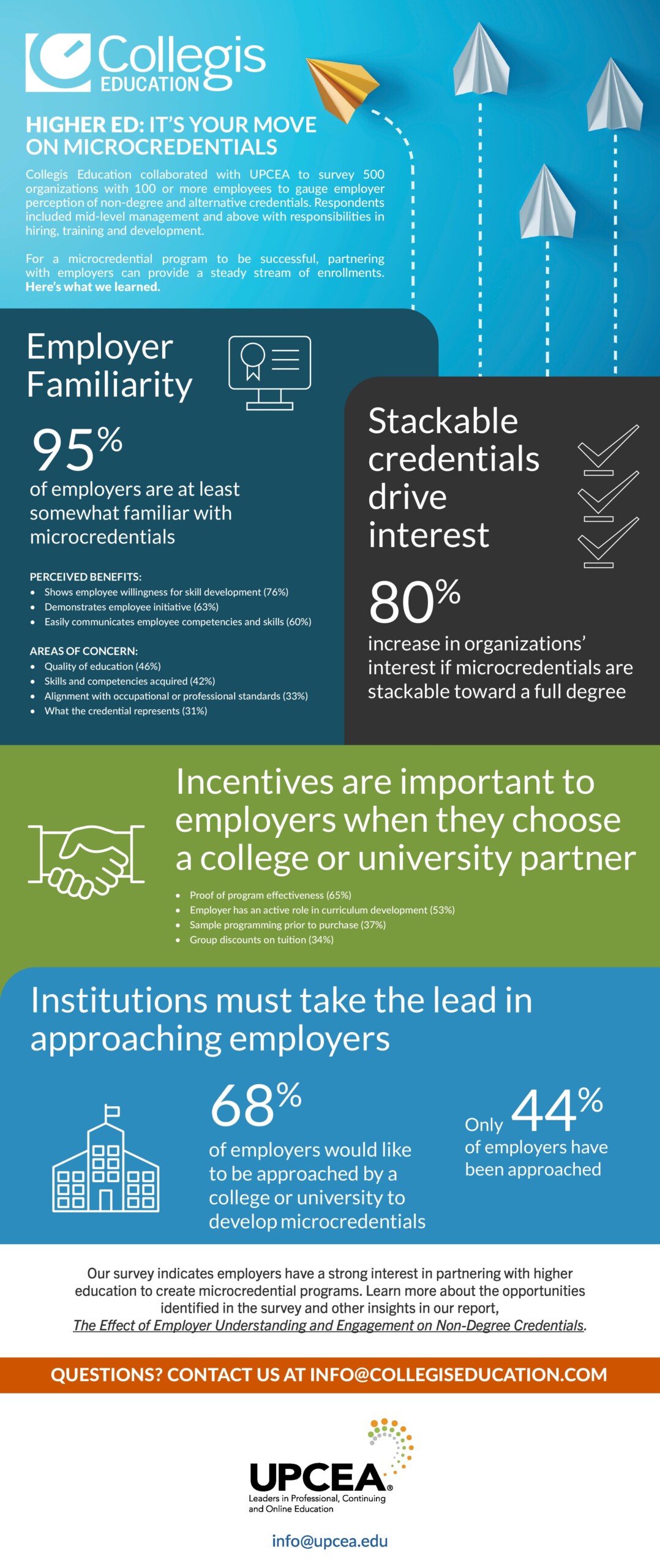
To capitalize on the growing demand for microcredentials, institutions must proactively engage employers with well-designed, industry-aligned programs. By addressing employer concerns and offering flexible, high-value learning pathways, colleges and universities can establish long-term workforce partnerships and create sustainable enrollment pipelines.
The insights found in the infographic only scratch the surface of what the research uncovered. Download the full report to learn what incentivizes employers to work with four-year higher ed schools.
Unlock Employer Insights
Learn what businesses seek in higher ed partnerships. Download the report today.